Choosing a car seat for your child feels straightforward until you are standing in the store looking at 30 options with different weight limits, expiration dates, and installation systems. The short answer is: the right seat is the one that fits your child’s current size, installs correctly in your specific vehicle, and keeps them in the most protective position for their stage.

This guide walks through every stage from newborn through age 7, what to look for at each step, and which accessories are actually worth adding.

Quick Answer: Which Seat for Which Stage

StageSeat TypeTypical Range
Birth to ~2 yearsRear-facing (infant or convertible)Birth to 35-50 lb
~2 to ~4 yearsForward-facing with 5-point harness22-65 lb+
~4 to ~8 yearsHigh-back or backless booster40-120 lb

Stay in each stage until your child reaches the upper limit of the seat, not until a specific birthday. The American Academy of Pediatrics and NHTSA both confirm that rear-facing and then harnessed forward-facing positions offer the most protection at each respective stage.

Stage 1: Rear-Facing Seats for Newborns Through Toddlers

Rear-facing distributes crash forces across the back, neck, and head rather than concentrating them on a single point. For a newborn, whose head accounts for roughly 25 percent of body weight compared to about 6 percent in adults, this matters enormously.

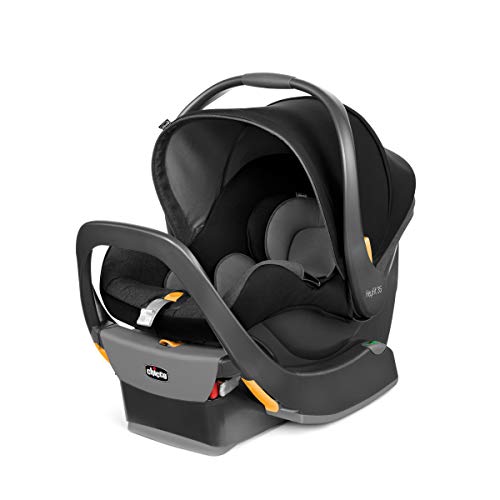
Infant-only seats are bucket-style carriers that typically support children from 4 lb (important for NICU graduates) up to 30-35 lb with a height limit around 32 inches. The Chicco KeyFit 35 Zip, for example, accommodates children up to 35 lb and 32 inches, weighs 9.3 lb on its own, and comes with the Chicco LATCH system that clicks in and out of a base in about 3 seconds. The detachable carrier also works as a bouncer and snaps into compatible strollers without an adapter.

The Nuna PIPA rx pairs with the Relx base, which includes a load leg and an anti-rebound bar. Both features reduce seat rotation in a frontal crash by up to 45 percent in Nuna’s internal testing. The seat shell weighs 7.7 lb without the base, making it one of the lighter options for parents with smaller vehicles.

When to move up: When your child’s head is within 1 inch of the top of the shell or they exceed the weight limit, it is time for a convertible seat rather than a larger infant carrier.

Convertible seats install rear-facing from birth and then flip forward-facing later. The Graco Extend2Fit rear-faces to 50 lb and forward-faces to 65 lb. The 4-position extension panel adds 5 inches of legroom, which is a practical fix for tall toddlers who run out of leg space before they hit the weight limit. At 18.1 lb installed, it is heavier than many infant seats but stays in the vehicle rather than being carried around.

The Britax Boulevard ClickTight is a consistently tested performer, rear-facing from 5 lb to 40 lb. The ClickTight installation system threads the vehicle seatbelt through a chamber and locks it without needing to yank or brace your knee against the seat. Independent crash testing by the Insurance Institute for Highway Safety rates it as one of the easier seats to install correctly on the first attempt. It weighs 18.5 lb installed.

Cons to weigh for this stage:

  • Infant seats have a limited weight window, often just 18-24 months of use, which means you will likely buy two seats per child unless you start with a convertible.
  • Convertible seats cannot be carried into the house with a sleeping infant.
  • Higher-weight rear-facing limits (50 lb) add cost; the Graco Extend2Fit starts around $200 vs. $100 for basic convertible options.
  • Some rear-facing convertibles have a wide footprint that does not fit well in smaller sedans.

Stage 2: Forward-Facing Seats with 5-Point Harness

Once your child has truly outgrown rear-facing limits, a forward-facing seat with a 5-point harness is the next level of protection. The harness distributes crash energy across the shoulders, hips, and between the legs. The chest clip must sit at armpit level, not on the stomach, to work correctly.

The Britax Advocate ClickTight ARB (Anti-Rebound Bar) handles children from 25 lb to 65 lb forward-facing and up to 49 inches tall. The anti-rebound bar contacts the vehicle seat back during a rear crash, reducing the seat’s rearward rotation. It weighs 25.6 lb, which is on the heavier end but gives it a stable feel in a vehicle.

The Diono Radian 3RXT is notable for its steel frame and aluminum reinforcements and accommodates children up to 120 lb in a harness configuration. If you have three children to seat across a rear row, it is also one of the narrowest full-featured seats available at 17 inches wide, compared to 19-22 inches for most competitors.

For families who travel by air, note that car seats used on aircraft must display an FAA approval label. The Graco Extend2Fit and several Britax models carry this label. Check the seat’s manual before packing it for a flight.

Harness tightness check: With the child buckled, pinch the shoulder strap at the collarbone. If you can pinch a fold of webbing, tighten the harness. If you cannot pinch any excess, it is snug enough. This check takes about 4 seconds and is worth doing every single trip.

Cons to weigh for this stage:

  • Many forward-facing seats have an upper weight limit of 65 lb, which means a tall child may outgrow it by height before weight.
  • Bulkier seats (Britax Advocate at 25.6 lb) are difficult to move between vehicles.
  • The chest clip placement is a repeated error; even experienced parents occasionally leave it too low, which reduces effectiveness.

Stage 3: Booster Seats for Ages 4-8

A booster raises the child so the vehicle’s own seatbelt fits correctly: lap band across the upper thighs (not the soft stomach), shoulder band across the chest and shoulder (not the neck). Children who are buckled with a seatbelt that crosses the neck are at risk of serious abdominal and spinal injury in a crash.

Your child is ready for a booster only when they can sit properly for the entire trip without slouching, crossing their legs, or pulling the shoulder belt behind them. Many children under age 6 or 45 lb struggle to maintain this position, especially on long drives.

High-back boosters provide head and torso support and are the better choice when the vehicle seat back is low or when the child still needs lateral head support during sleep. The Graco TurboBooster 2.0 LX fits children from 30 lb to 100 lb with a back and 40-100 lb backless. At 10.2 lb it is easy to move between cars, and the wide armrests fold for narrow back seats. The UPPAbaby Alta high-back booster adjusts from 38 to 57 inches in height and features a steel frame with side-impact protection wings rated to children up to 50 inches tall.

Backless boosters work in vehicles with head restraints that rise high enough to reach the back of the child’s head. The Chicco GoFit Plus covers 40-110 lb and folds flat for travel. At 4.1 lb, it is one of the lighter backless options.

A note on expiration: Car seats expire. Britax and Chicco set expiration at 6 years from manufacture; Graco products are generally 7-10 years depending on model. Check the sticker on the bottom of the seat. An expired seat may have degraded plastic or a recalled component that has since been updated in newer production runs.

Cons to weigh for this stage:

  • Backless boosters require a vehicle head restraint that meets the child’s head height; not all vehicles qualify.
  • Children with ADHD or sensory sensitivities often struggle to stay positioned correctly in a booster, which undermines the benefit. A longer harnessed seat may be the safer choice for some children up to 65 lb.
  • High-back boosters add significant bulk in a three-row SUV third row.

Stage 4: Accessories Worth Buying (and What to Skip)

Car seat accessories divide clearly into two groups: those that come from the seat manufacturer and are crash-tested as a system, and aftermarket products that are not.

Worth buying:

  • Seat protectors (vehicle seat): A mat under the car seat prevents the base from compressing or marking your vehicle upholstery. The Britax Vehicle Seat Protector and the Diono Ultra Mat are designed to not add instability. Check that yours does not elevate the car seat base enough to affect installation angle. Weight: 1.2 lb for most options.
  • Mirror for rear-facing observation: A large, shatter-resistant mirror mounted on the headrest behind a rear-facing infant lets the driver see the baby’s face without turning around. The Brica Fold n’ Go Travel Mirror mounts in under 30 seconds and collapses for travel.
  • Sunshades: UV window shades that attach with suction or static cling keep direct sun off a rear-facing infant. Children under 6 months should not have sunscreen applied (per AAP guidance), making shade the primary protection. Make sure any sunshade is not blocking an airbag sensor or obscuring the driver’s sightlines.
  • Infant head and body inserts: Only use inserts that ship inside the box with the seat. They are tested with that specific seat. After-market inserts from other brands alter the fit of the harness and can place the child in a position the seat was not tested for, which may reduce crash protection.

Skip or verify carefully:

  • Harness covers, strap pads, and “comfy covers” from third-party brands: these can compress during a crash and create slack in the harness or shift the child’s position. Not tested with your seat.
  • Rolled-up blankets tucked around a newborn: blankets under or around the harness affect crash performance. Place blankets on top of the buckled harness if warmth is needed.
  • Aftermarket chest clip covers: the chest clip is a functional safety component, not just a buckle. Covers that add thickness can cause the clip to position differently than tested.

For accessories that come from established brands, search for items by name on Amazon before purchasing:

Check current Amazon prices before purchasing as prices vary.

Installation: the Step Most Parents Get Wrong

The NHTSA estimates that a significant share of car seats are used incorrectly. The most common errors are:

  1. Harness straps too loose (the pinch test fails)
  2. Chest clip positioned on the stomach instead of armpit level
  3. Seat moves more than 1 inch at the belt path after installation
  4. Rear-facing recline angle too upright for infants under 1 year (head falls forward, airway risk)

Each car seat has an angle indicator, typically a bubble level or colored line, on the seat shell. For infants under 4 months or those with low head control, the seat should be at its most reclined position. Most infant seats have three or more recline positions on the base.

LATCH vs. seatbelt installation: use whichever achieves less than 1 inch of movement and is within your vehicle’s LATCH weight limit (typically 65 lb combined child plus seat weight, per FMVSS 213 and most vehicle owner manuals). Once the combined weight exceeds the vehicle’s LATCH limit, switch to seatbelt installation even if the seat has LATCH hardware.

Free installation checks are available nationwide. NHTSA’s inspection station locator lists certified Child Passenger Safety Technicians (CPSTs) near you by zip code.

Bottom Line: What to Buy at Each Stage

The best car seat at every stage is the one that:

  1. Fits your child’s current height and weight within the seat’s tested limits
  2. Installs with less than 1 inch of movement in your specific vehicle
  3. Gets used on every trip, every time

Start with a rear-facing seat (infant or convertible) and stay there as long as the seat allows. Move to a forward-facing harness only after outgrowing rear-facing limits. Move to a booster only after outgrowing the harness AND when your child can hold the correct seatbelt position for an entire trip without being prompted.

For most families, two or three seats cover a child from birth to age 8. A convertible like the Graco Extend2Fit or Britax Boulevard ClickTight followed by a high-back booster like the Graco TurboBooster 2.0 covers most children through age 7 with two purchases instead of three. Check current Amazon prices before buying.

Register every seat with its manufacturer immediately after purchase so you receive recall notifications automatically. Check CPSC.gov for current recalls before installing any used seat. Never use a seat involved in a moderate or severe crash, even if it looks undamaged.

For additional guidance on testing methodology and how we evaluate car seats at Kiddopicks, visit our methodology page.