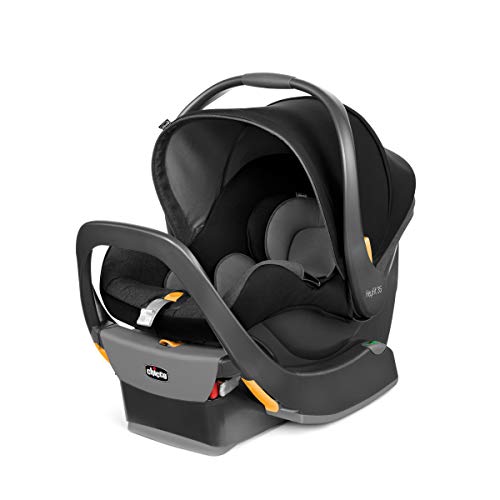
Quick answer: rear-face until the seat says stop
The short answer every certified Child Passenger Safety Technician (CPST) gives is the same: keep your child rear-facing until they reach the rear-facing weight limit OR height limit printed on their specific seat, whichever comes first. Not until age 2. Not until their feet touch the vehicle seat back. Until the seat’s own printed limit.
The American Academy of Pediatrics (AAP) updated its car seat guidance to align with this weight-and-height-first rule after research confirmed that rear-facing distributes crash energy across the entire back, shoulders, and head through the seat shell, not through the child’s neck and spine. The National Highway Traffic Safety Administration (NHTSA) states that rear-facing car seats are the best protection available for children in the event of a crash.
For most children, that means staying rear-facing somewhere between age 2 and 4, depending on which seat you own. A child in a Graco Extend2Fit (rear-facing limit: 50 lb) will rear-face longer than a child in an older infant bucket seat with a 30 lb limit. The seat you own matters as much as your child’s size.
Seat limits: the only numbers that matter
Every convertible car seat has two rear-facing limits printed on a label on the seat body: a maximum rear-facing weight and a maximum rear-facing height. Your child needs to stay rear-facing until they exceed either one.
Here are the limits on commonly owned seats so you can check your own:
- Graco Extend2Fit: rear-facing to 50 lb, height limit typically 49 inches (varies by model year — check your label)
- Britax One4Life: rear-facing to 50 lb
- Chicco NextFit Zip: rear-facing to 40 lb
- Nuna RAVA: rear-facing to 50 lb
- UPPAbaby KNOX: rear-facing to 50 lb
- Britax Boulevard ClickTight: rear-facing to 40 lb
An important clarification: the height limit is actually about head clearance, not overall height. Most manufacturers define it as “the child’s head must be at least 1 inch below the top of the seat shell.” Check your manual for the exact measurement rule your seat uses.
If your child has outgrown their infant-only bucket seat (typical rear-facing limit: 30 to 35 lb, head clearance usually 1 inch from seat top), they have NOT outgrown rear-facing. They have outgrown that specific seat. A convertible seat with a 50 lb rear-facing limit will let them keep rear-facing for another year or two.
One number parents often overlook: the average 2-year-old weighs about 27 lb and the average 3-year-old weighs about 31 lb. A 50 lb rear-facing limit means most children can stay rear-facing well past their third birthday on the right seat.
Why rear-facing longer: the physics argument
This section is not about guilt. It is about understanding what makes rear-facing safer, so you can make an informed decision and stop second-guessing yourself every time your 3-year-old’s knees bend against the back seat.
In a frontal crash (which accounts for roughly 57% of serious passenger vehicle crashes, per NHTSA data), the vehicle stops suddenly and everything inside continues moving forward. For a forward-facing child in a 5-point harness, those forces concentrate on the harness straps at the shoulder and hips, and on the child’s neck as the head whips forward. For a rear-facing child, the entire seat cradles the child and distributes those same forces across the back, buttocks, and head.
The benefit is most significant for children under 2 years old because their head is proportionally very heavy relative to their neck and spine development. But the physics apply at any age: rear-facing is still protective at 3 and 4 years old, which is why organizations like the AAP and NHTSA recommend extending rear-facing to the seat’s weight and height limits rather than switching at a fixed birthday.
Bent knees are not a problem. Children’s legs are flexible. The documented injury risk is to the head and spine, not the legs. Pediatric orthopedic research does not show elevated leg injury risk from rear-facing leg positioning.
Choosing a forward-facing seat: what to check before you turn around
When your child finally does reach the rear-facing limit of their seat, the next step is a forward-facing convertible seat with a 5-point harness, not a booster. The AAP recommends keeping children in a forward-facing seat with a harness until they outgrow that seat’s forward-facing harness limits, which typically means weight limits of 65 to 80 lb.
Here is what to look for:
Forward-facing harness weight limit. Look for at least 65 lb. The Britax One4Life goes to 65 lb forward-facing with a harness, and the Graco Extend2Fit goes to 65 lb as well. The Chicco NextFit Zip goes to 65 lb. The Nuna RAVA goes to 65 lb. Seats with a 80 lb forward-facing harness limit exist but are less common.
LATCH or belt installation, not both at once. FMVSS 213 (the federal safety standard for car seats) governs installation. Above 65 lb, most manufacturers require seat belt installation, not LATCH. Read your seat manual before assuming LATCH works at all weights.
Harness slot position. For forward-facing, harness straps should be at or above the child’s shoulders. For rear-facing, straps go at or below the shoulders. This is the most commonly mis-set parameter CPSTs correct at check events.
Top tether. Always use the top tether strap when forward-facing. NHTSA data shows the top tether reduces forward head excursion by up to 6 inches in a crash. The anchor is usually on the vehicle seat back or rear shelf. Check your vehicle owner manual for the location.
For Amazon search links:
- Check current Amazon price on the Britax One4Life
- Check current Amazon price on the Graco Extend2Fit
- Check current Amazon price on the Nuna RAVA
Common reasons parents switch early (and why they do not hold up)
“My child is uncomfortable.” Children who have always rear-faced do not find it uncomfortable. The discomfort is usually a parent’s projection. If a child genuinely seems distressed, check harness fit and recline angle first. The Chicco NextFit Zip and the Britax Boulevard ClickTight both have multi-position reclines that can help.
“Their feet touch the seat back.” As noted above, this is normal and not a safety issue. There is no documented elevated injury risk from a child’s feet contacting the vehicle seat back while rear-facing.
“They seem bored facing backward.” This is real and understandable. A window cling at their eye level, a mirror, or an audiobook often solves it. It is not a safety reason to switch.
“They hit the weight limit on their infant seat at 8 months.” This means they outgrew that specific infant seat, not rear-facing in general. Move to a convertible seat with a higher rear-facing limit and continue rear-facing.
“Someone told me to turn at 2.” The AAP’s current guidance moved away from a fixed age recommendation. The current AAP position (referenced at aap.org) is to rear-face until the seat’s limits are reached, not until a specific birthday.
Bottom line: follow the seat, not the birthday
Switch from rear-facing to forward-facing when your child reaches the rear-facing weight limit OR height limit printed on their seat. Not before. For most children on modern convertible seats with 50 lb rear-facing limits, that means somewhere between age 3 and 4.
If you are unsure whether your child has reached the limit, or if you are unsure about installation, find a free car seat check event through the NHTSA locator at nhtsa.gov or Safe Kids Worldwide. Certified CPSTs check seats at no charge and can confirm harness fit, recline angle, installation method, and whether it is time to switch.
The practical checklist before turning the seat around:
- Confirm the child’s weight is at or above the rear-facing weight limit on the seat label.
- OR confirm the child’s head is within 1 inch of the seat shell top (check your manual for the exact rule).
- If neither limit is reached, keep rear-facing regardless of age.
- When switching, set harness slots AT or above the shoulders (not below).
- Attach the top tether to the correct vehicle anchor.
- If using LATCH, confirm the child’s weight is within the LATCH weight limit for your specific seat.
For a convertible seat that handles both stages well, the Graco Extend2Fit (rear-facing to 50 lb, forward-facing harness to 65 lb) and the Britax One4Life (rear-facing to 50 lb, forward-facing harness to 65 lb) are consistently recommended by CPSTs for maximizing rear-facing time without requiring a third seat. You can compare current prices on 50 lb rear-facing convertible seats on Amazon to find what fits your budget and vehicle.
This is one of the few car seat decisions where the right answer is straightforward: check the label, follow the limits, and use the top tether every single time.