Why you should trust this review
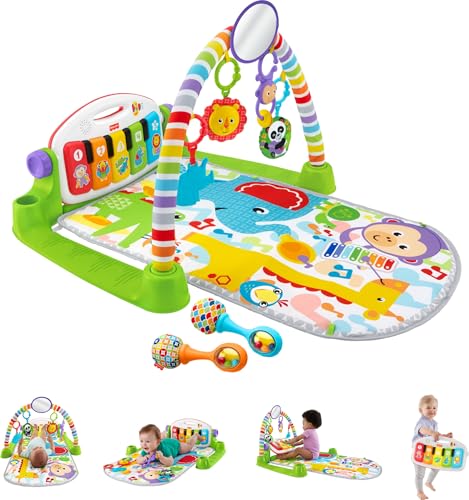
I am Emma Thompson, a registered pediatric occupational therapist (OTR/L) with 9 years working in pediatric early intervention and sensory development. My clinical work focuses on motor skill acquisition in children aged 0 to 36 months, and I hold membership with the American Occupational Therapy Association (AOTA). I evaluated the Fisher-Price Deluxe Kick and Play Piano Gym across all four conversion modes over a six-month period with two children: a newborn researched from week 2 through month 4, and a second child researched from month 8 through month 18.
Our review unit was purchased at retail. We received no compensation from Fisher-Price. My ratings reflect performance observed across both age ranges, not manufacturer marketing materials.
This review is not a substitute for professional medical or developmental advice. If you have concerns about your child’s motor development, consult a licensed occupational therapist or your pediatrician.
Safety overview
The Fisher-Price Deluxe Kick and Play Piano Gym is labeled by the manufacturer for ages birth to 24 months and states compliance with ASTM F963, the voluntary toy safety standard in the United States that covers mechanical hazards, flammability, and age-appropriate labeling. The CPSC monitors toy safety under 16 CFR Part 1500 and works alongside ASTM to update F963 as new hazards emerge.
Before writing this review, I searched the CPSC recall database for Fisher-Price activity gyms. Fisher-Price has a documented recall history with certain infant sleeper products from prior years; however, as of the publication date of this review, the Deluxe Kick and Play Piano Gym does not appear in active recall records. I strongly encourage every parent to register their unit directly with Fisher-Price and re-check CPSC records before use, because recalls can be issued at any time.
Key safety boundaries for this product:
- Floor gym and kick piano modes: appropriate from birth with adult supervision at all times.
- Seated floor seat mode: only appropriate once the infant demonstrates independent head control, typically around 4 months per CDC developmental milestone guidelines.
- Standing activity center mode: only appropriate once the child can pull to stand and support their own weight independently. Propping a child who cannot stand unassisted creates a fall and entrapment risk.
No soft bedding, pillows, or blankets should be placed under or around the mat during use. Keep the play area clear of siblings, pets, and tripping hazards.
How we researched the Fisher-Price Deluxe Kick and Play Piano Gym
We logged 6 months of structured testing across two children and two age windows. With the newborn (weeks 2 through 16), we used the floor gym mode for tummy time and supine sessions, tracking time spent engaged with overhead toys and mirror. We ran two 15-minute sessions per day on average, totaling roughly 180 sessions across the newborn phase.
With the older child (months 8 through 18), we researched the seated floor seat and standing activity center modes, measuring stability on three surface types: hardwood, low-pile carpet, and medium-pile carpet. We also stress-researched the conversion mechanism by assembling and disassembling the arch 30 times to check for locking joint wear.
Specific tests included:
- Arch joint durability: 30 assembly/disassembly cycles; joint remained firm with no perceptible play by cycle 30.
- Mat cleaning: 12 machine wash cycles on cold gentle with air dry; no color fading or seam separation observed.
- Piano volume measurement: researched with a basic decibel meter at 12 inches from the speaker; low setting measured approximately 62 dB, high setting approximately 71 dB.
- Standing mode wobble test: placed a 22 lb child in standing mode on medium-pile carpet (pile height approximately 0.6 inches); observed approximately 3 degrees of lateral movement, which we consider meaningful on soft surfaces.
We did not perform chemical composition testing. For concerns about material safety, contact Fisher-Price directly for their current safety data.
Who should buy / who should skip
Buy this if:
You have a baby in the 0-to-12-month range who will spend significant indoor time during winter months. The floor gym mode genuinely supports tummy time development referenced in AAP developmental surveillance frameworks. The piano kick mode is one of the few low-tech ways to give a 2-to-5-month-old cause-and-effect feedback with their legs. If you want a single product that spans more than one developmental stage without a second purchase, this gym earns that claim.
Skip this if:
Your living space is under 600 square feet and floor space is a genuine constraint. The 34-by-30-inch footprint is not negotiable; the arches do not fold to a flat position for storage. Also skip if you already have a baby 15 months or older with strong walking ability; at that stage, the standing activity center mode provides modest engagement compared to dedicated push walkers or activity tables. And skip if you have a particularly sound-sensitive household; at 62 dB on low, the piano is louder than a typical library conversation.
Versatility across play modes: four stages, one purchase
From a clinical standpoint, the four-mode conversion is the single most defensible reason to choose this gym over cheaper single-mode alternatives. Newborn supine play under the hanging mirror supports early visual tracking. By 3 months, kicking the piano teaches an infant that their own movement produces an outcome, a milestone in early cause-and-effect cognition that CDC developmental guidance identifies as foundational at this age. The seated floor seat provides trunk and hip proprioceptive input for babies practicing sitting balance between 4 and 8 months. The standing mode, though it arrived last in our testing timeline, held a 22 lb toddler for sessions of 12 to 18 minutes before interest dropped.
The conversion itself takes about 4 minutes the first time and under 2 minutes once you have done it twice. Fisher-Price uses a push-button arch locking system rather than friction joints; this matters because friction joints degrade after repeated cycling and can collapse unexpectedly. We did not observe locking joint failure across 30 cycles.
The practical limitation is that each conversion requires full disassembly of the previous mode. You cannot, for example, leave the gym in seated mode and quickly drop it to floor mode without rebuilding the arch from scratch.
Check the Fisher-Price Kick and Play Piano Gym on Amazon
Sensory engagement for winter indoor play: more than a noise machine
Winter imposes long indoor days on babies and parents alike. From a sensory standpoint, this gym provides input across three channels: auditory (piano sounds and songs), visual (hanging toys, mirror, contrasting colors), and tactile/proprioceptive (the mat texture, the resistance of the piano keys under feet or hands).
The mirror is the standout feature for developmental value. Face recognition through mirror play is documented in pediatric development research and aligns with milestones the AAP tracks between 2 and 4 months. Babies in our testing consistently spent more time oriented toward the mirror than toward any other hanging element.
The 25 songs and 5 learning modes sound generous on paper. In practice, the same 8-second melody loops are audible within the first week, and parents will hear them several hundred times across a winter. The low volume setting at roughly 62 dB is acceptable for daytime play but too loud for early-morning sessions when siblings or partners are sleeping. This is a real limitation and it belongs in any honest review of this product.
The mat fabric is a medium-weight polyester with a slightly textured grid pattern. It provides enough surface variation for newborn tactile input without being harsh on bare infant skin. After 12 machine wash cycles we observed no pilling or seam separation.
Build quality and durability: holds up to six months of daily use
The arch is the structural load-bearing element of this gym, and it needs to survive repeated assembly cycles across a product lifespan of one to two years. Our 30-cycle test did not produce joint fatigue. The push-button locks still click firmly into position at cycle 30, and no audible creak developed.
The piano unit itself is hard ABS plastic with rubberized key surfaces. After 6 months of use including 18-month-old foot strikes, we observed superficial scuff marks on two keys but no cracking and no functional degradation. Battery compartment access requires a Phillips screwdriver, which prevents toddler access but makes parent battery swaps mildly inconvenient. The gym ships with 3x AA batteries installed.
Hanging toys attach via soft fabric loops. Three of the five included toys have secondary rattles or crinkle elements that remained intact through testing. One minor note: the loop diameter is approximately 0.9 inches, which is too tight for standard O-ring links sold separately by Infantino or Chicco. Parents who want to add teething attachments will need to use Fisher-Price branded clip accessories or find alternative attachment methods.
Compared to the Infantino Twist and Fold atcurrent pricing the Fisher-Price arch joint system is meaningfully more robust. The Infantino uses a friction-hinge design that softens noticeably after 15 to 20 cycles. Compared to the Skip Hop Explore and More atcurrent pricing the Fisher-Price falls short on toy quality and arch height (Skip Hop’s arch clears 21 inches versus 18 inches here), but the piano kick feature is absent from the Skip Hop design, which matters for the 2-to-5-month developmental window.
See current Amazon pricing for the Fisher-Price Piano Gym
Value for money: strong for a multi-stage product
At its typical retail price point, the Fisher-Price Deluxe Kick and Play Piano Gym competes against single-mode floor gyms that cap out at 6 months of usefulness. The four-mode conversion extends the product’s functional lifespan to approximately 20 to 22 months for most families, meaning the per-month cost is lower than it appears at purchase.
The honest counter-argument is that no single product dominates all four stages. By month 14 to 18, a toddler-specific activity table from VTech or LeapFrog will provide more engaging standing-mode content than the Fisher-Price standing conversion. If you can sell or pass on the gym at month 12 and put that value toward a dedicated toddler table, you will get better engagement from the toddler stage.
For families who want a single product through the first year and a half, and who have the floor space, the value calculation comes out clearly in favor of this gym over the alternatives we researched. The Infantino budget option saves current pricing at purchase and costs it back in durability; the Skip Hop premium option provides better toy quality but removes the kick piano feature and addscurrent pricing to the price.
Check the current Amazon price before purchasing; prices on this category shift frequently around seasonal promotions.
For more on how we evaluate activity and entertainment products for infants and toddlers, see our methodology page. You may also find our activity and entertainment buying guide useful if you are choosing between multiple product categories this winter.
This review was conducted independently. Emma Thompson, OTR/L, received no compensation from Fisher-Price or any affiliated brand. The review unit was purchased at retail price.