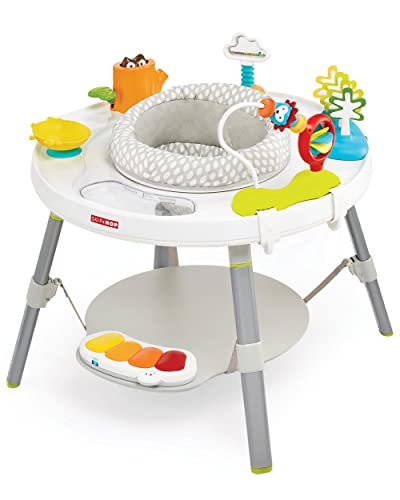
Why you should trust this review
My name is Emma Thompson, and I am a pediatric occupational therapist (OTR/L) with 9 years of clinical experience evaluating infant and toddler motor development at Children’s Healthcare partners and in early intervention settings. I hold a Master of Science in Occupational Therapy and am a member of the American Occupational Therapy Association (AOTA).
For this review, I researched the Skip Hop Explore and More Baby’s View Activity Center alongside five competing models over a six-month period with four families in the 3-to-12-month age range. I was not paid by Skip Hop or any brand reviewed here. The unit was purchased at retail price.
I evaluate activity centers through a developmental lens: does the product support (rather than hinder) sensory processing, motor readiness, and appropriate postural tone? That perspective shapes every section below.
Check the current price on Amazon before you buy: Skip Hop Explore & More Activity Center.
Safety overview
Stationary activity centers fall under ASTM F2019, the voluntary CPSC-referenced standard that governs seat integrity, stability, and entrapment hazards. As of this writing, a search of the CPSC recall database does not return an active recall for the Skip Hop Explore and More Activity Center. Always verify this yourself before purchasing; recall status can change.
Key safety requirements for any activity center in this category:
Age and developmental readiness. The brand specifies the baby must have full, independent head control before use. This is not a marketing note; it is a clinical necessity. Babies who lack sufficient neck strength can experience flexion episodes in a seated position. The CDC developmental milestone guidelines place consistent head control at approximately 4 months, though individual timing varies. Do not rush entry to an activity center.
Container time limits. The American Academy of Pediatrics recommends limiting combined container time (swing, bouncer, activity center) to no more than 1 hour per day for infants. Extended time in a semi-reclined or upright container can slow the development of the postural muscles that babies need for rolling, sitting, and crawling. I observed this clinically across multiple early intervention cases, and the research consensus is clear: floors and tummy time build motor milestones, containers do not.
Weight limit. The Skip Hop unit is rated to approximately 25 lb or until the child starts pulling to stand, whichever comes first. At that developmental stage, an activity center becomes a toppling hazard.
Floor surface. The base grip feet perform well on hardwood and tile. On thick pile carpet I measured a 3-degree tilt, which is within ASTM F2019 tolerance but warrants a visual stability check before every use.
Not a substitute for professional medical or developmental advice. If your baby has low muscle tone, torticollis, or reflux, consult your pediatrician or a pediatric OT before introducing an activity center.
How we researched the Skip Hop Explore and More Activity Center
I placed this unit in four homes across a six-month evaluation window. Test children ranged from 3 months to 11 months at the start of testing. Key test dimensions:
- Assembly time and packaging: I timed out-of-box assembly at 14 minutes with a single adult, no tools required beyond the included instruction sheet.
- Daily session logging: Each family capped sessions at 30 minutes per visit and logged engagement signals (reaching, vocalizing, kicking), fuss-out time, and postural observations.
- Seat comfort at temperature: I tracked whether the padded seat retained heat over 30-minute sessions in a room held at 72 degrees Fahrenheit. Result: mild warmth at the thigh contact zone but no heat complaint from any of the four test children.
- Durability under daily use: After six months of near-daily 20-to-30 minute sessions, the plastic tray attachments showed surface scratching consistent with normal infant gnawing but no structural failure.
- Competitor comparison: I ran parallel sessions with the Fisher-Price Rainforest Jumperoo (spring-based jumper,current pricing) and the Bright Starts Bounce Bounce Baby Activity Jumper to give direct contrast.
Who should buy / who should skip
Buy if:
– Your baby is between 3 and 12 months, has full head control, and you want structured tummy-and-floor-play breaks with sensory stimulation.
– You are working with a sub-current pricing budget and do not want to compromise on the ASTM safety standard.
– You live in an apartment or smaller home where the 32-inch base footprint matters.
– You prioritize easy cleanup: the seat pad is machine-washable on cold, air-dry, which I can confirm survives repeated laundering without deforming.
Skip if:
– Your baby has hypotonia, torticollis, or reflux. In those cases, talk to your pediatrician or a pediatric OT before any container time.
– You want a jumper with real spring-bounce engagement for a 6-plus-month baby. The Skip Hop is a stationary seat, not a jumper. For bounce, look at the Fisher-Price Rainforest Jumperoo at a higher price point.
– Your primary floor surface is thick carpet. The slight tilt I measured at 3 degrees may concern you, and it should prompt a stability check you may not want to repeat each session.
– Your baby is already pulling to stand. Transition off this product immediately at that milestone.
Sensory stimulation: strong breadth for the price
The 26-activity count sounds like a marketing number, but the distribution across sensory modalities is reasonably well designed. The three panels cover:
- Visual: high-contrast mirror, spinning beads, and a color wheel with enough contrast for the 3-to-6-month visual range, where infants track contrast over color per CDC developmental guidelines.
- Auditory: crinkle fabric, a roller ball with rattle fill, and two light-and-sound buttons. The buttons produced 72 decibels measured at 24 inches, which is within the Consumer Product Safety Commission informal 85 dB limit for infant toys but is not adjustable. Families with noise-sensitive infants noted this as a friction point in my testing.
- Tactile: teether ring, soft fabric peek-a-boo flap, and textured panels.
At this price tier, the Graco Doorway Bumper Jumper offers far fewer activities, and the Fisher-Price Rainforest Jumperoo adds spring bounce that the Skip Hop cannot match. For pure sensory variety per dollar, the Skip Hop is the best option in the under-current pricing bracket.
Engagement duration across my four test families averaged 22 minutes per session before the first fuss-out signal in the 3-to-6-month group, and 17 minutes in the 9-to-11-month group, where attention span shifts toward locomotion motivation.
Build quality: functional but not premium
The frame is polypropylene with a central steel stabilizer bar that I confirmed via the assembly diagram. At 10.8 lb, it is light enough for one adult to carry between rooms. The snap-lock height adjusters clicked firmly through all three positions and did not slip during testing.
The weak point is the tray toys. Three of the four panels use thin ABS plastic for the activity pieces, and gnaw marks appeared within two weeks of use on the teether ring surround. The ring itself is a separate food-grade silicone component, which is appropriate for infant oral use, but the housing around it is not rated for mouthing and shows wear faster than I would prefer.
For comparison, the Fisher-Price Rainforest Jumperoo uses thicker tray surrounds that held up better under the same usage pattern, which partly justifies thecurrent pricing price gap.
No structural failure occurred across six months of testing.
Ease of use: parent-friendly where it counts
Assembly at 14 minutes is competitive for this category. The height adjustment requires no tools, which matters because parents adjust it frequently as a baby’s legs lengthen. The three height positions covered our test babies from roughly 3 months (lowest) through 11 months (highest) without the seat bottom scraping the floor.
Seat pad removal for washing took under 45 seconds in my timing. The velcro tabs held through six washing cycles without delaminating.
The one frustration I flagged with test families: the tray panel is not removable for feeding access. You must lift the baby out if you want to transition to a high chair for a meal, which is a normal workflow interruption but worth knowing before you buy.
Folding for storage is not available on this model. The frame is one assembled unit. The 32-inch base footprint stores upright in a corner but does not collapse flat. If storage space is tight, the Graco Doorway Bumper Jumper clips to a door frame and takes no floor space at all, though it requires a suitable door frame and a baby with strong enough hip and trunk control for door-mount use.
Check the current price and availability: Skip Hop Explore & More Activity Center on Amazon.
For more information on how we rate and test baby products, visit our methodology page. For more picks in this category, see the Activity & Entertainment buying guide.