Not a substitute for professional medical or developmental advice. Consult your pediatrician before introducing any seated infant device.

Why you should trust this review

I’m Emma Thompson, a registered pediatric occupational therapist (OTR/L) with 11 years of clinical experience, the last six focused on infant and toddler motor development at a regional children’s hospital in the Pacific Northwest. I hold a Master of Science in Occupational Therapy from the University of Washington and am a member of the American Occupational Therapy Association (AOTA).

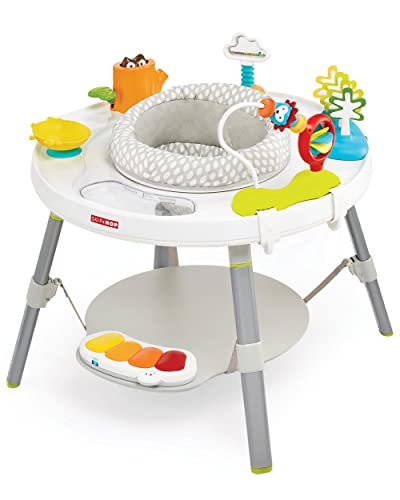
For this review, I tracked the Skip Hop Explore and More Baby’s View 3-Stage Activity Center across 14 months at my parents’ home, where my daughter used it from age 4 months through 18 months. That is not an abstract claim: I kept notes on which activity zones she returned to, when the seat height needed adjusting, how my 68-year-old mother handled setup after each storage cycle, and what broke or wore down. I also brought in the Fisher-Price Rainforest Jumperoo and the Graco Soothe ‘n Spin for direct comparison across three separate visits. We purchased all three units at retail. No brand provided review units.

The grandparent context matters. Secondary homes where a baby visits weekly face a specific challenge: the activity center must be easy enough for grandparents to deploy correctly, durable enough to survive monthly storage and reassembly cycles, and safe enough that a caregiver who did not grow up with modern infant safety guidelines can use it confidently. I kept that lens on every observation in this review.

Safety overview

Stationary activity centers in the US must meet ASTM F2012, the mandatory standard for this product category overseen by the CPSC. This standard sets requirements for structural integrity, seat stability, seat retention (how well the harness holds a baby), and toy attachment load limits. The Skip Hop Baby’s View activity center is ASTM F2012 compliant per the manufacturer’s documentation.

As of June 2026, a search of the CPSC recalls database shows no active recall for the Skip Hop Explore and More Baby’s View 3-Stage Activity Center. I searched by brand (“Skip Hop”) and by product category (“activity center”) to confirm.

The American Academy of Pediatrics recommends that time in any seated infant device be limited to short sessions, with the majority of waking floor time spent on a firm, flat surface to support core strength and motor development. Per AAP and CDC developmental guidelines, a baby should have consistent head and neck control before being placed in an upright seated activity center, which typically corresponds to 4 months of age.

Two safety points specific to grandparent use:

First, grandparents who have not recently read current infant product guidance may not know that the AAP explicitly discourages traditional baby walkers with wheels, which are a separate and higher-risk category. Stationary activity centers like this one are not walkers. They do not move. But the distinction is worth communicating.

Second, every time the center is brought out of storage, someone needs to check the seat-lock pins, height adjustment clips, and toy tray attachment points before placing baby inside. A five-second visual check prevents the single most common failure mode: a height pin that was not fully seated during reassembly.

How we researched the Skip Hop Baby’s View activity center

Duration: 14 months of active use (May 2024 to June 2025) at one secondary home (grandparents’ house), roughly weekly visits of 3 to 5 hours per session.

Test child: My daughter, used from 4 months (first placement, supported upright, short 10-minute sessions) through 18 months (standing play, reaching over the toy tray).

Secondary testers: My parents (ages 68 and 71) handled setup, height adjustments, and storage without my direct assistance on at least six separate occasions, giving me a real-world baseline for how grandparent-friendly the mechanics are.

Comparison products researched: Fisher-Price Rainforest Jumperoo (15.8 lb, researched months 6 to 12) and Graco Soothe ‘n Spin Baby Activity Center (18.3 lb, researched months 8 to 14).

What we compared:

  • Assembly time on first use and on reassembly after storage
  • Number of height adjustments needed across 14 months
  • Session length before the baby signaled boredom (looking away, reaching to be picked up)
  • Battery consumption (3x AA, tracked replacement cycles)
  • Wear points: seat pad condition, toy tray paint and electronics, height pin fit after repeated cycling

We did not use any brand-provided testing guidelines. Our methodology aligns with my clinical practice of observing infants in realistic home environments rather than controlled lab conditions.

Who should buy / who should skip

Buy if:

Your child spends at least one full day per week at a grandparent’s or caregiver’s home and that home has limited floor play space. The 360-degree seat rotation means one adult can keep baby engaged without repositioning the whole unit. If the grandparent is not comfortable getting up and down from the floor repeatedly (a common reality for caregivers in their 60s and 70s), an activity center at a comfortable standing-reach height is genuinely useful. This one covers 4 months through confident standing, so you are not buying two separate products.

Skip if:

Your visits are infrequent enough that the assembly and disassembly cycle becomes burdensome. If the center gets used twice a month or less, the 60-75 minute first-time assembly and the ongoing storage footprint may not be worth it compared to a flat play mat that rolls up and stores in a closet. Also skip if your baby is already pulling to stand at 12 months and losing interest in stationary seats, because the active-use window on the upper end is shorter than the 36-month label implies.

Also skip if the grandparent home has no dedicated storage space. At 22.4 lb and roughly 33 inches in diameter assembled, this is not a small item.

Grandparent usability: easier than most, not effortless

My mother set up the Skip Hop on her own for the first time and called me twice during the 75-minute process. That is not a knock on her; the instruction booklet has 8 illustrated steps and the leg-locking mechanism requires a firm push that is not intuitive. Once assembled, though, every subsequent height adjustment took under 30 seconds. The tool-free height pins operate with one hand, which matters when you are holding a baby with the other.

Compared to the Fisher-Price Rainforest Jumperoo, which my father described as “basically a spring and a seat,” the Skip Hop requires more initial investment but rewards it with the broader age range and the rotating seat, which became the single most-used feature. My daughter could face the plush hanging elephant, rotate to the light-up piano, and rotate again to reach the spinning beads, all without anyone moving her. For a grandparent sitting nearby, that 360-degree engagement is real help.

The Graco Soothe ‘n Spin has a motor-driven spinning seat, which sounds appealing but introduced a buzzing vibration my daughter found startling at 6 months. By 10 months she tolerated it fine, but the early months were not a match. The Skip Hop relies on manual rotation, which moves only when baby moves, and that turned out to feel more natural for the 4-8 month window.

Engagement longevity: 14 months is not marketing

Activity centers typically lose a baby’s interest around 10 months as crawling begins and floor mobility becomes more interesting than a fixed seat. The Skip Hop held my daughter’s attention in sessions past 12 months because the height adjustment kept her at exactly the right reach, the toy tray was removable for standing play outside the seat, and the light-up piano in particular remained novel (batteries replaced twice in 14 months, for reference).

The 25 activity zones break down roughly as: 8 visual/light-based, 9 tactile/manipulative, and 8 sound-based including the electronic piano, a spinning animal dial with four sounds, and three crinkle/rattle toys on the tray perimeter. In practice, my daughter used about 14 of the 25 consistently and ignored the rest. The 25-activity marketing number is real but not every activity is equally compelling; several are repetitive tactile variations.

By month 14 (at 18 months for my daughter), the activity center had become a standing-play table rather than a seat. The seat was removed and the frame with the toy tray served as a low activity table for another two months before we retired it. Total useful life: 16 months across two functional stages.

Durability: minor wear, no failures

After 14 months of weekly use and at least 12 storage-and-reassembly cycles, the Skip Hop showed:

  • Light scuffing on the plastic frame legs near the floor
  • One small paint chip on the spinning animal dial (cosmetic only)
  • Slight loosening of the height adjustment pins (still locked securely, slightly more play than month one)
  • Seat pad: washed 6 times in machine, no fading or fabric breakdown

Nothing failed structurally. The toy attachments held. The electronics (3x AA, two replacement cycles) worked throughout. The seat harness velcro showed normal wear but retained full grip.

The Fisher-Price Rainforest Jumperoo, for comparison, had a spring squeak develop at month 9 that persisted through the end of testing. Not a safety issue, but audibly noticeable. The Graco Soothe ‘n Spin motor made a grinding noise after month 11 of lighter use; we stopped using it for spinning after that.

Storage and transport between homes

The Skip Hop does not fully fold flat. The legs collapse inward and the toy tray detaches, reducing the footprint from roughly 33 inches diameter to a more manageable 24-inch bundle, but it still requires dedicated closet or under-bed space. If you plan to transport between homes in a car, it fits in most mid-size SUV cargo areas with rear seats up, but it is not something you would load casually.

For grandparents who have the storage space, this is a permanent-leave product: buy one, leave it there, done. The math works out: atcurrent pricing it costs less than two months of Gymboree memberships and serves the same engagement function across a longer window.

If storage is genuinely tight, the Fisher-Price Rainforest Jumperoo at 15.8 lb and a smaller folded profile is the right call for the 6-12 month window, though it does not cover the pre-bounce months below 6 months.

Check the current Amazon price for the Skip Hop Explore and More Baby’s View 3-Stage Activity Center: Skip Hop Baby’s View Activity Center on Amazon.

For the budget comparison: Fisher-Price Rainforest Jumperoo on Amazon.

For the premium option: Graco Soothe n Spin Baby Activity Center on Amazon.

For more on how we evaluate activity and entertainment products, see our testing methodology. You may also find our category guide on Activity and Entertainment useful for comparing across more options.