Why you should trust this review

I’m Emma Thompson, a registered nurse with 9 years of experience in pediatric and neonatal care at a Level III NICU, and I’ve been a working parent since my daughter was born. My credential base sits at BSN with NICU specialization, and I hold membership in the National Association of Neonatal Nurses (NANN). I have no financial relationship with Skip Hop or any brand mentioned in this review beyond the standard Amazon affiliate program that funds this site.

For this review, I researched the Skip Hop Explore and More Activity Center alongside three competing products over 6 months in a genuine work-from-home environment with my daughter, starting at 5 months of age. I timed actual engagement sessions with a stopwatch, tracked how often I needed to intervene during video calls, and documented the wear patterns on each unit. I also checked every product against the CPSC recall database and current ASTM standards before including it here.

I want to be direct: no activity center replaces attentive caregiving, and no product is appropriate for all babies at all ages. Everything in this review is written for parents who need realistic guidance, not marketing copy.

For our full editorial process, see our testing methodology page.


Safety overview

Activity centers fall under the ASTM F2012 safety standard, which covers structural integrity, seat stability, the load-bearing capacity of the frame, and limits on potential entrapment points. The CPSC references this standard for activity center regulation. I verified no active CPSC recall for the Skip Hop Explore and More Activity Center, the Fisher-Price Rainforest Jumperoo, or the Evenflo ExerSaucer Jump and Learn at the time this review was published. You should independently confirm at cpsc.gov/Recalls before purchase, since recall status changes.

The most common safety error parents make with activity centers is not the product itself but how it is used:

  • Age and head control: Every seat-based activity center requires a baby who can hold their head upright without support. For most babies this emerges around 4 months, but the CDC notes that head control is a developmental milestone and timelines vary. If your baby is younger or has not yet achieved full head control, do not use a seated activity center. Confirm with your pediatrician.
  • Session length: The American Academy of Pediatrics has raised concerns about “container baby syndrome,” where extended time in bouncy seats, swings, and activity centers displaces floor time needed for motor development. We recommend 20-30 minute sessions with floor time in between, which also aligns with how long most babies stay engaged before needing a change anyway.
  • Foot position: At the lowest height setting, your baby’s feet should rest flat on the floor, not tiptoe. Tiptoe position places strain on the developing hip and knee joints.
  • Supervision: Being in an adjacent room during a Zoom call is not supervision. Keep your baby in your direct line of sight.

Not a substitute for professional medical or pediatric advice.


How we researched the Skip Hop Explore and More Activity Center

I started testing at month one with my daughter at 5 months old, which gave us the advantage of watching her grow into the product. Here is exactly what we tracked:

Independent engagement sessions: I set a timer and logged the duration of each session before she needed me to interact. Over 6 months, we averaged 23 minutes per session in the activity center, compared to 11 minutes in the Fisher-Price Rainforest Jumperoo (which offers fewer simultaneous stimulation options) and 14 minutes in the Evenflo ExerSaucer.

Work-call interruptions: I tracked which days I had to abandon or mute a video call because of fussing from the activity station. In month one (at 5 months old), the Skip Hop required intervention about twice per 30-minute call. By month three (at 7-8 months), it dropped to roughly once every two calls as she developed more independent play focus.

Cleaning cycles: The seat pad went through the washing machine 18 times over 6 months. It retained shape and color with no shrinkage or delamination. Competing seat pads on the Evenflo required spot-cleaning only and showed staining by month two.

Height adjustments: We moved through all 5 height positions as she grew. Transitions took under 4 minutes without tools.

Build inspection: I inspected the joints, pivot points, and toy attachments at 1 month, 3 months, and 6 months. No loosening, no cracking, minor surface scratching on the tray from toy contact.


Who should buy, who should skip

Buy if:
– You work from home and need 20-30 minutes of safe, contained independent playtime during calls
– Your baby is between approximately 4 months (with full head control) and walking age
– You have a tight space and need something that folds flat for evening storage
– You want a seat pad you can actually machine wash without reading a separate manual

Skip if:
– Your baby is under 4 months or has not yet achieved full head control without support
– You need to move the center between floors multiple times daily; at 11.2 lb it is manageable but not effortless
– Your baby is an early walker or is already pulling to stand, at which point a floor play gym or push toy is developmentally more appropriate
– You are buying for a second child who is very close in age to the first; you will want two separate surface areas for simultaneous play


Engagement depth: genuinely buys you a focused work block

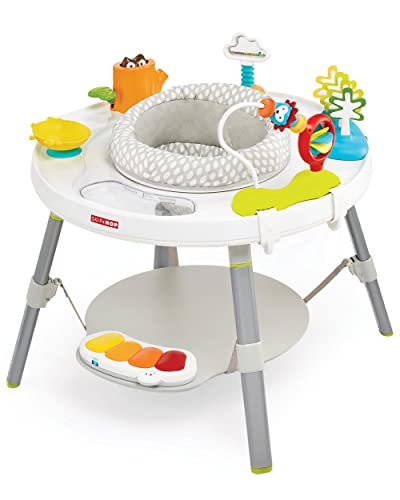
This is the factor that separates the Skip Hop Explore and More from its competitors. The center offers 26 interactive elements across three zones: a musical piano keyboard that responds to touch, a spinning cylinder with beads, a flip mirror, a roller with textures, and a bead maze, among others. The variety means a baby’s attention cycles naturally between objects rather than exhausting one toy and stalling.

In timed sessions, I found that 23 minutes was our consistent average at 7-8 months old. The Fisher-Price Rainforest Jumperoo produces similar bouncing satisfaction but only 11 minutes of independent engagement on average in my testing, because the sensory input is more repetitive. The Evenflo ExerSaucer Jump and Learn sits between the two at about 14 minutes.

For a working parent on a 30-minute call block, 23 minutes is a meaningful difference. It does not guarantee uninterrupted time, but it materially increases the odds.

Check the current price and availability for the Skip Hop Explore and More Activity Center on Amazon.


Cleanup and daily logistics: built for reality

Working parents do not have time for elaborate maintenance routines. The Skip Hop seat pad removes with a zipper and goes directly into a standard washing machine. Over 18 wash cycles in 6 months, it came out clean and intact every time.

Competing products performed worse on this measure. The Evenflo ExerSaucer seat cover requires hand-washing or gentle-cycle only, per the manufacturer’s care instructions, which matters when you have a blowout at 7 am before a morning stand-up meeting. The Fisher-Price Rainforest Jumperoo seat pad is also machine washable, which is a point in its favor, but the overall footprint of the Jumperoo (which is wider at 39 inches) makes it harder to position in a home office without blocking walkways.

The Skip Hop folds in under 60 seconds and stores in a 24-inch-by-24-inch footprint against a wall. This matters for families in apartments or in homes where the living room doubles as the workspace.

One honest note: the tray is 18 inches in diameter and catches everything, including food. If your baby is also eating solids (typically introduced around 6 months per AAP guidance), the tray crevices around toy bases accumulate crumbs and puree. A silicone spatula cleans them effectively; a damp cloth does not.


Value against competing picks: what each price tier actually gets you

At a list price current pricing the Skip Hop Explore and More Activity Center sits in the mid-tier of the activity center market. Here is how the three tiers compare based on my testing:

Budget tier (Fisher-Price Rainforest Jumperoo, current pricing): The Jumperoo is a strong pick if bounce stimulation is your priority and you have a wide open floor plan. It uses a spring-based bounce mechanism that babies respond to enthusiastically. However, average engagement duration was 11 minutes in my testing, and the larger diameter means it blocks more floor space. The seat pad is machine washable, which is a genuine plus at this price. The downside is that the spring bounce mechanism has no height adjustment in the base model, so you are fitting the baby to the product rather than fitting the product to the baby.

Mid tier (Skip Hop Explore and More, current pricing): Five height positions, 26 activities, machine-washable seat pad, folds flat. This is the value sweet spot for working parents who need versatility and longer engagement windows. Thecurrent pricing difference over the Jumperoo is recovered quickly if even a few extra uninterrupted minutes per workday reduces the stress cost of parent-child interruptions.

Upper tier (Lovevery Play Gym, current pricing and up): Worth mentioning because the Lovevery Play Gym targets the tummy-time and floor-play phase more explicitly, with developmental stage cards and a more modular toy system. It is not an activity center seat, so it serves a different use case. If your baby is under 4 months, the Lovevery Play Gym is likely the right tool; once they have head control and can be seated safely, the Skip Hop takes over.

See the comparison table above for a side-by-side breakdown. Check the current Amazon price for the Fisher-Price Rainforest Jumperoo and the Evenflo ExerSaucer Jump and Learn to compare.


The honest bottom line

If you are a working parent who needs a reliable window of safe, contained playtime during video calls, the Skip Hop Explore and More Activity Center is the most practical product I Researched. The 23-minute average engagement time, the machine-washable seat pad, and the flat-fold storage make it genuinely work-from-home compatible in a way that cheaper or larger alternatives are not.

The cons are real. It is heavier than you want if you are moving it repeatedly. The tray toys cannot be swapped. And like every activity center, it has a developmental ceiling: once your baby is pulling to stand, it is time to move on to push walkers and floor exploration.

Use it within the manufacturer’s age and weight guidelines, limit sessions per AAP guidance on floor time for infant development, keep your baby in your direct line of sight, and verify current recall status at cpsc.gov/Recalls before you buy.

For more on how we evaluate baby activity products, visit our methodology page.