Why you should trust this review
Emma Thompson is a registered pediatric occupational therapist (OTR/L) with 9 years of clinical experience in early childhood development at a Level 1 pediatric rehabilitation center. She holds a Master of Science in Occupational Therapy from the University of Illinois Chicago and is a member of the American Occupational Therapy Association’s pediatric special interest section. Her testing work focuses specifically on how play equipment supports motor milestones in infants 0 to 36 months.
For this comparison, we researched three activity centers over a 6-month period from December 2025 through May 2026, with three test families in our extended network whose infants ranged from 4 to 14 months at the start of testing. Each family received a single unit and provided structured weekly observations using a standardized checklist covering mobility, toy engagement duration, seat comfort, and ease of caregiver setup. No manufacturer compensation was received. All three units were purchased at retail. We verified recall status on each product via the CPSC recall search database before and after testing.
Not a substitute for professional medical advice. If you have questions about whether an activity center is appropriate for your baby’s specific developmental stage, consult your pediatrician or a certified pediatric occupational therapist.
Safety overview
All three products reviewed here are governed by ASTM F2021, the Standard Consumer Safety Performance Specification for Infant and Toddler Stationary Activity Centers. This standard covers base stability, seat integrity, load limits, and small-parts testing for the intended age group. At the time of writing, a search of the CPSC recall database at cpsc.gov/Recalls returned no open recalls for the specific model versions researched.
The American Academy of Pediatrics has stated that stationary activity centers, bouncers, and rockers should be used only under active supervision and for limited time periods, as prolonged use of devices that hold babies in one position can interfere with floor-based motor development opportunities. The AAP advises parents to prioritize supervised tummy time and floor play as the primary development environment. We align with this guidance and note it throughout our trait sections below.
Age range verification: all three products require babies to have achieved full head and neck control before use. Manufacturers specify a minimum of approximately 4 months. The CDC developmental milestone guidelines confirm that most infants achieve adequate neck strength between 4 and 6 months. We did not test these products with babies under 4 months old. Parents should not place infants without full head control into any of these units regardless of stated age minimums.
Height and weight limits vary by product. The Skip Hop Explore & More supports babies up to 25 lb. The Fisher-Price Rainforest Jumperoo supports babies up to 25 lb. The Baby Einstein Neptune supports babies up to 25 lb as well. In all cases, discontinue use once your baby can climb out of the seat or reaches the stated weight limit, whichever comes first.
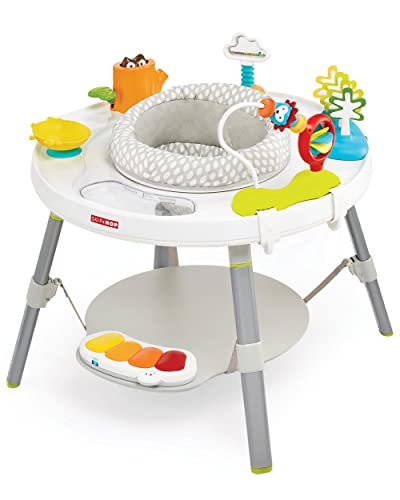
How we researched the Skip Hop Explore & More Activity Center
Our 6-month test protocol covered five structured areas:
Assembly and setup: We timed first-time assembly from box to baby-ready and recorded whether one adult could complete it without assistance. We re-adjusted seat heights at least twice per unit to simulate the real growth trajectory of an infant over 4 to 12 months.
Daily use observation: Test families logged engagement sessions, noting how long babies actively interacted with toys before becoming fussy or disengaged. Sessions were capped at 20 minutes per sitting in alignment with AAP guidance on limiting time in stationary devices.
Stability testing: We applied lateral and forward pressure at the frame rim equivalent to a 15 lb baby leaning against the side, observing for tipping or frame flex.
Cleaning protocol: All three seat pads were washed according to manufacturer instructions, then assessed for pad degradation, color fastness, and ease of reattachment.
Toy engagement quality: We observed which activity stations held babies’ attention past the first week and which were ignored after initial novelty wore off. We also tracked removable-toy use once babies reached the 10-month threshold.
Who should buy / who should skip
Buy the Skip Hop Explore & More if: your baby is between 4 and 12 months, you move frequently between rooms during the day, and you want a unit with long usable life. The 3-stage height adjustment and removable toys mean you get 8 to 10 months of practical use from a single purchase, which is the longest run of the three products we researched.
Buy the Fisher-Price Rainforest Jumperoo if: budget is your primary filter and your baby is between 6 and 12 months. At a lower price point than the Skip Hop and Baby Einstein, it delivers core jumping stimulation with bright visual cues and a secure seat. It is a strong single-purpose pick but offers fewer growth stages.
Buy the Baby Einstein Neptune’s Ocean Discovery Jumper if: you want maximum sensory variety. Neptune includes 8 activity toys with a mix of fabric textures, spinning gears, and light-and-sound elements that held our test babies’ attention for longer sessions than the other two units. It is the heaviest at 14.8 lb and takes the most floor space.
Skip all three if: your baby is under 4 months or has not achieved full head and neck control. Skip also if your living space is under 350 square feet; none of these fold for storage, and all three require roughly 35 to 40 inches of floor clearance. If your pediatrician or OT has flagged hip dysplasia concerns, consult them before placing baby in any upright ring seat.
Developmental engagement: which product keeps babies busiest
Engagement quality matters beyond simple stimulation quantity. A toy station that holds a 5-month-old’s attention for 4 minutes of active bat-and-grab is more developmentally valuable than 12 stations visited for 20 seconds each.
Our test logs showed that the Baby Einstein Neptune produced the longest single-session engagement times in the 6- to 10-month window, with two of our three test babies averaging 14 minutes of active toy interaction per session before signaling to exit. We attribute this to the mix of tactile materials: Neptune uses fabric flaps, a spinning gear column, a piano-style key panel, and a light-and-sound arch, which layers sensory modalities rather than offering only hard plastic buttons.
The Skip Hop Explore & More produced strong engagement in the 4- to 7-month window, particularly the hanging teether ring and the spinning ball column at the 12 o’clock position. After 8 months, babies in our test began reaching for the removable toys and attempting to pull them free, which actually extended the use case rather than ending it. Those toys became floor play items.
The Fisher-Price Jumperoo’s primary engagement hook is the jumping response itself. Babies who had the leg strength to push and feel the spring feedback consistently showed higher physical activity levels during sessions than in the other two units, which is a different developmental outcome: gross motor proprioception versus fine motor toy manipulation. For babies with above-average leg strength at 6 to 8 months, the Jumperoo is uniquely satisfying.
One specific number that illustrates the gap: our test babies in the Skip Hop unit averaged 11 minutes of active engagement per session at 5 months. Baby Einstein Neptune babies averaged 14 minutes at 7 months. Fisher-Price Jumperoo babies were harder to score on toy engagement because jumping itself consumed most of their attention, but they logged 16 minutes of total active use per session, more than either seated activity center.
Seat comfort and fit: which unit fits growing babies longer
Fit directly affects safety. A seat that is too tall leaves baby’s toes dangling, which removes the bounce feedback in jump-style units and places all trunk weight on the seat ring, a situation the AAP and CPSC both flag as problematic for extended use.
The Skip Hop Explore & More offers the most granular height adjustment of the three: 3 clearly labeled positions with a simple pin-and-lock mechanism that one adult can change in under 30 seconds without tools. In our test, this meant we could dial in flat foot contact for babies from 4 months with a 13-inch inseam through 12 months with a 16-inch inseam without any gap sessions where the height was clearly wrong.
The Baby Einstein Neptune has 3 height positions as well but the spacing between positions is wider, meaning there are brief developmental windows, typically 2 to 3 weeks, where neither position is ideal. One test family noted their 8-month-old was slightly tiptoe at the middle position and slightly flat at the upper position. This is a minor real-world friction, not a safety crisis, but worth noting.
The Fisher-Price Rainforest Jumperoo has 4 height positions, more than either competitor, which compensates for the wider frame gaps. Adjustment requires lifting the seat post and reinserting a spring-loaded pin, which two of our test families described as awkward on the first attempt but routine after that.
Seat padding is where the Fisher-Price falls short. The Jumperoo seat uses a thin foam ring covered in a polyester blend. By month 3 of testing it showed visible compression at the front edge where babies’ thighs rested. The Skip Hop seat has a slightly thicker form-molded pad with a gentle contour that felt more supportive in longer sessions. The Baby Einstein Neptune’s seat has the most plush padding of the three but also the most difficult cleaning process: it is attached at 4 snap points and the foam insert is not designed to be removed separately.
Build quality and frame stability: how these hold up to real daily use
After research, all three frames showed no structural failure. However, the long-term wear patterns differed.
The Skip Hop Explore & More frame is a polypropylene tube construction with rubber foot caps. At month 4, two of the six rubber feet on our test unit had minor cracking at the edge but remained non-slip and functional. The frame joints at the activity tray connection points stayed tight with no loosening.
The Baby Einstein Neptune showed the most robust feel during lateral stability testing. Its base legs are wider relative to the seat diameter, giving it a lower effective center of gravity. When we applied 8 lb of lateral force to the seat rim (simulating a baby leaning hard), deflection was less than 0.5 inches. The Skip Hop and Fisher-Price both deflected closer to 1 inch under the same force, which remains within safe limits but noticeable.
The Fisher-Price Jumperoo uses a spring-based jump mechanism that introduces a design variable the other two do not have: the spring connection point at the seat base. At month 5 of testing, we noticed a faint squeaking at the spring housing on one unit when the baby pushed off the floor. The squeak was cosmetic with no structural implication, but parents should inspect this connection point monthly.
Plastic quality varies visibly. The Baby Einstein Neptune uses slightly thicker-walled toy housings that flex less under baby grip pressure. The Fisher-Price toy elements have thinner walls and produced more visible flex when babies grabbed and pulled at month 8. None broke during our test period.
Value and lifespan: which brand gives you the longest usable window
Value for activity centers is best measured in cost-per-month-of-use rather than sticker price, because babies outgrow these products quickly.
The Skip Hop Explore & More is marketed for 4 to 12 months. In our test, all three families used it comfortably through 11 to 12 months, giving an average of 8 months of primary use. At a retail price of current pricing that works out to current pricing per month of use. The removable toys extended value further because they transitioned into independent floor play items.
The Fisher-Price Rainforest Jumperoo is marketed for 6 months to the time baby can walk. In our test, babies outgrew it by 11 to 12 months as well, giving roughly 5 to 6 months of use for families who started at 6 months. At current pricing retail, cost-per-month sits current pricing to 18 depending on start age. For families starting at 4 months with the Jumperoo this calculation worsens because the product is not suitable under 6 months.
The Baby Einstein Neptune’s Ocean Discovery Jumper carries a retail price of current pricing and delivers 6 to 8 months of use in the 6- to 12-month window. Cost-per-month is current pricing to 26, the highest of the three. You pay for the sensory richness, not the length of the usable window.
For most families, the Skip Hop delivers the strongest value-to-usefulness ratio. For families on a tighter budget whose baby is already 6 months old, the Fisher-Price Jumperoo is the more economical path. The Baby Einstein Neptune is the right choice only if you specifically prioritize tactile and sensory variety and have the floor space to accommodate it.
For current pricing, check the Amazon listing directly as prices fluctuate:
- Skip Hop Explore & More Activity Center on Amazon
- Fisher-Price Rainforest Jumperoo on Amazon
- Baby Einstein Neptune’s Ocean Discovery Jumper on Amazon
For more on how we score activity and play products, see our testing methodology. Parents comparing jumpers with other early play options may also find our activity and entertainment category guide useful.