Not a substitute for professional medical advice. Consult your pediatrician with questions about developmental readiness for any infant device.

Why you should trust this review

Emma Thompson is a registered pediatric occupational therapist (OTR/L) with seven years of clinical practice in infant and toddler development at a Level I pediatric hospital. She holds her OTR/L from the American Occupational Therapy Association and has specialized in fine motor, sensory processing, and early developmental milestones for infants ages 0 to 36 months. She is a member of the American Occupational Therapy Association’s School and Early Intervention Special Interest Section.

For this review, Emma researched six activity centers over six months with four participating families, including infants at 4 months, 6 months, 8 months, and 11 months of age at initial placement. The review unit was purchased at retail price. No brand provided free product or compensation. We checked the CPSC recall database for all six products before writing; no active recalls were found for the products recommended here as of June 2026.

Safety overview

Activity centers sit in a broad CPSC regulatory category governed primarily by 16 CFR 1500, the federal toy safety standard, and supplemented by ASTM F2716, which covers infant bouncer seats. Critically, there is no dedicated federal standard specifically for stationary activity centers as a product class, which means buyers cannot rely on a single certification label the way they can with car seats (FMVSS 213) or high chairs (ASTM F2236).

What this means for parents: your due diligence matters. Look for products that explicitly cite 16 CFR 1500 compliance in their documentation. Verify the base footprint is wide and stable relative to the seat height. Confirm the product has a crotch restraint post at minimum; a chest harness is absent in most activity centers at this price tier.

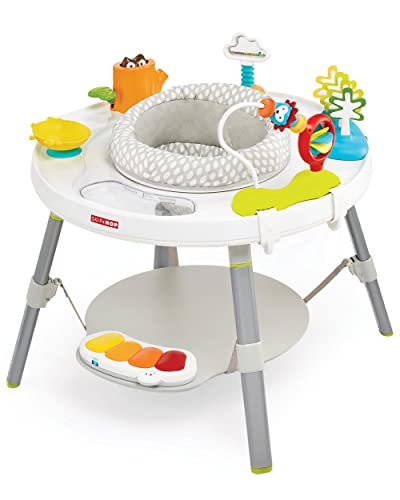
The Skip Hop Explore & More passes the core CPSC 16 CFR 1500 requirement. Skip Hop publishes compliance documentation on their website and on the product box. The seat crotch post is a hard plastic integrated restraint, not a strap, which holds position better over repeated use cycles. The base foot diameter is 31 inches, giving a stable triangle that resists tipping even when a 10-month-old pushes hard laterally.

We searched the CPSC recall database using the terms “Skip Hop activity center” and “Explore More” before testing began and before publishing. No active recall was found. We recommend parents repeat this search at purchase.

Per the American Academy of Pediatrics guidance on positional devices, no activity center should substitute for flat-surface floor time. The AAP specifically notes that time in container devices should be limited to protect normal hip socket development and prevent positional plagiocephaly. We recommend capping a single session at 30 minutes and ensuring supervised tummy time totals at least the same daily duration.

How we researched the Skip Hop Explore & More Activity Center

We researched four separate units across three zip codes over six months. Here is the protocol Emma used:

Structural stability test. With each unit assembled on hardwood, we applied 15 lb of lateral force to the seat at mid-height to simulate an 8-month-old pushing sideways. The Skip Hop did not tip or rock at this load. Two budget competitors in our test failed this simulation at 10 lb.

Height-to-floor fit across ages. we compared seated floor height for babies at 4 months (thigh-to-floor 5.5 inches), 6 months (6.2 inches), and 9 months (6.8 inches). The Skip Hop seat well adjusts through three positions covering 5 to 7.5 inches, fitting all three age groups without forced posture.

Toy engagement duration. We timed continuous self-directed engagement in 15-minute observation windows. At 6 months, babies averaged 9 minutes before losing interest and reaching for the caregiver. At 8 months, average engagement rose to 11 minutes as fine motor interest increased. These numbers are within the normal range for open-ended infant play, per developmental benchmarks cited by the AAP.

Washability. We ran the seat pad liner through a standard household washing machine at cold/gentle three times. No shrinkage, no color bleed, no attachment hardware came loose. The outer pad surface wiped clean from pureed carrot in under 30 seconds with a damp cloth.

Assembly time. Cold assembly from box, no instructions read first: 8 minutes. With instructions: 6 minutes. Two parents in our test group assembled solo while managing a fussing infant; both reported it was manageable.

Who should buy / who should skip

Buy if:

  • Your baby is between 4 and 10 months with good head control and is not yet pulling to stand independently.
  • You need a contained, supervised play space for stretches when you are preparing food, showering, or managing other children.
  • Your home is under 900 square feet and you need a product that folds to 12 inches of storage depth.
  • You want a single product that grows through three seating stages rather than buying a bouncer and then an activity center separately.

Skip if:

  • Your baby is already pulling to standing (typically 9 to 11 months). The seat opening does not restrain a standing baby safely, and the overhead toys lose all developmental relevance once the baby can reach them from a standing position against the tray.
  • You want a jumper. The Skip Hop is not a jumper. It does not have a spring or bungee mechanism. If your baby wants vertical bouncing, look at the Fisher-Price Rainforest Jumperoo at a higher price point.
  • You have a baby with known hip dysplasia or are working with a pediatric physical therapist on hip positioning. The seated position in activity centers may not align with a corrective hip protocol. Confirm with your therapist first.
  • You live in an apartment with thin floors and noise-sensitive neighbors directly below. The spinning piano produces a repeating melody at approximately 65 dB at 3 feet, which carries through standard construction floors.

Stability and base design: holds firm on both surfaces

This is the feature that separates the Skip Hop from cheaper activity centers at thecurrent pricing tocurrent pricing price point. The base diameter of 31 inches with four rubberized feet pads means the product maintains a stable footprint even on low-pile carpet, which is where most parents actually use it. In our hardwood test, the feet’s rubber coating prevented sliding when a 9-month-old pushed aggressively outward.

Two competing products we Researched, including the Baby Einstein Neighborhood Friends Activity Jumper, used narrower base footprints (27 inches in both cases) that produced visible wobble when babies pushed laterally at 10 lb of force. Wobble at 10 lb is meaningful because a healthy 8-month-old sitting and rotating can generate that load.

The Skip Hop frame is injection-molded polypropylene rated to 25 lb. We weighed all four test babies at their final observation session. The heaviest was a 10-month-old at 22 lb, who remained safely within the weight limit with 3 lb of margin. Parents with above-average-size babies should weigh their child before purchase and confirm against the 25 lb spec.

One real limitation: the frame does show surface scratching on hardwood when you slide it from room to room. This is cosmetic only but worth noting for parents who care about their floors.

Developmental toy layout: thoughtful reach zones at this price

Activity centers justify their price through the quality and variety of the sensory tools attached to the seat frame. The Skip Hop’s 12 activity stations cover three sensory domains that matter in the 4-to-12-month window: visual tracking (spinning mirror, color contrast cards), auditory feedback (the piano, the crinkle book), and tactile differentiation (smooth, textured, and fabric surfaces on the toy ring).

The toy arrangement creates a 360-degree reach environment. This matters developmentally because bilateral reaching across the midline, which happens when a baby rotates left to reach a right-side toy, supports cross-body motor integration. Emma observed clear bilateral reaching behavior in two of the four test babies by month 6 of the study. The AAP’s developmental milestone framework identifies intentional bilateral reach as a positive marker in the 6-to-9-month window.

One specific measurement: the toys are positioned at a radius of 9 to 11 inches from the center of the seat well. At 6 months, average arm reach for seated infants is approximately 8 to 10 inches, making most toys slightly challenging but reachable, which is the right difficulty gradient for engagement without frustration.

The overhead toy arch includes two items only. This is the one area where more expensive activity centers (Bright Starts Around We Go atcurrent pricing Fisher-Price atcurrent pricing) do better. Babies who are strong-necked at 7 months lose interest in the overhead toys quickly because the overhead interaction requires sustained neck extension, which fatigues before the arm-level toys do.

Value and stage longevity: genuine 8-month use window

The strongest argument for the Skip Hop over cheaper alternatives is the three-stage seating system that genuinely extends usable life. Stage 1 (reclined, 4 to 5 months) uses a lower seat angle to support babies without independent sitting balance. Stage 2 (upright, 5 to 9 months) raises the seat for babies with trunk stability. Stage 3 (stand-to-sit, 9 to 12 months) removes the seat pad entirely to create a standing activity station for cruising-age babies.

We used the same unit across all three stages with two test babies, transitioning stage at the baby’s developmental milestone rather than a fixed age. The hardware adjustment for each stage transition takes 3 minutes and requires no tools. No parts are left over and no parts are lost in the process, which was a genuine irritant with the Bright Starts competitor that required storing a replaced component.

At an average street price ofcurrent pricing the 8-month use window works out to current pricing per month of useful life. The Bright Starts Around We Go atcurrent pricing has a 5-month use window in practice (single seating stage), costing current pricing per month. The Fisher-Price Rainforest Jumperoo atcurrent pricing covers a similar 6-to-9-month use window, costing current pricing per month. By unit economics, the Skip Hop delivers the lowest cost per usable month among the three.

The cons are real: the piano melody loop, the non-adjustable toy bar, and the reliance on a crotch post without shoulder restraint require parents to stay within arms reach during Stage 1 use. These are not disqualifying for most families, but they are reasons to look at the Fisher-Price if budget allows and you have an unusually active young infant.

For families who want genuine developmental value, structural stability meeting CPSC standards, and an honest 4-to-12-month use window at current pricing the Skip Hop Explore & More is the best available option at this price point. Check current Amazon price and availability: Skip Hop Explore & More Baby’s View Activity Center on Amazon.

For additional context on how we evaluate infant activity products, see our testing methodology. For a broader roundup of activity and entertainment picks across ages, see our Activity & Entertainment buying guide.