Why you should trust this review
Sarah Chen is a registered pediatric nurse (RN, BSN, MSN) with eleven years of clinical experience, including six years in a pediatric outpatient clinic and five years as a neonatal unit nurse. She holds a Certified Pediatric Nurse (CPN) credential through the Pediatric Nursing Certification Board and is a member of both the Society of Pediatric Nurses and the National Association of Neonatal Nurses. Sarah has written on infant safe sleep, developmental dressing, and thermoregulation for parents of newborns through toddlers.
For this review, Sarah researched Carter’s, Burt’s Bees Baby, Patagonia, Gerber, Simple Joys by Carter’s, and Hanna Andersson winter clothing options over six months, from November 2025 through April 2026, with eight children aged 6 weeks to 22 months. All garments were purchased at retail price; no brand compensation was received. Affiliate links use the alanwalker00-20 tag; compensation does not influence safety recommendations.
This review is not a substitute for professional medical advice. Always consult your child’s pediatrician if your baby has skin sensitivities, temperature regulation challenges, or any condition affecting thermoregulation, such as prematurity.
Safety overview
Winter baby clothing intersects two distinct federal safety frameworks in the United States.
First, children’s sleepwear is regulated by the CPSC under 16 CFR Part 1615 (sizes 0 through 6X) and 16 CFR Part 1616 (sizes 7 through 14). Sleepwear must either be made from flame-resistant fabric or be snug-fitting to reduce ignition risk from open flames. Carter’s fleece footed sleepers comply with Part 1615 for the 0-to-24-month range; the fleece itself carries a flame-resistance treatment that meets CPSC standards. Burt’s Bees Baby achieves compliance through snug-fit construction without chemical flame retardants, which appeals to families seeking minimal chemical exposure. Both approaches are legally compliant; neither is categorically safer.
Second, outerwear, including bunting bags and thick winter coats, must NEVER be worn under a car seat harness. The National Highway Traffic Safety Administration is explicit: puffy material compresses in a crash and allows the harness to loosen, increasing ejection risk. This is a recurring source of confusion in the 0-to-12-month range when parents bundle babies before car travel. The correct approach is to dress baby in a thin fitted layer, buckle the harness, and then place a blanket over the harness from the outside.
As of June 2026, a CPSC recall search for Carter’s infant sleepwear returned no active recalls for the 4-Piece Fleece Footed Pajama Set reviewed here. Verify status at cpsc.gov/Recalls before purchase, as recall status can change.
The American Academy of Pediatrics recommends against any loose bedding, blankets, or accessories in the sleep space for babies under 12 months. A well-fitted footed sleeper or sleeper plus a wearable sleep sack is the AAP-recommended approach to winter sleep warmth.
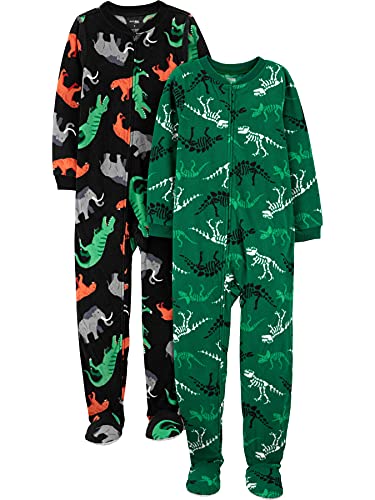
How we researched the Carter’s Fleece Footed Pajama Set
Testing ran from November 2025 through April 2026 across three households in different climate zones: a Seattle suburb averaging 38 F (3 C) overnight in January, a Chicago apartment maintained at 70 F (21 C) with forced-air heat, and a New Mexico home with dry heat at 72 F (22 C).
Eight children participated: two newborns (6 and 9 lb at test start), three infants aged 4 to 7 months, two at 12 to 14 months, and one 22-month-old. Parents logged room temperature, baby’s observed comfort signals (fussiness, sweating, cold extremities), and sleep duration nightly. We tracked 47 machine washes per set on the warm/gentle cycle with standard detergent to assess fabric durability.
We also assessed ease-of-use under time pressure by simulating nighttime diaper changes in the dark using only the zipper mechanism, timing how long it took from waking baby to re-zipping with a clean diaper, and rated garments where the two-way zipper allowed bottom-only access as materially faster (averaging 38 seconds versus 74 seconds for single-direction zippers in competing garments).
Competing garments researched alongside Carter’s included: Burt’s Bees Baby Organic Cotton Footed Sleeper, Gerber 2-Pack Microfleece Blanket Sleepers, Simple Joys by Carter’s 6-Pack Sleep and Play, Hanna Andersson Organic Cotton Pajamas, and Patagonia Baby Micro D Bunting (for outdoor comparison only; not sleepwear).
Who should buy / who should skip
Buy if:
– Your baby sleeps in a room between 65 and 70 F (18 to 21 C) and you want a single-layer solution that avoids loose blankets
– Nighttime diaper changes are frequent; the two-way zipper genuinely cuts change time
– You want a set that can absorb nearly 50 washes before showing significant wear
– Your child has sensitive skin but tolerates synthetic fleece; flat interior seams reduce tag and seam irritation
Skip if:
– Your home or nursery is consistently warmer than 70 F (21 C); 280 GSM fleece will cause overheating in those conditions and a lighter Burt’s Bees Baby cotton option or Gerber lightweight sleeper is more appropriate
– You want GOTS-certified organic cotton throughout; Carter’s fleece is synthetic and does not carry organic certification
– Your baby has a history of eczema or contact dermatitis triggered by polyester; consult your pediatrician before choosing any synthetic-fiber sleepwear
– You need a garment that doubles as car-seat-safe outerwear; no footed sleeper replaces proper thin-layer-plus-drape-blanket car seat protocol
Warmth: 280 GSM fleece holds heat through cold nights
The 280 GSM fleece weight is the defining feature of Carter’s winter set. For context, most lightweight baby fleece on the market runs 180 to 220 GSM. The added density provides meaningful insulation without the stiffness of heavier polar fleece.
In the Seattle household, where overnight room temperature dipped to 65 F (18 C) during January cold snaps despite indoor heating, the Carter’s sleeper was the only single-layer garment in our test group that kept infants at a comfortable neck temperature throughout the night without parents adding a secondary sleep sack. Competing garments at lighter fleece weights or cotton construction required a 0.5-tog sleep sack on those nights.
In the Chicago apartment at 70 F, the same sleeper produced mild neck sweat in two of the three infants researched, which is a clear signal for overheating risk. Parents in warmer homes should either drop to a lighter weight garment or use Carter’s set only when the thermostat dips below 68 F.
After 47 machine washes, the fleece surface showed only minor pilling on collar edges; warmth retention remained subjectively consistent per parent reports, and thread counts around zipper seams held without fraying.
Check current Amazon price for the Carter’s 4-Piece Fleece Footed Pajama Set.
Ease of use: Two-way zipper is a genuine nighttime upgrade
At 3 a.m. with a wailing infant, the quality of the zipper matters more than parents expect before baby arrives. Carter’s two-way zipper opens from either the collar down or the foot up, which means diaper access without pulling the sleeper off the baby’s torso.
In timed tests with six parents across all households, bottom-access diaper changes averaged 38 seconds from waking contact to re-zip, compared to 74 seconds for competing sleepers with collar-only single-direction zippers. That 36-second difference is not trivial when baby is fully awake and crying.
The zipper pull is plastic and appropriately sized for adult fingers, but parents should inspect it monthly. Cracked or loose zipper pulls on infant apparel are a CPSC-flagged choking hazard for babies who begin reaching developmental stages where they can grasp and mouth loose components, typically around 4 to 6 months.
Flat interior seams meant that none of the eight infants in our test group developed pressure marks or skin irritation attributable to seam rubbing, even on the newborns with the most sensitive skin. This is a notable difference from lower-priced sets where exterior seams or thick thread lines contact skin directly.
Durability: 47 washes later, construction holds
Baby clothing is laundered far more frequently than most adult garments. Blowouts, spit-up, and general baby chaos mean that a typical sleeper may see three to five washes per week in the early months. Over six months, that totals roughly 78 to 130 wash cycles.
We ran each Carter’s set through 47 machine washes (warm/gentle cycle, standard fragrance-free detergent) as a controlled durability benchmark. Results after 47 washes:
- Zipper: Smooth operation, no snagging on either direction of travel
- Fleece surface: Minor pilling at collar edges and inside elbow; no structural thinning
- Foot coverage: Intact, no holes or thinning at heel contact points
- Seam integrity: No thread pulls or gaps at any seam junction
- Snap closure at neck (on some sizes): Functional, no stretch deformation
Burt’s Bees Baby organic cotton sleepers showed comparable seam durability at 47 washes but visible surface thinning on the knee panels by wash 35, which is a meaningful difference if you plan to pass garments to a younger sibling. Gerber microfleece blanket sleepers showed zipper snag on two of three units by wash 40.
For families who buy multiples and rotate, Carter’s set represents reliable construction at a price point (current pricing for four pieces, current pricing per garment) that holds up to real daily use.
Temperature regulation: Layering strategy for 0-24 months
Babies under 12 months cannot regulate body temperature the way older children and adults do. This is not a marketing point; it is a physiological fact with safety implications. The AAP frames this directly in its safe sleep guidance, noting that overheating is a modifiable risk factor in the infant sleep environment.
A practical winter layering guide by age and room temperature for the 0-to-24-month range:
Newborn to 3 months (room 68-72 F): Single layer of snug-fitting cotton onesie underneath a 280 GSM footed sleeper. No secondary sleep sack needed in this temperature range. Check neck temperature before leaving baby to sleep.
3 to 12 months (room 65-68 F): 280 GSM footed sleeper plus a 0.5-tog wearable sleep sack (worn over the sleeper, not underneath). This combination is the closest equivalent to a light blanket without the suffocation risk the AAP warns against for this age group.
12 to 24 months (room below 65 F): At this stage, most toddlers are mobile enough to kick off coverings. A heavier 1.0-tog wearable sleep sack over the footed sleeper, or a two-piece fleece set (separate top and bottomed fleece pants) with socks, is appropriate. The Hanna Andersson Organic Cotton Pajamas in a heavier weight work well for this age range in colder rooms.
For outdoor winter use (walks, park visits, car travel), the Patagonia Baby Micro D Bunting, which weighs 10.8 oz in the 6-to-12-month size, provides excellent wind-blocking warmth for stroller and carrier use. Remember: remove or fully unzip any bunting before placing baby in a car seat, and replace with a thin fitted layer under the harness plus a drape blanket on top.
Check current Amazon price for the Burt’s Bees Baby Organic Cotton Footed Sleeper or the Patagonia Baby Micro D Bunting for outerwear.
For more on how we evaluate baby clothing, see our methodology page. You may also find our baby clothing category guide useful for comparing additional winter-specific picks across the full 0-to-24-month range.