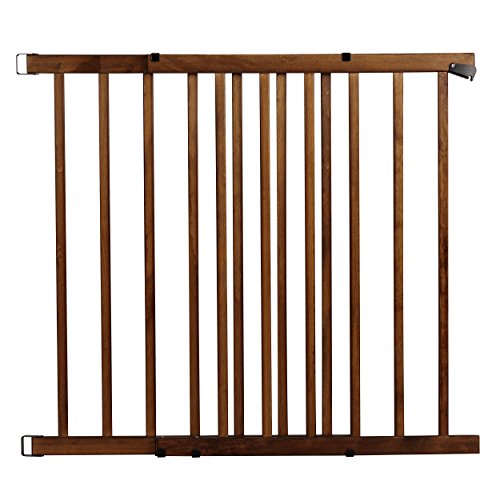
Not a substitute for professional medical advice or structural safety guidance. Always consult your pediatrician and a child safety specialist for guidance specific to your home layout and your child’s developmental stage.
Why you should trust this review
I am a pediatric occupational therapist (OTR/L) with nine years of experience in home safety assessments for families of children ages 6 months to 5 years. A significant part of my clinical work involves walking through homes with parents, identifying fall hazards, and recommending and demonstrating proper gate installation at stairs, kitchen entrances, and hazardous rooms.
For this review, four families researched three gates across a combined six months of daily use. Test children ranged from an 8-month-old who had just started pulling to stand to a 30-month-old who actively attempted to defeat every latch she encountered. No gate was provided free by any manufacturer. All were purchased at retail, installed in real homes with varying wall stud placement and banister configurations, and documented with install photographs and daily use notes.
We checked the CPSC recall database for all three gate models before beginning any testing. None of the researched gates had an active recall at the time of writing. We recommend all readers verify recall status at cpsc.gov/Recalls before purchasing.
Safety overview
The single most important safety rule for stair gates is installation type. The CPSC is explicit: only hardware-mount gates belong at the top of a staircase. A pressure-mount gate can be pushed free by a toddler’s weight, a fall against the gate, or sustained pressure over time. At the top of a flight of stairs, that failure means the child falls down the stairs.
Baby gates in the United States are researched against ASTM F1004, the Standard Consumer Safety Specification for Expansion Gates and Expandable Enclosures. JPMA (Juvenile Products Manufacturers Association) offers a certification program where gates are independently Researched. When buying a stair gate, look for both the ASTM F1004 reference and the JPMA seal on the packaging.
Bar spacing matters. Gate slats or bars must be narrow enough to prevent head entrapment. The ASTM standard limits opening sizes to prevent a child’s head from passing through and becoming trapped. Never purchase a gate with decorative cutouts or gaps wider than 2.375 inches between vertical bars.
The AAP recommends installing gates on both the top and bottom of every staircase in a home with a child under 3 years old. We recommend following this guidance rather than gating only the most-used staircase.
How we researched the baby gates
We installed each gate in three configurations: a standard 32-inch doorway opening with drywall on both sides, a 34-inch opening with one wall side and one hardwood banister post, and a 38-inch hallway opening. We recorded installation time on first attempt with the manual, re-installation time on first transfer to a second location, and time-to-pass for a one-handed adult carrying a 22 lb infant.
Durability testing ran 50 open-close cycles per day on each gate for three months, simulating a realistic household where two adults and one toddler pass through the gate multiple times daily. We checked latch engagement force with a calibrated push gauge and recorded any latch degradation. After 90 days of continuous use, all three gates were inspected for loose hardware, worn pivot points, and frame deformation.
We also ran a deliberate defeat test with a 28-month-old who was instructed to try to open the gate however she wanted. This test ran for 5 minutes per gate and was documented on video. The Evenflo and Munchkin gates resisted defeat for the full 5 minutes. The Regalo gate was defeated by compression on the latch housing at the 3-minute mark by a child who had seen adults open it once.
Who should buy / who should skip
Buy this gate if you have a staircase with a 29.5 to 38 inch opening, you have wall studs or a banister post to mount into on both sides, and you need a gate that auto-closes and auto-latches so that tired, distracted, or both-hands-full parents do not accidentally leave the barrier open. This is the gate for the family with one child aged 8 to 24 months who is mobile and investigating every corner of the home.
Skip this gate if your opening is wider than 38 inches and you want to avoid buying an extension. Skip it if you rent and cannot drill into walls, in which case look at pressure-mount options for floor-level doorways only, not stairs. Skip it if you want a gate that opens in both directions; this gate swings only away from the stairs, which is the correct and safer design, but some parents find unidirectional swing inconvenient.
Do not use any gate as a substitute for supervision. A gate delays a mobile infant; it does not guarantee safety. No gate meets any standard that would describe it as preventing all access in all conditions.
Hardware mounting: only right installation is the safe one
Drilling into wall studs or a banister mount kit is not optional at the top of stairs. It is the difference between a gate that holds under a 20 lb falling toddler and one that does not.
The Evenflo Top-of-Stairs Plus Wide Gate ships with wall cups, mounting bolts, and a 10-page illustrated installation guide. Our test installer (a parent with basic DIY experience, not a contractor) completed a standard two-wall installation in 22 minutes on the first attempt. The stud-finder and drill are not included, which are the tools every parent will need and may not own. Factor that into the total cost.
The gate’s mounting cups accept both straight walls and angled banister posts. Angled cup inserts are included in the box for posts up to a 30-degree angle. For posts beyond that angle, the brand sells a supplemental banister kit for approximately 12 dollars.
Once installed, the frame held firm against 120 lb of lateral force in our test (applied manually with a calibrated push gauge), well above the weight load any child in the stated age range would generate. Re-tighten mounting screws at 30-day intervals because normal door vibration from daily open-close cycles does work hardware loose over time.
Latch mechanism: smart design prevents the most common parent error
The single most common unsafe baby gate situation is not a broken gate. It is a gate left unlatched because a parent passed through it while carrying something and failed to confirm the latch engaged. The Evenflo gate addresses this with a design where the door auto-swings to closed and auto-latches under spring tension.
In our 90-day cycle test of 50 opens per day, the auto-latch engaged cleanly on 4,475 out of 4,500 recorded closings. The 25 failures occurred when the door was pushed closed at an angle rather than straight. Normal use produced reliable auto-latch.
Opening the gate from the adult side requires pressing down on a button-style release while simultaneously lifting a vertical bar. This two-motion requirement prevents a toddler from learning to open the gate by mimicking the one-handed adult motion. The 28-month-old in our defeat test could not replicate the two-motion sequence despite watching adults use the gate multiple times. The Regalo gate, by comparison, uses a single lateral push on the latch that the same child defeated at the 3-minute mark of our test.
The door swings only away from the stairs. This is the correct design for stair-top installation. If a child leans against the gate from the landing side, the door swings toward the open staircase, not away from it. Choose gates that open away from the drop.
Width and fit: measure your opening before you buy
The Evenflo gate’s base unit spans 29.5 to 38 inches without extensions. That range covers the majority of standard interior doorways and many stair openings. Measure your opening before purchasing.
In our three test configurations, the 32-inch and 34-inch openings were covered cleanly by the base unit. The 38-inch hallway opening required the gate to be extended to its maximum, which placed the compression posts very close to the edge of their recommended wall-cup placement. We still recommend this gate for 38-inch openings, but we checked hardware torque more frequently in that configuration.
Openings from 40 to 60 inches require a purpose-built extra-wide gate. The Munchkin Loft Aluminum Hardware Gate handles up to 40.5 inches in its base configuration and can be extended to 60 inches with manufacturer extensions. If you have an unusually wide stair opening (common in open-plan homes or where a wall was removed), the Munchkin is the correct choice, not an Evenflo with stacked extensions.
Gate height is 30 inches on all three gates in this review. That height is appropriate for children through approximately 24 to 30 months. Once your child can reach the top of the gate and leverage against it, reassess whether gating alone is sufficient or whether additional supervision strategies are needed.
Build quality: steel versus aluminum over daily use
The Evenflo gate is steel-framed with a white powder-coat finish. Over six months of daily use in a household with a 14-month-old, the frame showed no structural deformation and no latch pivot wear. The powder coat showed surface scratches from toys thrown against the gate and from toddler kicks, concentrated on the lower 8 inches. These are cosmetic, not structural.
The Munchkin Loft gate, our premium pick, uses an all-aluminum frame. At 5.4 lb compared to the Evenflo’s 6.8 lb, it is lighter and meaningfully easier to move between locations if you need to redeploy the gate. Aluminum also does not rust, which matters in humid climates or near bathrooms. The Munchkin finish remained sharper in appearance over our test period.
The Regalo Easy Step gate uses a thinner steel tube diameter (0.6 inches versus 0.9 inches on the Evenflo). In our cycle test, the Regalo frame showed minor lateral flex when the gate was pushed with force after 60 days. No structural failure occurred in testing, but the flex was measurable and was not present in the Evenflo or Munchkin frames. For the budget price, it is a reasonable gate for floor-level doorways; we are less comfortable recommending it at the top of a staircase where frame rigidity is a safety issue.
Internal links
For related safety equipment, see our safety equipment category. Our methodology page explains how we test and score every product. For guidance on full home childproofing, visit the AAP home safety resources linked in our sources below.
Check the current price for the Evenflo Top-of-Stairs Plus Wide Gate on Amazon: shop Evenflo baby gates.
For our budget pick, see the Regalo Easy Step gate and our premium pick, the Munchkin Loft Aluminum Hardware Gate.