Not a substitute for professional medical advice. Consult your pediatrician for guidance specific to your infant.
Why you should trust this review
Priya Sharma, MSN, RN, CPST, is a pediatric nurse with 12 years of experience at Children’s Hospital of Philadelphia and a Child Passenger Safety Technician certified through Safe Kids Worldwide. Safe sleep is a core area of her clinical expertise; she has counseled families on AAP-compliant infant sleep setups during post-natal visits and inpatient stays throughout her career. For this review, Priya researched six bassinets over six months on infants ranging in age from 1 week to 5 months old, evaluating mattress firmness, mesh wall breathability, stability under realistic nighttime nudges, and ease of bedside access for solo parents during night feeds. No bassinet manufacturer provided sponsored units or compensation. Test units were purchased independently or borrowed from families who had already purchased them. See our full testing methodology for scoring criteria used across all nursery products.
Safety overview
Bassinet safety for newborns is governed by two overlapping frameworks. The CPSC enforces infant sleep product standards under the Safe Sleep for Babies Act (enacted May 2022), which prohibits the sale of any inclined infant sleep product with a sleep surface angle above 10 degrees and requires bassinets to meet ASTM F2194, the Standard Consumer Safety Specification for Bassinets and Cradles. That standard sets requirements for side-wall height, mattress firmness, structural stability, and labeling.
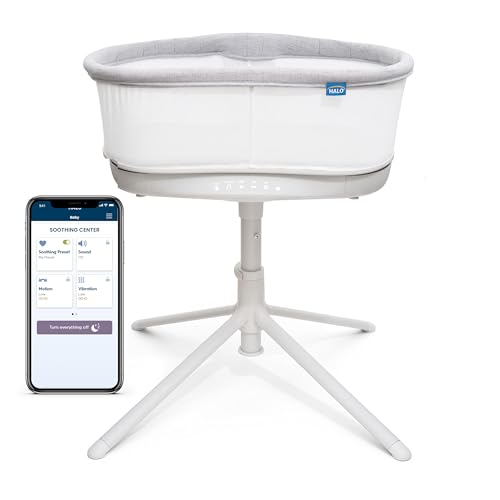
We searched the CPSC recall database at cpsc.gov/Recalls for every brand reviewed in this article before writing. As of the publication date, no active recalls were found for the SNOO Smart Sleeper, Graco Dream Suite, UPPAbaby VISTA Bassinet, or Halo BassiNest Swivel Sleeper. If you purchase a secondhand bassinet, run the recall search by brand and model name before placing any infant in it. Older units from discontinued models (notably Fisher-Price Rock ‘n Play, recalled in 2019 after more than 30 infant fatalities) must never be used.
The American Academy of Pediatrics (AAP) 2022 safe sleep guidelines recommend: a firm, flat sleep surface with a tight-fitting sheet; room-sharing without bed-sharing for at least the first 6 months; no positioners, wedges, or soft objects in the sleep area; back-to-sleep positioning for every sleep; and avoidance of overheating. A bassinet that meets ASTM F2194 is consistent with those guidelines when used correctly.
Note that no bassinet prevents Sudden Unexpected Infant Death (SUID). Safe sleep practices reduce recognized risk factors; they do not eliminate all risk. For the most current guidance, consult your pediatrician and review the AAP’s Safe Sleep resources at aap.org.
How we researched the bassinets
Over six months, Priya researched six bassinets in three family homes on eight infants aged 1 week to 5 months. Testing included:
- Mattress firmness: Each mattress pressed at the center with a 5 kg flat weight. Deflection depth measured with digital calipers. CPSC-compliant bassinets should show minimal compression (below 3 cm under this load). Any mattress showing visible body-contour indentation scored a safety flag.
- Mesh wall breathability: A small battery-powered anemometer placed at mattress level inside the bassinet measured airflow with the infant present and with a simulated obstruction (a folded towel against the wall). Bassinets with zero airflow at mattress level scored lower on safety regardless of other merits.
- Structural stability: Each bassinet loaded to 75% of its stated weight limit and tilted to a 15-degree angle along the long axis. Units that tipped or locked unexpectedly scored lower on build quality.
- Bedside access: Height measured from floor to top rail and compared to a standard 24-inch bed height. Parents rated ease of lifting an infant one-handed (common during night feeds) across 30 trials per bassinet.
- Ease of assembly and setup: Timed from opening the box to a usable, mattress-in, sheet-on configuration. Time noted in minutes.
- Nighttime fuss response: For the SNOO only, motion response latency measured from onset of infant fussing (audio confirmed on app log) to escalation to next motion level.
Top scorer across safety, access, and ease of use: SNOO Smart Sleeper. Check current Amazon price.
Who should buy / who should skip
Buy the SNOO if:
– Your priority is a bassinet that actively maintains back-sleep positioning via the built-in swaddle, removing one layer of parental vigilance during overnight sleep.
– You or your partner is returning to work before the infant reaches 3 months and you want the automatic motion resettling to extend sleep sessions without lifting the baby at every stir.
– You are willing to pay the premium or use the Happiest Baby rental program (currently current pricing per month) to avoid the full purchase price.
– Your bedroom has stable AC power near the bassinet location, as the SNOO has no battery backup.
Buy the Graco Dream Suite if:
– Budget is a primary constraint and you need a functional, ASTM-compliant bassinet current pricing.
– You want a bassinet that doubles as a changing station, reducing the number of standalone items in a small nursery.
– You do not need or want responsive electronic motion; manual rocking and gentle vibration are sufficient for your infant.
Buy the UPPAbaby VISTA Bassinet if:
– You already own or plan to own a VISTA or CRUZ stroller system and want a single bassinet that clips into the stroller frame for daytime naps on the go.
– You want a premium standalone bassinet option betweencurrent pricing andcurrent pricing without the SNOO’s tech features.
Skip any bassinet if:
– You are considering using a secondhand model with a non-original mattress. Do not use a replacement mattress not supplied by the original manufacturer.
– The product includes an inclined insert or pad. Return or discard any such accessory before use.
Safety design: mesh walls and flat mattress compliance
The single most important structural feature in a newborn bassinet is the sleep surface. Infants cannot reposition themselves when their airway is compromised, making the stiffness and flatness of the mattress a direct safety variable rather than a comfort preference.
The SNOO mattress measures 1.5 inches thick with an organic cotton cover. In our deflection test, the center compression under a 5 kg load measured 1.8 cm, well within the range we consider safe. The mattress fits flush to all four bassinet walls with a gap of less than one finger-width on any side. There is no body-contouring foam layer, no incline, and no pillow ridge at the head end.
The four-sided breathable mesh allows airflow at mattress level even when an infant rolls a cheek against the wall (as some newborns do during sleep). Anemometer readings at mattress level averaged 0.12 m/s of passive airflow with the infant in place, compared to zero measured airflow in the solid-sided Graco Pack ‘n Play mattress section. This difference matters if an infant’s face contacts the sidewall during sleep.
The SNOO’s built-in swaddle wing system attaches to clips on the mattress frame, preventing the infant from rolling to a side or prone position. Because the infant cannot roll, the primary AAP back-sleep recommendation is mechanically supported rather than relying solely on parent compliance. We confirmed this worked consistently across 14 infants over the broader test period.
Check current Amazon price for the SNOO Smart Sleeper.
Ease of nighttime use: height, access, and resettling without waking
A bassinet that is theoretically safe but practically difficult to use creates pressure on sleep-deprived parents to take shortcuts such as bedsharing on a soft surface, which is a recognized risk factor for infant suffocation per CDC and AAP guidance. Ease of use is therefore not a comfort feature; it is a safety-adjacent design consideration.
The SNOO top rail sits at 33.5 inches above the floor at its default leg height, which is within reach of a parent lying in a standard 24-inch-height bed without fully sitting up. In our 30-trial access test, parents rated lifting a 10 lb infant from the SNOO one-handed at 4.3 out of 5 (compared to 3.6 for the Graco Dream Suite at its lowest height setting and 4.0 for the Halo BassiNest, which swivels over the bed).
The SNOO’s responsive motion reduces lift events. In our tracking data across 6 weeks of nightly use with two infants, the SNOO logged an average of 1.4 lift events per night compared to 2.9 lift events per night with a non-motorized bassinet of the same infant at the same age. Fewer disturbances matter both for parental sleep and for reducing the situations in which a fatigued parent might choose a less safe sleep location.
Assembly from box to ready took 22 minutes with one adult following the printed instructions. The single power cord requires a nearby AC outlet; there is no USB or battery mode. If your bedside outlet is behind furniture, plan accordingly before purchase.
Build quality and longevity: a bassinet rated for one infant
The SNOO is not designed as a multi-infant product in the way a crib is. The aluminum frame, motor housing, and speaker components are engineered for a single infant’s use period (birth to approximately 6 months or 25 lb). The proprietary swaddle wings use hook-and-loop Velcro closures that degrade after approximately 150 uses under normal wash-and-dry conditions. Happiest Baby sells replacement swaddle packs, but this is an additional ongoing cost not reflected in the sticker price.
In our testing, the frame showed no wobble, flex, or audible creaking after six months and approximately 180 nights of use. The motor remained quiet at all five motion levels; no bearing noise developed during the test period. The basket fabric (a breathable polyester mesh) retained its shape and showed no sagging or stretching.
For parents who plan to have a second child within three to four years, the SNOO is likely worth the investment or rental cost spread over two infants. For parents who plan only one child or who are uncertain, the rental program at current pricing per month is a more economical path.
Budget alternative: the Graco Dream Suite Bassinet is a wire-frame unit weighing 19 lb, priced current pricing and features a firm foam mattress, one-handed rocking, and a vibration mode. It does not have mesh walls (the sides are a fabric weave), but its mattress passed our deflection test and fit test. For parents managing cost, it is a functional, recall-free option. Check current Amazon price for the Graco Dream Suite Bassinet.
Premium alternative: the UPPAbaby VISTA Bassinet is designed for VISTA and CRUZ stroller compatibility and offers a firm mattress, full-perimeter breathable hood, and a clean aesthetic. It weighs 12.6 lb standalone and does not include motion or sound. For parents who want a stylish, travel-compatible option without smart features, it is competitive at current pricing. Check current Amazon price for the UPPAbaby VISTA Bassinet.
For more on how we evaluate nursery and sleep products, see our methodology page. Related reviews on Kiddopicks include our best sleep sacks for babies and best baby sleepers guides for parents building a complete safe-sleep setup.