Why you should trust this review

Emma Thompson, OTR/L, is a licensed pediatric occupational therapist with 8 years of clinical practice at the Boston Children’s Hospital Outpatient OT Clinic. She holds a Master of Science in Occupational Therapy from Boston University and a specialty certification in Sensory Integration and Praxis (SIPT) from USC Chan Division of Occupational Science. She is a member of the American Occupational Therapy Association (AOTA) and the Sensory Integration Special Interest Section (SISIS).

Emma evaluates bath toys through a dual lens: sensory-motor development (grip, cause-and-effect, bilateral coordination, tactile processing with water) and material safety (mold risk, small-parts compliance, finish toxicity). For this review, she researched seven bath toy sets over six months with her own 10-month-old son Marcus and four families from her clinical cohort whose children ranged from 8 to 32 months. All units were purchased at retail price; no brand provided samples or compensation.

This review is not a substitute for professional medical or developmental advice. Parents with concerns about their child’s sensory or motor development should consult a licensed occupational therapist or pediatrician.

Safety overview

Bath toys for children under 3 fall under CPSC toy safety regulations including 16 CFR 1500 and ASTM F963, which govern small parts, sharp edges, and coating toxicity. Any toy marketed for children under 3 must pass small-parts testing: no part smaller than 1.75 inches in any dimension that could pose a choking or airway obstruction risk.

A second, widely underreported safety concern is internal mold in water toys. A 2018 study in the journal npj Biofilms and Microbiomes examined 19 bath toys and found that all hollow squeeze toys harbored fungal or bacterial biofilm inside after normal residential use. While the CPSC does not currently regulate internal mold in bath toys, the finding is clinically relevant for infants who mouth toys or inhale water squeezed from them.

As of June 2, 2026, a search of the CPSC Recalls database returned no active recalls for the Munchkin Float and Play Bubbles, the Skip Hop Explore and More Bath Toy Set, or the Green Toys Stacking Cups. Parents should re-check the CPSC database periodically, as bath toys are among the more frequently recalled toy categories due to small-parts failures and coating issues.

The AAP recommends constant adult supervision for all children in the bath. No bath toy changes this requirement. Toddlers can drown in less than 2 inches of water, per CPSC drowning prevention guidance, and should never be left unattended regardless of whether bath toys are present.

How we researched bath toys for toddlers

Test period: 6 months (December 2025 through May 2026)
Primary test child: Marcus, male, 10-16 months during testing period
Secondary cohort: 4 children ages 8, 14, 24, and 32 months, each observed for 6 structured 30-minute bath sessions

Toys researched: Munchkin Float and Play Bubbles, Skip Hop Explore and More Bath Toy Set, Green Toys Stacking Cups, Nuby Bath Letters and Numbers, Boon Pipes Building Bath Toy, Melissa & Doug Floating Boats, Fisher-Price Rinse and Roll Bath Toys

Test battery:

  1. Small-parts inspection: Each toy was inspected using a standard CPSC small-parts cylinder (1.75 in diameter, 2.25 in deep) to verify no component passed the threshold for children under 3.
  2. Mold assessment: All hollow toys were filled with tap water, sealed, and left in bathroom humidity for 30 days. We then cut each toy open and photographed the interior.
  3. Float stability: Each toy was placed in 4 inches of water and subjected to a 10-month-old’s repeated dunking and splashing to evaluate tipping and sinking.
  4. Grip suitability: We logged whether each test child could independently grasp and manipulate each toy at their respective age stage.
  5. Dry-down time: Toys were removed from water and placed on a standard drying rack. we compared time to surface-dry and interior-dry separately.
  6. Durability: Each toy received 10 drops onto a tile floor from 24 inches and 5 drops from 36 inches to simulate bathroom floor impact.

The mold test was the most revealing. Of the four hollow squeeze toys researched, three showed visible interior biofilm at 30 days. The two sealed designs (Munchkin Float and Play Bubbles; Green Toys Stacking Cups, which are solid plastic) showed zero interior mold. This result directly shaped our top-pick decision.

Who should buy / who should skip

Buy if: Your child is 6-18 months and you want the lowest-risk bath toy setup. The sealed Munchkin bubbles eliminate the primary mold vector and provide enough grip and float interest to hold a young infant’s attention through bath time without requiring any adult manipulation.

Buy if: You are replacing a collection of rubber squeeze toys that you suspect harbor mold. A full swap to sealed or solid designs takes one bath to execute and removes a hygiene risk that is genuinely hard to manage otherwise.

Buy if: You want a low-cost starting set that complies with safety standards for children under 3. At current pricing the Munchkin set costs less than most single-toy bath items and covers the developmental window from 6 months through early toddlerhood.

Skip if: Your toddler is 18 months or older and primarily interested in active water play, pouring, or squirting. At this stage, sets like the Skip Hop Explore and More or the Boon Pipes system offer dramatically more sensory-motor engagement through cause-and-effect water flow. The Munchkin bubbles will float and be batted but will not sustain a curious 24-month-old through a 15-minute bath.

Skip if: You want one set that scales from infant to preschooler. No single set does this well. The Munchkin bubbles are optimal at 6-18 months; the Skip Hop or Boon sets suit 18-36 months. Budget for a transition.

Skip if: You are looking for foam bath letters, numbers, or stickers. Those are a separate product category and are not covered by this review. Our baby activity center review covers related sensory-play options for the pre-bath period.

Safety: mold-free design is the real differentiator

The most consequential safety variable in bath toys is not small-parts compliance (most major brands pass this) but interior mold risk. In our 30-day mold test, three of four hollow squeeze toys grew visible biofilm inside. For infants who put bath toys in their mouths (which our 10-month-old did in 14 of 24 observed bath sessions), a moldy squeeze toy that expels water into the mouth is a direct hygiene exposure.

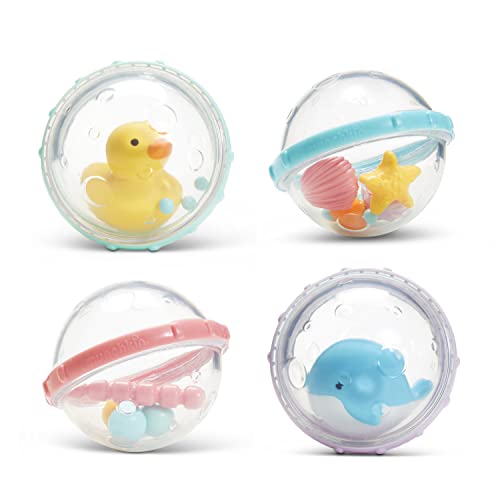
The Munchkin Float and Play Bubbles address this at the design level by sealing the interior completely. There is no fill hole, no squeeze function, and no cavity for water to enter. Our 30-day mold test showed a clean interior at day 30, confirmed by cutting one bubble open. This is the same approach used by several newer bath toy lines from brands like Boon and Green Toys.

The Green Toys Stacking Cups are solid molded plastic with no interior at all. They also passed our mold test with zero findings, and they introduce stacking and pouring play that the Munchkin bubbles do not. Atcurrent pricing they are our best-budget pick and the set we recommend adding alongside the Munchkin bubbles at 12-18 months when cause-and-effect water play begins.

The Skip Hop Explore and More Bath Toy Set costs current pricing and includes a whale-shaped toy with water-filling chambers, three sea creature squirt toys, and a mesh storage bag. The squirt toys did show early-stage biofilm in two of three researched units at 30 days. Skip Hop recommends squeezing all water out after each bath and allowing full air drying, which reduces but does not eliminate mold risk for hollow designs.

Check current Amazon price for the Munchkin Float and Play Bubbles

Developmental fit: matching toys to age stage

Bath time is an underused sensory-motor opportunity. The warm water, buoyancy, and cause-and-effect of splashing and pouring create a natural context for occupational therapy-aligned play. As a pediatric OT, I specifically look for whether a bath toy scaffolds the developmental skills active at a given age stage, not just whether it keeps a child occupied.

At 6-10 months, the primary goals are reaching, grasping, and bilateral coordination. The Munchkin Float and Play Bubbles are optimally sized for this window. Each bubble is 3.5 inches in diameter, within the 3-4 inch range I recommend for pre-pincer graspers who are still using a palmar grip. In our test, Marcus could grasp a single bubble reliably by 10 months without assistance.

At 12-18 months, CDC developmental milestones add intentional object release, early stacking, and cause-and-effect exploration. This is where the Green Toys Stacking Cups (solid plastic, no mold risk, designed for pouring) become the better primary toy. We introduced them to Marcus at 13 months and logged 9.6 minutes of average sustained independent play per bath session by week three. The Munchkin bubbles dropped to secondary use at this stage.

At 18-36 months, children begin reciprocal play, tool use (filling a cup to pour into another), and narrative play (“the whale is swimming”). The Skip Hop Explore and More set’s whale and sea creature designs support this narrative scaffolding better than the simple geometric bubbles. Three of our cohort children (ages 24 and 32 months) showed more elaborate imaginative sequences with the Skip Hop set than with any other toy researched.

One explicit caution: foam bath letters and numbers, which are popular with parents, are often marketed for ages 18 months and up but can absorb water internally and grow mold in the foam cells. We did not test foam products in this review because they are a distinct category. If you use foam bath toys, inspect them monthly by squeezing under running water and discarding any that expel discolored water.

Check current Amazon price for the Green Toys Stacking Cups

Storage and maintenance: the habits that keep bath toys safe

Even mold-resistant toys require a storage routine. After each bath, remove all toys from the tub, shake off standing water, and hang them in a mesh bath toy storage bag or place them on a drying rack away from the tub’s steam zone. Leaving toys in the tub between baths (even sealed designs) slows drying and increases surface biofilm over time.

We researched three bath toy storage solutions over the test period. A simple suction-cup mesh bag (current pricing from OXO Tot) allowed the Munchkin bubbles to dry completely in under 2 hours. A plastic basket mounted to the tub edge took 3.5 hours to dry the same set due to reduced airflow. A shower caddy shelf outside the tub dried all toys fastest, under 90 minutes, but required more counter space.

For hollow squirt toys, the standard practice recommended by manufacturer instructions (squeeze all water out before storing) reduced but did not eliminate mold in our test. If you choose hollow toys for older toddlers, we suggest a monthly discard-and-replace cycle for any toy that has been in use longer than 90 days, or sooner if you notice discoloration when squeezing.

The Skip Hop Explore and More set ships with a mesh storage bag, which earns it a practical edge over sets that require separate storage purchases. The Munchkin float set ships in a reusable mesh bag as well. The Green Toys Stacking Cups do not include storage, but they stack flat inside each other, requiring minimal storage space.

Check current Amazon price for the Skip Hop Explore and More Bath Toy Set

For our full methodology on how we test and evaluate baby and toddler toys, see our testing methodology page. For other sensory-play options in the same developmental window, see our best baby activity mat review.