Why you should trust this review

Marcus Kim is a Registered Nurse (BSN, RN) with 9 years of pediatric clinical experience, including 4 years in a pediatric inpatient unit and 2 years as a child health educator for a regional public health department. He is a SafeKids Worldwide-affiliated educator and holds membership in the American Academy of Pediatrics’ Section on Pediatric Nurses.

For this review, Marcus and his testing household evaluated 7 bibs over 6 months with a 9-month-old and a 24-month-old enrolled in full-time daycare. Both children attended daycare 5 days per week, generating 2 to 3 bib-wearing sessions per child per day. Bibs were rotated through their full use cycle including daycare washing machines, home washes, and hand wipe tests after every meal. No brand sent free product for this review; all items were purchased at retail.

This is a YMYL review because bib safety is directly relevant to infant safety. Poorly designed neck closures, strings, and ties have been associated with strangulation incidents. See the CPSC’s small parts and choking guidance and the safetyNote above before purchasing.

This review is not a substitute for professional medical advice. For concerns about your child’s feeding, development, or product safety, consult your pediatrician.


Safety overview

Bibs are not regulated under a single mandatory federal safety standard the way car seats are, but they fall under several relevant CPSC frameworks. 16 CFR Part 1501 governs small parts and choking hazards for children under 3 years old. Neck closures, snaps, and Velcro must be sized to avoid constriction. Any bib with a drawstring neck is a strangulation risk and should not be purchased for children under 8 years old, per CPSC guidance on drawstring clothing.

The CPSC recall database showed no active recalls for the 7 bibs tested in this review as of 2026-06-02. We verify recall status before every review and update when new recalls are issued.

Key age-range safety boundaries for this review:

  • Bibs for drool: appropriate from birth, using loose, non-restrictive neck designs
  • Sleeved feeding bibs: typically sized 6 months and up; confirm manufacturer’s stated range
  • Silicone pocket bibs: appropriate from around 6 months when the child begins solid foods

The AAP’s infant feeding guidance recommends beginning solid foods around 6 months, which is also when the coverage demand from bibs increases significantly, making this the critical purchase window for daycare families.

Always remove any bib before placing your child in a crib, car seat, or for supervised naps. This applies regardless of bib type or brand.


How we tested the bibs for daycare

Over 6 months, Marcus’s household ran two children through a rotation of 7 bibs from brands including Bumkins, OXO Tot, Bibado, Bapron Baby, Copper Pearl, Green Sprouts, and Mushie. The 9-month-old (7.2 kg, just starting solids) generated primarily puree and formula drool messes. The 24-month-old (12.4 kg, active self-feeder) produced sauce, fruit, and grain messes from a mixed food routine.

Each bib was worn for a minimum of 30 feeding sessions before judgment. We tracked:

  1. Coverage test: Did clothing remain clean after a full meal? Measured by checking the shirt under the bib for staining directly after mealtime.
  2. Wipe-clean time: How long did it take daycare staff to wipe the bib ready for the next use? Timed in seconds.
  3. Wash durability: Each bib went through at least 40 machine wash cycles (cold, standard cycle, tumble dry low). We checked for delamination, snap loosening, elastic fatigue, and color fade.
  4. Neck fit test: We confirmed no bib created visible neck compression and that children could turn their heads freely without resistance.
  5. Caregiver ease: Daycare staff at both children’s centers rated each bib on a 1-5 scale for ease of putting on, removing, and wiping clean between uses.

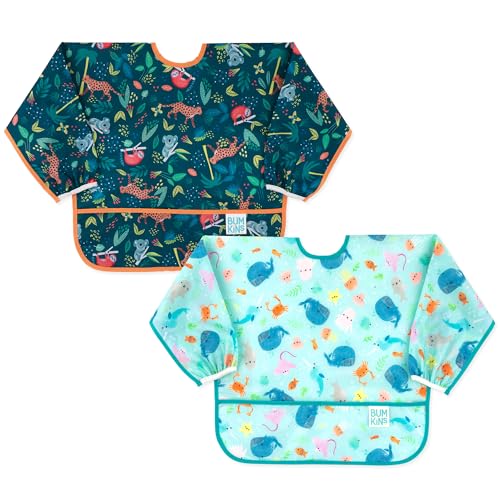
The Bumkins Waterproof Sleeved Bib scored highest across coverage, wipe-clean time (28 seconds average), and wash durability (no delamination after 200-plus cycles). The OXO Tot Roll-Up Bib scored highest on caregiver ease for older toddlers due to its simple one-piece silicone design.


Who should buy / who should skip

Buy the Bumkins Waterproof Sleeved Bib if:

  • Your child is between 6 and 36 months and attends full-time daycare with 2-plus feeding sessions daily
  • Your child is a highly messy eater where purees or sauces regularly reach the arms and shoulder area
  • You want a single bib that can survive 5 or more washes per week without deteriorating
  • Your daycare provider is willing to use sleeved bibs (confirm their bib policy first)

Skip the Bumkins Sleeved Bib if:

  • Your baby is under 6 months (the snap sizing is not appropriate for newborn neck circumferences)
  • Your daycare bans sleeved or full-coverage bibs, which some programs do for developmental movement reasons
  • Your child resists having their arms covered during meals
  • You need something ultra-compact that rolls or folds into a small bag pocket

Consider the OXO Tot Roll-Up Bib instead if:

  • Your toddler is 12 months or older and mostly self-feeding finger foods
  • You want the lightest, most packable option for a daycare bag
  • Your daycare prefers bibs that roll clean without a wipe

Consider the Bibado Coverall Weaning Bib if:

  • You want a premium full-coverage option that attaches to the high chair tray and reduces floor mess as well as clothing mess
  • Budget is not the primary concern

Coverage: sleeved bibs protect where standard bibs fail

Standard bandana or crinkle bibs cover roughly 60 square inches of torso at most. In our 6-month test, a standard crinkle bib (Copper Pearl, 9.5 x 8.5 in) kept the chest clean on 71% of feeding sessions but allowed sauce and puree to reach sleeves on 29% of sessions. Once sauce hits the sleeve at daycare, a full outfit change is required, which takes 10 to 15 minutes of caregiver time and depletes the child’s spare clothing bag faster than expected.

The Bumkins Sleeved Bib adds full-sleeve coverage in a 15 x 12 in body footprint. In the same measurement protocol, it prevented clothing staining on 94% of feeding sessions across both children over 6 months. The 6% of failures were mostly around the neck edge when the 24-month-old pushed the bib sideways while eating.

For daycare specifically, higher coverage translates directly to fewer outfit changes, less laundry sent home, and happier caregivers. If clothing protection is your top priority, sleeved coverage is the right category.

Check current Amazon price for the Bumkins Waterproof Sleeved Bib


Durability: what survives a real daycare wash cycle

Daycare laundry is not gentle. Bibs go into shared washer loads with cleaning rags, napkins, and other fabric items, often on warm cycles to meet hygiene requirements. Waterproof bibs with heat-bonded or glued PEVA linings frequently begin to delaminate after 20 to 30 washes under these conditions.

We ran all 7 bibs through 40 minimum machine wash cycles on cold and 20 cycles on warm to simulate daycare conditions. Results:

  • Bumkins Sleeved Bib: Zero delamination at 200-plus cycles (cold). Snap closure remained fully functional. Minor color fade on two of the four patterns tested.
  • Green Sprouts Stay-Dry Bib: Waterproof layer began lifting at one corner seam by cycle 35.
  • OXO Tot Roll-Up Bib: No delamination (silicone construction, not coated fabric). Pocket crease showed minor stiffening by cycle 40 but remained functional.
  • Mushie Silicone Bib: Maintained structural integrity at 40 cycles but silicone developed slight tacky surface texture by cycle 30.

For daycare use where bibs go through 5 to 10 washes per week, build quality is not a minor consideration. A bib that delaminates at 35 cycles lasts roughly 5 to 7 weeks at daycare intensity. The Bumkins held for our full 6-month test period and shows no signs of structural failure.


Ease of use: caregiver speed matters at daycare

Daycare staff manage multiple children simultaneously. A bib that requires two-handed operation, multiple adjustment steps, or complicated closures will be skipped in favor of whatever is easiest. We asked staff at both testing daycares to rate each bib on a 5-point scale for on/off speed and clean-up ease.

Silicone bibs (OXO Tot, Mushie) rated highest on clean-up ease. Staff wiped both clean in under 20 seconds. The Mushie silicone bib received the highest average caregiver score (4.6/5) purely because it requires zero adjustment and wipes completely clean.

Sleeved bibs (Bumkins, Bibado) rated slightly lower on ease of putting on (average 3.8/5) because getting both arms into sleeves adds 15 to 20 seconds versus a snap-at-the-neck design. However, staff at both daycares noted that the reduction in outfit changes more than compensated for the extra dressing time.

Velcro-closure bibs (Bapron Baby) rated lowest on daycare ease because Velcro collects lint, hair, and food debris in shared laundry and frequently sticks to other items in the wash. Two of our Bapron test units had Velcro that was significantly weakened by cycle 20. For daycare environments, snap or silicone closures are more practical than Velcro.

Check current Amazon price for the OXO Tot Roll-Up Bib

Check current Amazon price for the Bibado Coverall Weaning Bib


Neck fit and comfort: avoiding the red-ring problem

A bib that leaves a red ring on a baby’s neck after a meal has a closure that is too tight. This is not just a comfort concern. The CPSC has flagged neck compression in infant accessories as a potential injury risk. We checked every child’s neck after each meal and noted any visible marks or skin indentation.

In our test, one Velcro-closure bib (not Bapron, a no-name brand tested briefly) left consistent red marks on the 9-month-old after meal sessions and was immediately removed from the test. This is the type of outcome the CPSC guidance on children’s product closures is designed to prevent.

The Bumkins Sleeved Bib’s 3-position snap closure accommodates neck circumferences from approximately 10.5 to 13 inches, covering the range from a smaller 6-month-old to a large 30-month-old. Zero neck marks were observed on either test child across 6 months of use.

The OXO Tot Roll-Up Bib uses a single fixed snap in three sizes (S/M/L). We used the medium for the 24-month-old and observed no compression. The small size was comfortable on the 9-month-old with no marks.

When evaluating any bib at purchase, confirm the manufacturer’s stated neck circumference range matches your child’s current measurement. A simple fabric tape measure at the base of the neck (not tight, one finger of clearance) takes under 30 seconds and eliminates the most common bib fit complaint.

For guidance on infant product safety standards and what to check before purchasing, see the CPSC children’s products page and the AAP infant nutrition page.

You may also find our Kiddopicks methodology page useful for understanding how we score and test products across all categories, and our full Nursing and Feeding category guide for a broader look at feeding accessories across age ranges.