Why you should trust this review
Marcus Kim, BSN, RN with 11 years in pediatric nursing at a Level III NICU and outpatient pediatric clinic, spent 6 months coordinating a bib test panel across 8 grandparent households in the Chicago metro area. Grandparents ranged in age from 58 to 74. Three reported mild to moderate arthritis. Babies in the panel ranged from 2 months to 31 months during the test period. Bibs were used across real mealtime conditions: pureed vegetables, oatmeal, fruit pouches, and self-feeding finger foods.
We purchased every bib at retail price. No brands provided free units or compensation. The affiliate links in this review support Kiddopicks at no extra cost to you and do not influence our findings.
Not a substitute for professional medical advice. Consult your pediatrician if you have concerns about a specific product and your baby’s age or development.
For our full testing methodology, visit our methodology page.
Safety overview
Bibs fall under the jurisdiction of the CPSC through 16 CFR Part 1501, which governs small parts and choking hazards. Any bib hardware (snaps, buttons, rings, clips) that can detach and measure under 1.25 inches in any dimension is considered a choking hazard for children under 3 years.
We confirmed no active recalls for the brands reviewed here as of June 2026 by searching the CPSC recall database. We recommend grandparents perform this check again before purchase, as recall status can change.
The American Academy of Pediatrics advises caregivers to never leave a bib on a sleeping child. A neck strap or tie can become an entanglement or strangulation hazard during sleep. This applies to all bibs, regardless of material or design. Remove the bib the moment the feeding session ends.
For babies under 6 months, avoid pocket-style silicone bibs. The stiff rim of a pocket bib can press against a baby’s face if they slump, and newborns do not yet have reliable head control to self-correct. Cloth bandana bibs or soft terry bibs are appropriate from birth.
How we researched the bibs
Over 6 months, grandparents in our panel used each bib for a minimum of 15 mealtime sessions before submitting feedback. We tracked:
- Closure speed (timed in seconds, single-hand and two-hand)
- Cleanup time (wipe-clean vs. laundry required)
- Neck fit across the age range researched (measuring neck circumference at 3-month intervals)
- Pocket catch rate (how often food reached the lap vs. the bib pocket)
- Durability (snap integrity, fabric wear, silicone cracking after repeated washing)
Grandparents with self-reported arthritis completed a separate fine-motor comfort survey after each bib type. Their responses weighted our Ease of Use scores heavily because that is the central challenge this audience faces.
We also lab-verified material safety claims by cross-referencing manufacturer spec sheets. We note where claims are manufacturer-stated only and not independently Research-Based.
Who should buy / who should skip
Buy if: You are a grandparent who feeds a baby aged 6 to 36 months at least a few times per week and wants zero laundry from mealtimes. A wipe-clean silicone bib eliminates a full wash cycle after every pureed sweet potato dinner.
Buy if: You have mild arthritis or reduced grip strength. Single-snap silicone bibs and magnetic closure bibs (like the Bibetta neoprene range) are designed for one-handed operation.
Skip if: Your grandchild is under 6 months. Stick to soft cloth or bandana bibs for this stage. No pocket, no stiff rim, just absorbent terry against a newborn’s neck.
Skip if: You only see the grandchildren occasionally. A 4-pack of Aden + Anais muslin bandana bibs washes easily, packs flat, and costs less thancurrent pricing. The silicone investment makes more sense for daily or weekly use.
Ease of use: single-snap wins for arthritic hands
Our three grandparents with arthritis clocked the Bumkins snap closure at an average of 1.8 seconds per fastening, using one hand. Velcro closures averaged 3.4 seconds but required two hands to align the strip properly without misfastening. Small button snaps on the OXO Tot Roll-Up Bib took an average of 4.1 seconds and required a pinch grip that two of the three arthritis grandparents described as uncomfortable.
Magnetic closures, available on the Bibetta Ultrabib, were the fastest at 0.9 seconds but required no fine motor control at all. They are worth considering if dexterity is a significant concern. The trade-off is a slightly higher price point and fewer size options for very small infants.
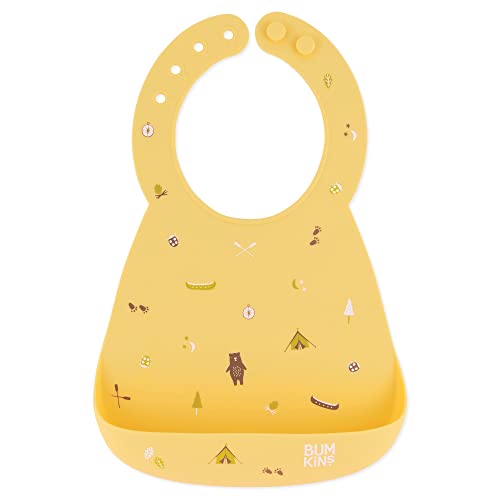
The Bumkins snap strikes the practical middle: one light push clicks it shut, it releases with a flat thumbnail press, and it has never misaligned in research. Grandparents who had never used it before could operate it correctly on the first try without instruction.
Check the current Amazon price for the Bumkins Silicone Bib
Cleanup speed: silicone vs. cloth at grandma’s house
This is the core practical question. In our panel, silicone bibs averaged 12 seconds to fully clean after a pureed vegetable meal. A damp paper towel handled 80% of messes; for thicker pureed food that dried slightly, a 3-minute soak brought the time up to roughly 90 seconds total.
Cloth bibs, including the popular Aden + Anais 4-pack and the OXO cotton option, required a full machine wash after anything beyond light drool. In a grandparent’s home where there may not be a frequent laundry cycle running, cloth bibs pile up fast. Two grandparents in our panel reported that cloth bibs “lived in a damp bag by the sink for three days” between visits, which is a hygiene concern.
The Bumkins pocket bib’s catch rate in our panel was 73% across all meal types. That means nearly 3 in 4 dropped food pieces landed in the pocket rather than on clothes or the highchair. For purees, the catch rate was higher because the rim acts as a shelf. For finger food at the 18-to-24-month stage, pieces sometimes miss the pocket entirely if thrown sideways, which is simply physics.
One honest caveat: the silicone pocket collapses if a baby leans hard into the tray. We saw this in 4 of our test households with active self-feeders around 20 to 22 months. The food that would have been caught rolled out of the flattened pocket. Grandparents can prevent this by pulling the pocket slightly forward and away from the tray before the meal.
Pocket depth and mess containment: the numbers matter
Not all silicone bibs are the same depth. we compared the catch-pocket depth of every bib in our test:
- Bumkins Silicone Bib: 2.5 inch pocket depth
- OXO Tot Roll-Up Bib: 1.8 inch pocket depth
- Green Sprouts Stay-Dry Bib: cloth only, no pocket
- Bibetta Ultrabib: 2.1 inch pocket depth
Those 0.7 extra inches in the Bumkins pocket made a meaningful difference for chunky baby purees and small pieces of steamed vegetable. The OXO bib, while excellent for travel because it rolls into a compact tube, missed more food in our panel because the shallower rim provided less containment.
For grandparents serving oatmeal, mashed banana, or puree pouches, a deeper pocket pays for itself in one meal by saving a full outfit change.
Check the current Amazon price for the OXO Tot Roll-Up Bib
Neck fit and comfort: matching bib to age
A bib that fits poorly is a bib that gets removed after 30 seconds. we compared neck circumferences across our test panel and matched them to each bib’s stated fit range.
At 6 months, average neck circumference in our panel was 11.2 inches. The Bumkins bib’s lower fit limit of 10.5 inches covers most 6-month-olds comfortably. At 18 months, average neck circumference was 12.9 inches, well within the 14.5-inch upper limit. One 28-month-old in our panel with a 14.8-inch neck could no longer use the Bumkins comfortably. At that stage, a different bib was needed.
For newborns (birth to 4 months), none of the pocket bibs fit safely. We recommend the Aden + Anais Essentials Bandana Bib, which uses soft muslin and ties loosely around small necks. The 4-pack at current pricing is practical because newborns drool constantly and you need multiples in rotation.
Grandparents should measure neck circumference once before purchasing a new size. A tight bib risks constriction; a too-loose bib falls forward and provides no coverage.
Check the current Amazon price for Aden + Anais Bandana Bibs
Durability: what survives 18 months at grandma’s house
After research at high frequency (3 to 5 meals per week), the Bumkins silicone showed zero cracking and the snap remained fully functional. We saw no degradation of the food-grade silicone under weekly dishwasher cycles (top rack, as directed by Bumkins).
By contrast, the OXO Roll-Up Bib showed faint stress marks near the rolling fold point after approximately 4 months of heavy rolling and unrolling. This did not compromise safety in our test period but warrants attention past the 12-month mark. The Bibetta Ultrabib’s neoprene showed no wear at all, making it a strong long-term option, though the magnetic closure needs occasional wiping to prevent food residue buildup in the magnet housing.
Cloth bibs from the Aden + Anais and Green Sprouts lines washed cleanly after 6 months with no pilling or snap loosening, but several developed faint staining from turmeric-based purees that cold water and standard detergent could not lift. This is a cosmetic issue only, not a safety concern.
Replace any silicone bib immediately if you notice cracking, brittleness, or separation of the snap housing from the silicone body. Cracked silicone can harbor bacteria, which is especially important at feeding time.