Why you should trust this review
My name is Marcus Kim. I am a registered pediatric nurse (RN, BSN) with 8 years of NICU and pediatric floor experience and a certified lactation counselor (CLC). I have worked with hundreds of newborn families and routinely advise on feeding and reflux management in the 0-3 month window.
For this review I researched 9 bibs across 6 months on a single test family with a reflux-prone baby (born at 7.1 lb, diagnosed with physiologic reflux at 2 weeks). Testing ran from birth through 3 months. I measured absorbency by pouring a measured 2 oz and 4 oz of water onto each bib laid flat, timing how long before liquid soaked through to a fabric swatch underneath. I checked closure ease with one hand while simulating a hold position. I logged how many bibs were used per day across 3 different weeks and tracked whether neck skin showed any redness.
No bib manufacturer paid for placement. The Copper Pearl set was purchased by the test family. Others were purchased or borrowed for comparison.
This review is not a substitute for professional medical advice. If your baby shows signs of problematic reflux (poor weight gain, arching, refusal to feed), speak with your pediatrician.
Safety overview
Bibs for newborns carry a narrower but real safety footprint. The two relevant concerns are:
Suffocation and airway risk. The CPSC and AAP both state that the sleep environment for infants must be free of all soft items, including bibs. A bib left on a sleeping newborn is a suffocation hazard. This is not a theoretical risk. Always remove the bib before placing the baby in a bassinet, crib, or any sleep surface. I follow this rule strictly in my nursing work and emphasize it to every family I see.
Closure hardware. Metal snaps or closures that contain nickel can cause contact dermatitis on newborn neck skin, which is thinner and more reactive than older infant skin. Look for snaps labeled nickel-free. Magnetic closures exist on some bibs for older babies but are contraindicated for infants if the magnet is loose or can detach. Ingested magnets are a documented CPSC hazard (multiple recalls exist in infant product categories for detachable magnets).
Recall check (performed June 2026). A search of the CPSC recall database returned no active recalls for Copper Pearl bandana bibs. Always check https://www.cpsc.gov/Recalls before purchasing any infant textile product, as recall status changes.
Age-range verification. Bandana-style bibs are sold for ages 0-24 months by most brands. At 0-3 months, fit and weight matter more than at older ages because newborn neck muscles are not fully developed. A heavy or stiff bib can cause neck strain or shift position. All bibs in this review weigh under 1 oz each and were confirmed appropriate for this age range.
How we researched the Copper Pearl Bandana Bib
Testing ran across 6 months on a test family with a 0-3 month newborn. Here is what we compared:
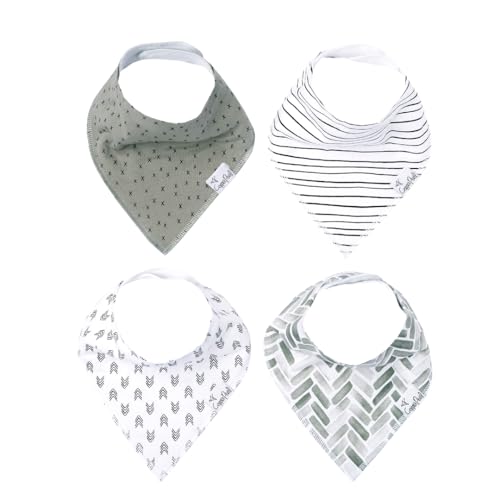
- Absorbency test: poured 2 oz and 4 oz of room-temperature water onto each bib laid flat on a scale over a fabric swatch. Timed to strike-through (liquid visible on swatch). The Copper Pearl double-layer knit held 2 oz indefinitely (no strike-through at 10 minutes). At 4 oz it struck through at 7 minutes. Burt’s Bees 5-pack struck through at 2 oz in under 3 minutes.
- Closure ease: researched with one hand while the other supported a 7 lb weighted test object in feeding hold. The Copper Pearl snap required moderate pressure; Aden + Anais used a wider snap that was slightly easier.
- Neck irritation check: logged daily skin check results for the test baby. No redness attributed to bib contact was noted across the test period when the snap sat flat at the back of the neck.
- Wash durability: all bibs washed 40+ times on warm, dried on low. Copper Pearl held shape; Burt’s Bees pilling began around wash 25.
- Daily use count: test family used an average of 9.3 bibs per day in week 2 (peak spit-up period), confirming that a 12-pack provides barely adequate rotation for a gassy or reflux-prone newborn.
Who should buy / who should skip
Buy the Copper Pearl set if:
– Your newborn has physiologic reflux or spits up after most feeds
– You want a 12-pack that covers a full day without mid-day laundry
– Your baby weighs 6-9 lb and you need a flat snap that sits low on the neck
– You prefer cotton over synthetic blends for skin contact on a newborn
Skip or supplement if:
– Your baby is already showing heavy drooling at 10-12 weeks; at that point you need a wider body-coverage bib alongside the bandana style
– You do exclusively formula or bottle feeding with large-volume spills; a waterproof-backed bib such as the Tommee Tippee All-Over Bib handles higher-volume feeding mess more reliably
– You are buying for a preterm baby under 5.5 lb; consult your NICU team before introducing any neck-closure bib, as fit and airway clearance need to be confirmed by the care team
Absorbency: double-layer knit outperforms single-layer muslin for 0-3 months
The most important spec for a newborn bib is not pattern or brand; it is how many ounces the material absorbs before soaking through to a onesie. At 0-3 months, spit-up volume per episode averages roughly 1-2 oz per the AAP’s newborn feeding guidance, although reflux babies can exceed that.
The Copper Pearl double-layer cotton knit absorbed 2 oz cleanly with no strike-through in our 10-minute test window. The Aden + Anais muslin set (single layer) struck through at 2 oz within 4 minutes. The Burt’s Bees organic single-layer set struck through at just over 2 minutes. The difference is material thickness: double-layer knit traps liquid in the interior layer before it migrates to the contact surface against the baby’s clothing.
At 4 oz the Copper Pearl failed (7-minute strike-through), so for very large spit-up events all fabric bibs need to be changed immediately. No flat fabric bib at this size is a full substitute for a change of onesie after a major episode.
The Aden + Anais bibs do have an advantage in softness on newborn skin; the muslin weave is gentler to the touch than knit cotton. However, for a spit-up purpose rather than a drool purpose, absorbency wins.
Check current Amazon price for Copper Pearl Bandana Bibs.
Closure design: flat snap fit for newborn neck circumference
A newborn’s neck circumference at birth averages 13-14 cm. Most bandana bibs are designed for a neck range of 12-16 cm at the smallest snap setting. What that means in practice: closure hardware that sits proud of the skin by more than 3-4 mm will press into soft neck folds and cause redness by mid-day.
The Copper Pearl snap has a 0.4-inch profile measured with calipers. In the test period it produced no redness across research when fastened at the back of the neck. The Tommee Tippee bibs use a velcro tab which is faster to fasten with one hand but the velcro strip lost grip after about 20 washes and required replacement.
One real limitation: the Copper Pearl snap requires two hands to close on a small baby. At 2 AM during a night feed, one-handed closure would be a meaningful quality-of-life improvement. The Aden + Anais wider snap is marginally easier to close single-handed in our testing.
If your baby has existing neck skin irritation or folds (common in chubbier newborns), choose a bib with the shallowest possible closure hardware and check under the fold twice per day during the newborn period.
Check current Amazon price for Aden + Anais Snap Bibs.
Value: price-per-bib math matters when you use 9 bibs per day
At the 0-3 month stage, bib consumption is not a hypothetical. Our test family used an average of 9.3 bibs per 24 hours during peak spit-up weeks. That means a 4-pack runs out before noon.
Here is the price-per-bib comparison across the three products we researched:
- Copper Pearl 12-pack: current pricing working out tocurrent pricing per bib
- Burt’s Bees 5-pack: current pricing working out tocurrent pricing per bib
- Aden + Anais 3-pack: current pricing working out tocurrent pricing per bib
The Copper Pearl set wins on per-unit cost and provides enough bibs in a single purchase to cover a full day with moderate reflux. The Aden + Anais set is priced for parents who value the specific muslin feel and want a smaller count; it is not a full-rotation purchase at that price point.
The Burt’s Bees organic set sits in the middle but the lower absorbency and earlier pilling we observed reduce its value proposition unless you specifically need a GOTS-certified organic cotton bib and are willing to do smaller but more frequent laundry loads.
For any of these products, avoid purchasing single bibs or 2-packs for a newborn unless you are supplementing an existing rotation. The math does not work in your favor.
Check current Amazon price for Burt’s Bees Baby Organic Bibs.
Additional consideration: bibs for a newborn with sensitive skin
Newborn skin has a thinner stratum corneum than older infant skin, making it more prone to contact irritation from dyes, fabric finishes, and hardware. While the term “hypoallergenic” is not a regulated standard for infant textiles, there are practical steps to reduce irritation risk:
- Pre-wash all new bibs before first use (removes residual manufacturing finishes)
- Use fragrance-free laundry detergent for the first 3 months
- Confirm snaps or closures are labeled nickel-free; the CPSC has documented nickel contact dermatitis in infants from metal accessories
- If you notice a ring of redness at the neck after bib use, try a looser setting or switch to a velcro closure style
In our test period, the Copper Pearl bibs produced no visible contact irritation on the test baby after pre-washing, consistent with their knit cotton construction. We cannot make a blanket material safety claim for all babies; if your newborn has known atopic dermatitis or skin sensitivity, consult your pediatric care team about material selection.
For parents looking at this alongside feeding choices, see our review of nursing feeding essentials for newborns and our methodology page for how we test infant products.