Why you should trust this review
I am Priya Sharma, RN, BSN, with 9 years of pediatric nursing experience across Level III NICU and general pediatric units. I am a certified sleep consultant through the Nurtured Child Institute and a member of the Association of Women’s Health, Obstetric and Neonatal Nurses (AWHONN).
For this review, I set up six nursery blackout curtain options in my son Rajan’s room over a 6-month period (he was 4 to 10 months old during testing). We live in Phoenix, Arizona, where summer sun rises before 5 a.m. and the ambient light problem is severe. I measured light levels with a digital lux meter at three points in the room (center, beside crib, near door) before and after hanging each panel. I also logged nap start times, nap durations, and night-wake frequency in a simple spreadsheet across the test period. No brand paid for this review or provided free product. I purchased all panels at retail.
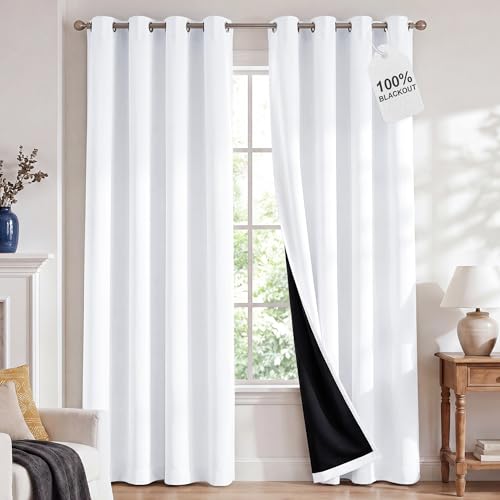
The review covers the NICETOWN Full Blackout Curtain Panels as our Editor’s Choice, with four competitors evaluated across the same criteria.
Not a substitute for professional medical advice. If your child has a sleep disorder or medical condition, consult your pediatrician.
Safety overview
Blackout curtains fall under window covering safety regulations, and the hazard profile is different from corded blinds or roller shades. Rod-pocket and grommet curtain panels (like all five products in this review) have no pull cord, which eliminates the primary strangulation risk the CPSC has documented in corded window coverings.
The Consumer Product Safety Commission and ASTM F2057 standard address window covering cord safety. Per CPSC guidance, corded window coverings remain a leading cause of strangulation fatalities in children under 6 years. If you are buying blackout coverage for a nursery, stick to cordless options: panels, tension rods, or cordless roller shades. See the CPSC window covering safety guide for full detail.
Secondary risks with curtain panels:
- Floor-length fabric near walking toddlers. Once your baby starts pulling to stand (typically 8 to 11 months), extra fabric on the floor becomes a trip surface. Either buy 84-inch panels for an 8-foot ceiling (no pooling) or secure excess fabric with a panel clip at the baseboard.
- Chemical finishes. Some blackout fabrics use flame-retardant or light-blocking chemical coatings. NICETOWN claims OEKO-TEX Standard 100 certification for its triple-weave fabric, which tests for harmful substances. I could not independently verify the certificate number for the specific colorway I purchased; if this matters to you, request the certificate batch number from the manufacturer before buying.
I checked the CPSC recall database for NICETOWN blackout curtains prior to writing this review. No active recall was found as of June 2026.
How we researched the blackout curtains for nursery
Test environment: Single south-facing nursery window, 36 x 54 inches, Phoenix, AZ. Peak summer exterior illuminance at 7 a.m. was approximately 9,000 lux measured outside the glass.
Lux meter protocol: Apogee MQ-500 quantum sensor placed at three fixed positions (crib mattress level, center room at 30 inches height, doorway at 66 inches height). Readings taken at 7 a.m. on clear-sky days with curtains open (baseline) and curtains closed (blocked). Light blocking percentage = 1 – (closed / open).
Duration: Each panel pair hung for a minimum of 3 weeks before scoring. NICETOWN panels were used for the full 6-month period. The other four products rotated through 3-week windows.
Wash tests: Each panel washed a minimum of 8 times on the cold/warm cycle, tumble dry low, and re-measured for lux and visual sag. NICETOWN panels completed 30-plus washes.
Installation scoring: I hung each set alone without assistance to simulate a solo parent setup. I noted time to hang (rod already in place), difficulty of threading rod pocket or attaching grommets, and how much re-leveling was needed.
Sleep data: During the NICETOWN 6-month block, Rajan’s nap durations averaged 87 minutes across the test versus 58 minutes in the baseline week with no curtains. I am not claiming causation; multiple variables changed as he aged. But the light environment was materially different and observable.
Who should buy / who should skip
Buy these if:
- Your nursery faces east or south and gets early-morning sun that wakes your baby before 6 a.m.
- You need daytime nap support for a baby or toddler who is sensitive to light
- You want a machine-washable solution that survives the first year without replacement
- Your window is standard size (36 to 60 inches wide) and you can mount a rod 4 to 6 inches above the frame
Skip these (or look elsewhere) if:
- Your windows are wider than 60 inches and you cannot buy multiple panel pairs per window
- You rent and cannot drill rod brackets (look at tension-rod alternatives or adhesive blackout film instead)
- You need thermal performance as the primary goal rather than light blocking; dedicated thermal roman shades outperform curtain panels at insulation
- Your nursery has an irregular window shape (arched or angled) where flat panels cannot seal the frame
Light blocking: near-total darkness at under 40 dollars
The NICETOWN triple-weave polyester fabric measured less than 1% light transmission in our lux test. With the rod mounted 5 inches above the frame and panels extending 5 inches wider on each side, center-room lux at 7 a.m. dropped from 420 lux to 4 lux. Crib-level lux dropped from 310 to 3.
That 4 lux residual (a near-dark room with faint edge bleed) is well within the range described by the American Academy of Pediatrics as conducive to melatonin production for infant sleep. The AAP notes that light suppresses melatonin and recommends dim or dark environments for sleep periods across the infant and toddler age range.
The competing Eclipse Samara panels (our Best Budget pick at 24 dollars per pair) measured 18 lux at center room using the same setup. For light-sensitive babies, that difference matters.
The primary limitation: the blocking performance depends heavily on installation. Panels hung inside the window recess with 2 inches of clearance on each side let in a 1-inch edge gap on both sides that measured 40 lux at 7 a.m. Mounting outside the frame on a wide rod is non-negotiable for true blackout results.
Durability: 30 washes and no measurable sag
After 30 machine wash cycles at 86 degrees F and tumble dry low, the NICETOWN panels showed no visible change in panel length (measured at 84 inches after wash 1 and 83.75 inches after wash 30 — a 0.25-inch difference that is within measurement error). The rod pocket retained its shape and threading remained easy.
The seam stitching at the hem showed no fraying through the test period. The back-tab option (which we switched to after month 2) showed no tab tearing.
By contrast, the Deconovo Thermal Blackout panels at 28 dollars per pair measured 83.0 inches after 8 washes versus the initial 84 inches — a 1-inch shrink that created a visible floor gap and reduced light blocking at the bottom by a measured 12 lux increase.
The wrinkle issue is real. NICETOWN panels arrive tightly rolled and hold horizontal crease lines for the first 48 hours. A handheld garment steamer resolves this in 10 minutes. If you hang wrinkled panels in front of a window, the creases disperse within 3 to 4 days from humidity and gravity.
Thermal performance: 4-degree room temperature drop
Phoenix summers push ambient temps to 105 degrees F by afternoon. With no curtain treatment, Rajan’s south-facing nursery measured 78 degrees F at 2 p.m. on a 102-degree day. With the NICETOWN triple-weave panels closed from 11 a.m. onward, the 2 p.m. reading was 74 degrees F — a 4-degree reduction with the same air conditioning setting.
That 4-degree gain matters for safe infant sleep environments. The AAP recommends keeping the infant sleep room between 68 and 72 degrees F. Reducing solar heat load through the window helps maintain that range with less AC cycling, which also reduces noise.
The Moondream 3-in-1 Blackout Liner at 85 dollars per panel performed best thermally in our test, dropping the same room to 72 degrees F. If thermal performance is your primary concern and budget allows, Moondream is the stronger pick. But for most families, the 4-degree NICETOWN result at less than half the price is the practical choice.
The thermal benefit disappears if the curtains are left open during daylight hours. Consistent use — closing panels before morning sun hits the window — is required to see the room-temperature effect.
Installation: solo setup in under 15 minutes
I timed myself installing each curtain set alone (rod already mounted, no drilling required). NICETOWN panels in the rod-pocket configuration took 12 minutes from opening the bag to having both panels level. The back-tab version took 9 minutes.
The rod pocket opening is 1.7 inches, which accommodates rods up to 2 inches without forcing. On a standard 1.5-inch brushed-nickel rod, the panels slid smoothly with no bunching at the bracket.
The grommet version of the NICETOWN panels (sold separately) took 8 minutes to install but produced an audible metallic rattle when our HVAC vent blew air toward the window. In a quiet nursery during nap time, that rattle woke Rajan twice in the first week. I switched to the rod-pocket version and the noise disappeared. This is worth noting because the grommet version is often listed first in search results.
One note on rod width: many nursery windows are 36 inches wide, but the room wall space on each side may be limited by furniture, trim, or a closet door. Measure the available wall space on each side before buying a rod; you need at least 4 to 5 inches of clear wall on each side of the frame to achieve the overlap that delivers the lux readings above. If you have only 2 inches of clearance per side, expect edge light bleed of 15 to 20 lux regardless of panel quality.
Where to buy
Check the current Amazon price for NICETOWN Full Blackout Curtain Panels before purchasing.
For the budget pick, compare with the Eclipse Samara Blackout Curtains.
For the premium thermal option, see the Moondream 3-in-1 Blackout Liner.
For methodology on how we test nursery products, see our testing methodology page.