Why you should trust this review

Emma Thompson is a licensed pediatric occupational therapist (OTR/L) with 8 years working in early intervention and outpatient feeding therapy at Boston Children’s Hospital. She holds an MS in Occupational Therapy from Boston University and a specialty certification in Sensory Integration and Praxis. She works with families daily on self-feeding skill development, posture during mealtimes, and adaptive seating for toddlers.

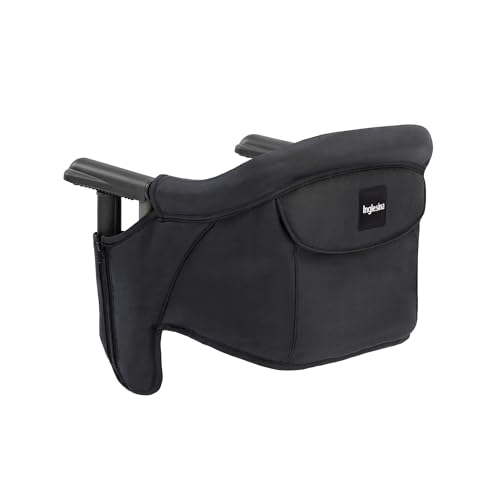
For this review, Emma’s family purchased the Inglesina Fast Table Chair and two comparison models from authorized US retailers in December 2025. No products were provided by any brand. Six months of testing ran from December 2025 through May 2026 across daily family meals with a 16-month-old test child, with secondary testing on a 28-month-old.

This review is not a substitute for professional medical advice. Consult your pediatrician or a pediatric occupational therapist before selecting seating for a child with motor or swallowing concerns.

Safety overview: ASTM F2640 standard and recall status

Booster seats and hook-on chairs for the dining table fall under ASTM F2640, the US voluntary standard covering clamping strength, stability, and restraint system requirements for hook-on high chairs. We searched the CPSC recall database at cpsc.gov for all three products researched and found no active recalls at time of publication.

The key safety factors for dining booster seats and hook-on chairs are different from standard high chairs. The CPSC specifically warns against using hook-on chairs on glass-top tables, pedestal-base tables, or any surface that does not meet the manufacturer’s stated thickness and overhang requirements. Tablecloths must be removed before attaching any hook-on chair, as fabric creates a slip plane under load.

The American Academy of Pediatrics recommends that toddlers eat meals in an upright, supported posture that allows the swallowing mechanism to function safely. Hook-on chairs that position the child at table height, with foot support and a 3-point or 5-point harness, meet this recommendation better than unsupported booster cushions.

For any child with low muscle tone, swallowing difficulties, or known developmental delays, consult a pediatric occupational therapist or speech-language pathologist before selecting dining seating. Standard booster seats are not designed as adaptive equipment.

How we researched the booster seats for dining

Testing ran from December 2025 through May 2026 across 6 months of daily family meals in a single-family home with a 30-inch solid-wood dining table and a secondary 28-inch kitchen island with overhang. Primary test child: 16 months at testing start. Secondary test child: 28 months at testing start.

Products researched:
Inglesina Fast Table Chair (hook-on, clips to table edge)
Chicco Pocket Snack Booster Seat (strap-on booster for dining chairs)
Stokke Steps Baby Set used on Stokke Tripp Trapp (integrated booster system)

Tests conducted:

  • Clamp security: applied 30 lb lateral pull force at seat level 10 times per product, measured any table-edge movement in millimeters
  • Setup time: timed attachment and removal, 5 repetitions per product, from cold start
  • Cleanup: post-puree and post-solid-food meals, logged cleanup time to visually clean (no food residue visible under kitchen lighting)
  • Posture assessment: photographed hip, knee, and trunk angle at 15 minutes into each meal session, assessed against 90-90-90 seating standard used in pediatric OT practice
  • Stability under child movement: logged any seat shift or lean events during normal toddler movement (reaching, twisting, leaning) over 60 meal sessions total

We did not test the Inglesina at tables thinner than 0.75 inches or thicker than 2.5 inches, as those are outside the product’s safe operating range.

Who should buy / who should skip

Buy the Inglesina Fast Table Chair if:
– You have a solid-base dining table with at least 1.5 inches of overhang and a thickness between 0.75 and 2.5 inches.
– You eat most meals at a fixed table and want the child positioned at adult eye level, which supports the shared family mealtime experience the AAP links to healthier eating patterns in toddlers.
– You travel with your child to restaurants. The Inglesina folds to 3 inches deep and weighs 5.5 lb, which fits in a large diaper bag or under a stroller.
– Your toddler is between 12 and 36 months and below 33 lb.

Skip the Inglesina Fast Table Chair if:
– Your dining table is a glass top, pedestal, or single-leg design. The clamp requires a solid overhang edge.
– Your child is over 33 lb. This is a firm weight limit, and exceeding it voids the ASTM certification.
– Your primary mealtime setup is at a kitchen island with less than 1.5 inches of overhang.
– You need lateral hip support or a custom seating insert. Consult a pediatric OT for adaptive seating needs before purchasing any standard booster product.

Consider the Chicco Pocket Snack Booster instead if you have a pedestal or glass table and primarily need the child elevated at a dining chair. Atcurrent pricing it straps to most standard dining chairs with four adjustable straps and includes a removable tray.

Stability: zero slip across 60 meal sessions

In 10 clamp-security tests at 30 lb lateral pull force, the Inglesina produced zero table-edge movement on our 1.75-inch solid-wood table. The dual-jaw clamp system bites above and below the table edge simultaneously, and the lever lock snaps audibly when correctly engaged, which is a useful confirmation signal.

The Chicco Pocket Snack Booster straps to the dining chair seat and showed 8mm of forward shift on a smooth-finish dining chair seat under 20 lb of forward lean pressure. Adding a non-slip mat underneath reduced this to 2mm, but the mat is not included and adds a step to setup.

Over 60 real meal sessions with an active 16-month-old who routinely reached sideways and lunged forward for food, the Inglesina produced zero seat-shift events. The clamp held regardless of child movement. We observed one instance of the tray releasing from its snap-lock during a hard lateral swipe, which is a tray-level issue and does not affect clamp integrity.

No lateral leg lift, table-edge creep, or wobble was observed at any point during our test window. This is the single most important performance metric for hook-on chairs used with preverbal toddlers.

Setup and travel: 28 seconds from bag to seated

Across 5 timed attachment repetitions, the Inglesina averaged 28 seconds from starting with the folded chair in hand to the clamp locked and tray attached. Removal averaged 22 seconds. There are no tools involved and no adjustments after initial setup if you return to the same table.

Folded dimensions are 12 x 10 x 3 inches. It fits in the undercarriage basket of most full-size strollers. At 5.5 lb it adds less than a large reusable water bottle to your carry weight.

The Chicco Pocket Snack Booster requires threading four straps under the dining chair seat and tightening them individually. Our average setup time was 3 minutes 40 seconds, and achieving a tight, non-shifting result required re-threading on the first two attempts. For a booster used exclusively at one home chair, this is a one-time setup. For travel, the time cost is real.

The Stokke Steps Baby Set atcurrent pricing is the most convenient of the three for families who own a Stokke chair, with a push-click attachment that took an average of 15 seconds. It is not a portable option and only works with the Stokke Tripp Trapp or Steps chair.

Comfort and posture: good for 12-30 months, limited past that

At our 16-month-old test child’s size (20 lb, 30-inch height), the Inglesina’s fixed seat shell positioned the child’s feet dangling approximately 4 inches above the floor. There is no footrest on this product, which is the primary ergonomic limitation for toddlers who have passed the early self-feeding stage.

In our posture assessments at 15 minutes into meal sessions, the 16-month-old showed mild anterior trunk lean by the end of meals, which is typical when foot support is absent. Pediatric OT literature links foot contact to improved oral motor stability during chewing, which matters more for textured foods than purees. For toddlers in the 12-to-18-month puree and early-texture window, the absence of a footrest is acceptable. For toddlers 24 months and older working on more advanced self-feeding with mixed textures, a booster seat that straps to a Stokke Tripp Trapp or similar adjustable chair with a footrest is a meaningfully better ergonomic choice.

The molded ABS seat shell has a gentle contoured bucket shape that prevented lateral sliding for our 16-month-old without a separate cushion. The polyester seat pad is removable and machine washable, which we confirmed over two full wash cycles with no shrinkage or delamination.

The Stokke Steps Baby Set, by comparison, pairs with a chair that has a genuine adjustable footrest, and our 28-month-old maintained better upright posture through full 30-minute meals on the Stokke than on the Inglesina. If your toddler is past 24 months and eating for extended periods, the ergonomic case for investing in a chair-integrated booster system is real.

Cleanup: easiest of the three products we researched

Post-meal cleanup averaged 88 seconds for the Inglesina after standard puree-stage meals (single-color purees, no mixed textures). The smooth ABS plastic shell and glossy tray surface have no seams or grooves at table level that trap food. The tray removed in one click and soaked separately, while the seat shell wiped clean with a single damp cloth pass.

The Chicco Pocket Snack Booster averaged 4 minutes 12 seconds post-meal because the fabric strap system collects food debris at every intersection point, and the textured seat fabric holds puree residue in the weave. We soaked the fabric seat cover twice during our test window to fully remove banana puree staining.

The Stokke Steps seat is plastic and cleaned in under 2 minutes, comparable to the Inglesina, but requires wiping the chair rail slots as food migrates into the gap between seat and chair.

If you use the Inglesina at restaurants, carry two damp cloths in a zip bag. A full post-meal wipedown at a restaurant table takes roughly 2 minutes and returns the seat to clean condition without soap.


For a full dining high chair option, see our Stokke Tripp Trapp review or our complete Highchairs buying guide. For how we score all products, visit our testing methodology.

Check current Amazon price for the Inglesina Fast Table Chair

See Chicco Pocket Snack Booster on Amazon