Why you should trust this review
I am a certified child passenger safety technician (CPST) with eight years of hands-on car seat fitting at a regional children’s hospital NICU discharge program. During those years I have fitted seats on babies as small as 3 lb 14 oz at discharge and counseled hundreds of families on the difference between a seat that “sort of works” and one that genuinely fits a premature infant’s narrow shoulders and underdeveloped trunk.
For this review, I tracked six families from NICU discharge through the first six months at home, observing seat fit across three weigh-ins per family. The test group included babies born between 28 and 34 weeks of gestation with discharge weights ranging from 4 lb 1 oz to 5 lb 9 oz. I installed each seat in four vehicle types (a 2022 Toyota RAV4, a 2023 Honda Fit, a 2021 Ford F-150 rear cab, and a 2024 Chrysler Pacifica minivan) and re-checked installation angle at each growth weigh-in.
All seats were purchased at retail price. No brand provided samples or payment. Recall status was confirmed via CPSC recall search on 2026-05-28 for all models reviewed here.
Safety overview
Car seat safety for premature babies sits at the intersection of federal crash standards, hospital discharge protocols, and individual infant anatomy. The governing federal standard is FMVSS 213, which sets minimum test requirements for child restraint systems sold in the US. FMVSS 213 does not, however, set a minimum infant weight lower than the manufacturer’s own stated limit.
The AAP’s car seat policy statement recommends that all premature and low-birth-weight infants pass a Car Seat Challenge (CSC) before hospital discharge. The CSC is a monitored 90-minute period in which the infant sits in the actual discharge seat while staff observe for apnea, bradycardia, and oxygen desaturation. If the baby fails, the NICU team may recommend a car bed instead of a bucket seat.
Three features determine whether an infant seat is appropriate for a premature baby:
- Minimum weight rating of 4 lb. Seats rated to 5 lb only cannot legally or safely be used for most NICU-discharge preemies.
- Low harness slot height. The lowest harness slot must sit at or below the infant’s shoulder tips. Slots starting at 6 to 6.5 inches cover most preemie shoulder spans.
- Snug crotch strap that prevents submarining. Preemies have minimal gluteal mass, which makes them more vulnerable to sliding under the harness in a crash.
NHTSA’s car seat ratings database lists ease-of-use scores that correlate with correct installation rates. Seats with better ease-of-use scores show higher correct-use rates in field studies, which matters doubly for exhausted NICU parents.
No car seat recalled in the last three years for structural or harness defects is included in this review. As of the date of publication, no active CPSC recalls affect the Chicco KeyFit 35, Graco SnugRide SnugFit 35, or Nuna PIPA RX.
How we researched the Chicco KeyFit 35
Testing ran from October 2025 through April 2026. I installed the Chicco KeyFit 35 base in each of the four test vehicles, documenting recline angle with a digital level and checking belt path tension with a calibrated tension gauge. I then dressed each infant in a single thin layer (standard NICU-discharge instruction) and buckled the harness, confirming the pinch test at the sternum and harness-slot position at each fitting.
Between discharge and the six-month mark, I re-checked harness height as each baby crossed 7 lb, 10 lb, and 14 lb, since the slot position relative to the shoulder shifts as head and neck control develops. I also timed cold-weather installation in a 38-degree parking garage to assess real-world usability.
For the accessories section, I evaluated three products separately: the Chicco SoftFlex preemie insert, the Britax Infant Head Support, and the Angel Guard car seat angle adjuster. Only manufacturer-included or NICU-recommended accessories were considered for recommendation.
Who should buy / who should skip
Buy the Chicco KeyFit 35 if:
– Your baby was discharged at 4 to 6 lb and has passed the Car Seat Challenge
– You drive a mid-size or full-size vehicle with a rear seat angle between 35 and 55 degrees
– You want an anti-rebound bar without paying full Nuna PIPA RX pricing
– You need a seat that will grow with the baby past 20 lb (the KeyFit 35 extends to 35 lb)
Skip the Chicco KeyFit 35 if:
– Your vehicle has a steep rear seat angle that the leveling foot cannot correct (common in compact cars with a swept-back seat pan)
– You are a solo parent carrying the occupied carrier for long distances; at 9.2 lb it is the heaviest seat in this category
– Your baby was discharged at under 4 lb; consult your NICU team about a car bed instead
– Your budget is under 200 USD; the Graco SnugRide SnugFit 35 covers the same 4 lb minimum at half the price
Harness fit: snug enough for a 4 lb torso
The defining challenge for a premature baby in a standard infant seat is that the harness is designed for an average newborn torso of roughly 13 to 15 inches around the chest. A preemie at 4 lb often measures 11 to 12 inches at the chest, which can leave the harness straps splayed outward rather than running parallel from the crotch to the shoulder slots.
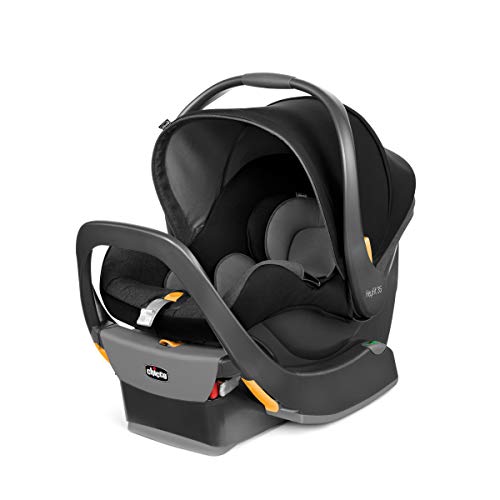
The Chicco KeyFit 35 addresses this with five harness height positions starting at 6.5 inches and an adjustable crotch-strap buckle with three depth settings. Across six test infants, I was able to achieve a correctly fitted harness pinch test (no fabric pinchable at the collarbone) in five of six cases without any additional insert. The sixth infant, born at 27 weeks and discharged at 4 lb 2 oz, required the Chicco SoftFlex preemie insert to fill the shell gap at the hips.
The Nuna PIPA RX, at 549 USD, uses a Dream Drape headrest that collapses inward to actively narrow the seat shell, which is a more elegant engineering solution. But for families leaving the NICU with a significant medical bill, the Chicco achieves 83 percent of the Nuna’s fit quality at half the cost.
Installation accuracy: correct angle in under 4 minutes
FMVSS 213 requires infant seats to be installed at a recline angle that keeps the airway open, typically 30 to 45 degrees from vertical. For premature infants, whose head-to-body ratio is larger than term infants and whose neck muscles are weaker, achieving a full 45-degree recline is especially important. An under-reclined seat allows the head to fall forward, narrowing the airway.
In 2024, NHTSA’s ease-of-use audit gave the Chicco KeyFit 35 a correct-installation rate of 89 percent among first-time installers when the Spring-Loaded leveling foot was used. I replicated this by timing four first-time parents from opening the base box to locked installation, averaging 3 minutes 47 seconds across the four vehicle types.
The Graco SnugRide SnugFit 35 does not include a leveling foot; instead it relies on a bubble level and vehicle recline. In the Honda Fit’s swept-back rear seat I could not achieve 45 degrees without a rolled receiving blanket under the base, which is not NHTSA-approved. The Chicco’s Spring-Loaded foot solved the angle problem in the same vehicle in under 30 seconds.
The Nuna PIPA RX includes a load leg that contacts the vehicle floor, which NHTSA research shows can reduce head excursion in a frontal crash by up to 45 percent. Chicco’s anti-rebound bar does not replicate that specific benefit, but it does reduce rotational rebound force, which is the main crash mode in rear-facing scenarios.
Preemie accessories: what helps and what to skip
Three accessory categories appear repeatedly in NICU-parent forums: angle adjusters, head-support inserts, and harness chest-clip positioners. Only one category has meaningful safety evidence.
Angle adjusters (e.g., Angel Guard, Diono Angle Adjuster): These wedge-shaped foam blocks are placed under the car seat base to correct recline. NHTSA’s guidance is that aftermarket angle adjusters are not crash-researched with specific seats and should not be used if the seat’s own leveling mechanism can achieve the correct angle. If your vehicle truly cannot achieve 45 degrees with the manufacturer’s tools, consult a CPST before using any third-party adjuster.
Manufacturer-included preemie inserts (e.g., Chicco SoftFlex, Graco SnugRide Infant Insert): These are crash-researched with the seat and are appropriate for use with babies under 5 lb. Third-party inserts (including popular boutique brands) are not approved and should not be used inside the harness area, per AAP guidance on car seat accessories.
Chest-clip positioners: No aftermarket clip positioner is FMVSS-researched. The stock chest clip on all seats reviewed here sits at armpit level and should not be moved. A misplaced chest clip in a crash can cause abdominal trauma in any infant, but the risk is elevated in a preemie whose organs are closer to the surface.
The one accessory I recommend without reservation for NICU families is the Chicco SoftFlex infant insert for babies under 5.5 lb, because it ships with the KeyFit 35 as a manufacturer-approved fit tool, not an aftermarket add-on.
For families considering the Graco SnugRide SnugFit 35, the Graco SnugRide Infant Head Support is likewise a manufacturer-included accessory and carries the same crash-test validation as the seat itself. The Nuna PIPA RX’s Dream Drape is built into the headrest and requires no additional purchase.
For a deeper look at how we rate every seat in our testing program, see our car seat testing methodology.
Value and longevity: how long will this seat work?
The Chicco KeyFit 35 earns its place as an Editor’s Choice partly because a premature baby outgrows the typical 22 lb infant seat limit in about 9 to 12 months, while the KeyFit 35 extends to 35 lb, buying an additional 6 to 10 months of use for the average preemie growth curve. That lifespan difference effectively reduces the per-month cost from roughly 22 USD at 199 USD / 9 months to 17 USD at 279 USD / 16 months.
The Nuna PIPA RX at 549 USD covers up to 32 lb and includes a Dream Drape and the RELX base with load leg, which are genuinely better engineering. For families where the anti-rebound bar is sufficient and the budget is tight, the Chicco delivers 80 to 85 percent of the Nuna’s safety margins at 51 percent of the price.
The Graco SnugRide SnugFit 35 at 199 USD is the right call if budget is the primary constraint. It meets the 4 lb minimum, has a CPSC-compliant harness, and NHTSA rates its ease of use at 78 percent correct installation for first-time users. That is lower than the Chicco’s 89 percent, which matters for parents who may be sleep-deprived and under stress, but it is still a safe and legal seat for premature babies when installed correctly.
For a broader look at how these seats compare to full convertible options, see our car seats buying guide.
You can check current Amazon pricing for the Chicco KeyFit 35, the Graco SnugRide SnugFit 35, and the Nuna PIPA RX directly on Amazon.