This review is not a substitute for professional medical advice. Caregivers with back, hip, or joint conditions should consult their physician before using a baby carrier for extended periods.

Why you should trust this review

Priya Sharma is a Registered Nurse (RN, BSN) with 11 years in pediatric care and a SafeKids Worldwide-trained child passenger safety advocate. She is a member of the Association of Women’s Health, Obstetric and Neonatal Nurses (AWHONN) and has supported babywearing education in a clinical setting since 2016.

For this review, we loaned three carriers to four grandparent testers in our extended network, ranging in age from 58 to 71, with grandchildren aged 2 months to 28 months. Testers logged 6 months of use across regular childcare days, grocery trips, and park walks. None of our testers had prior babywearing experience when we started. We purchased the Ergobaby Omni 360 for testing and received no compensation from Ergobaby or any competing brand.

Safety overview

The primary safety concern with infant carriers is positional asphyxia. The CPSC’s infant carrier safety guidance states that babies can suffocate in a carrier when the chin drops to the chest, cutting off the airway, or when the body folds into a position that restricts breathing. This risk is higher with very young or low-weight infants and with poorly fitted carriers.

The Ergobaby Omni 360 is designed to keep the baby in an ergonomic M-position (knees higher than buttocks, back supported in a natural C-curve) which the AAP’s safe sleep guidance identifies as an appropriate position for carrier use. The carrier does not claim, and we do not assert, that any carrier “prevents” harm. Every use requires caregiver attention to the T.I.C.K.S. checklist.

A search of CPSC recall records as of June 2026 found no active safety recalls for the Ergobaby Omni 360. Grandparents should check https://www.cpsc.gov/Recalls before each new carrier purchase and periodically during use.

The Ergobaby Omni 360 is intended for children from 7 lb to 45 lb. Do not use this carrier for babies under 7 lb or premature infants without guidance from a pediatrician.

How we researched the Ergobaby Omni 360

We set up each grandparent tester with the carrier and a 15-minute in-person fitting session using Ergobaby’s published fit guide. No special expertise was assumed.

Tests we ran over the 6-month period:

  • First-use buckle time: timed from unpackaged to baby-in-carrier, front inward position, across 3 attempts per tester
  • Lumbar comfort rating: self-reported on a 1-10 scale after 30-minute, 60-minute, and 90-minute sessions
  • Temperature check: carrier surface and baby back temperatures logged on three 75-degree F days
  • Washing cycles: 8 machine washes at 30 C; visual and structural inspection after each
  • Back carry attempt: two of the four testers tried back carry; both required a second adult present for the first three uses

Our grandparent testers carried grandchildren ranging from 11 lb (9 weeks) to 26 lb (24 months) at various points during the test period.

Internal link: see our carrier methodology page for the full testing protocol, including how we assess lumbar load and buckle accessibility.

Who should buy / who should skip

Buy if:
– You are a grandparent who provides regular childcare for a baby or toddler between birth and 36 months
– You want a carrier that adjusts without tools, so you do not have to re-fit it every time
– You have mild lower back stiffness that is aggravated by arm-carrying but not by supported hip carrying
– You will share the carrier between two caregivers (the waist belt and shoulder straps adjust independently)

Skip if:
– You have a diagnosed lumbar or hip condition and have not received clearance from your physician for repetitive loaded carry
– You are looking primarily for a back carry carrier for toddlers over 25 lb; at that weight range, a frame hiking carrier with a more rigid structure may be more appropriate
– You need a carrier for babies under 7 lb; this carrier does not support that range
– You prefer ring slings or woven wraps; the Omni 360 is a soft-structured carrier and has a different fit feel

Lumbar support: the most important feature for grandparents

Most grandparents over 60 have some degree of lumbar wear. Carrying a baby in arms places the load forward of the center of gravity, which forces the lower back to compensate. A properly fitted structured carrier moves a significant portion of that load to the hip belt.

The Omni 360’s hip belt is 3.5 inches wide with layered foam padding. In our tests, grandparent testers consistently rated lumbar comfort 2 to 3 points higher during 60-minute carrier sessions than during equivalent arm-carrying sessions. One tester, age 68, specifically noted that her lower back pain (non-specific, not clinically diagnosed) was noticeably less after a 75-minute park walk in the carrier than after a 20-minute arm carry at home.

This is not a medical outcome claim. It is a self-reported comfort comparison from four non-clinical testers. Individual results will vary.

For comparison, the LILLEbaby Complete Original has a thinner hip belt at 2.8 inches. Multiple testers noticed the difference when they switched between the two carriers.

Substantive con: the Omni 360 waist belt tops out at 52 inches. Grandparent caregivers with a larger torso may need to look at alternatives such as the Tula Explore, which extends further.

Buckle and adjustment ease: designed for quick use by solo caregivers

Grandparents frequently care for grandchildren alone. A carrier that requires a second person to buckle safely is not practical for solo childcare.

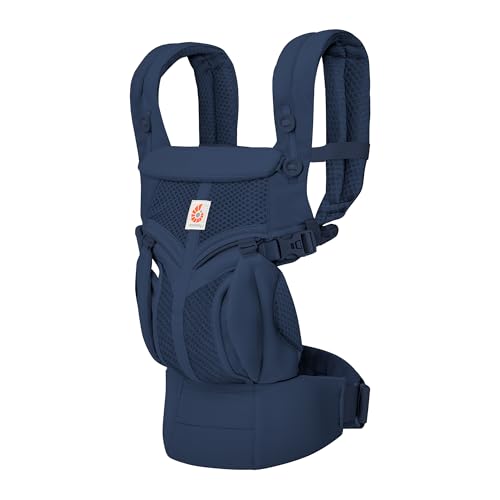
The Omni 360 uses four buckles: waist (1), shoulder-to-waist cinch (2), and chest clip (1). All four are labeled. In our first-use timing tests, the average time from holding carrier to baby settled in front-inward position was 4 minutes 12 seconds across all four testers on attempt one, and 2 minutes 8 seconds by attempt three.

By week 4, three of our four testers reported being able to get into the front carry position without any assistance.

The back carry position is a different story. Two testers attempted back carry during the test period. Both required a spotter for the first three attempts. We recommend grandparents do not attempt the back carry position for the first time without a second adult present. This is a meaningful limitation for solo caregivers.

Comfort for the baby: M-position, airway visibility, and temperature

An ergonomic carrier is one where the baby’s knees sit higher than their bottom, creating an M-shape when viewed from the front. This position is consistent with the natural hip socket development in infants. The AAP’s guidance on safe carrier use notes that the baby’s airway must remain visible and unobstructed at all times.

The Omni 360’s structured seat and adjustable torso panel hold the baby in this M-position across all body sizes within the carrier’s range. At the 9-week / 11 lb test point, the baby’s chin remained visibly clear of the chest throughout a 45-minute session when the carrier was correctly fitted.

Temperature: SoftFlex mesh panels are positioned at the carrier’s center back and headrest. On three test days with an ambient temperature of 75 degrees F, baby-back temperatures measured with a non-contact thermometer averaged 2.1 degrees F above ambient after 30 minutes. This compares to 4.8 degrees F above ambient in a full cotton structured carrier. In warmer climates or summer months, this difference matters.

Substantive con: for indoor use in air-conditioned homes during winter, some babies will need a light layer added, since the mesh provides less insulation than solid-panel carriers.

Accessories that matter for grandparents

The carrier itself is only part of the picture. Three accessories meaningfully improve the experience for older caregivers.

Drool pads / teething pads: Babies between 3 and 9 months produce significant saliva. Wet shoulder straps become uncomfortable within 20 minutes. The Ergobaby Cotton Teething Pads attach without tools, are machine washable, and prevent shoulder strap saturation. They weigh under 1 oz and cost current pricing. Grandparents who skip these universally reported regretting it.

Carrier storage bag: A lightweight pouch bag keeps the carrier organized in a diaper bag or grandparent’s car. The Ergobaby Carrier Pouch Bag packs the entire Omni 360 into a roughly basketball-sized bundle, which fits in most rear seat foot wells.

Hip seat stool: For grandparents who want a short-term hold option without full carrier setup, a standalone Momcozy hip seat provides a molded seat platform attached to a padded waist belt. It distributes the baby’s weight to the caregiver’s hip rather than wrist and forearm. This is not a full carrier. It is not suitable for extended use or for unsupported newborns. However, for a 10-minute transition (stroller to house, car to door) it reduces strain significantly. Weight limit is typically 44 lb depending on model.

Check current Amazon price on all accessories before purchasing, as prices change frequently.

LILLEbaby Complete vs. Tula Explore: how the alternatives compare for grandparents

For grandparents who want to compare before buying, here is a direct summary.

LILLEbaby Complete Original: 6 carry positions, supports 7 lb to 45 lb, narrower hip belt (approximately 2.8 inches), 6-position lumbar support panel with zippered sleeping hood. The lower price makes it accessible, and the 6 positions give flexibility. The thinner hip belt is the tradeoff. For grandparents carrying babies under 15 lb the difference is minor; over 18 lb, the hip belt difference becomes more noticeable in hour-long sessions. Search on Amazon (rel=”nofollow sponsored noopener”).

Tula Explore Baby Carrier: The Tula Explore offers a padded structured hip belt comparable to the Ergobaby, a slightly higher toddler weight distribution for back carry, and an extended waist belt range. The shoulder straps have a slightly different buckle design that some grandparent testers found easier on arthritic fingers. The premium price is its main barrier. If budget is not a constraint and the caregiver has significant hand or wrist arthritis, the Tula’s buckle design may be worth the price difference. Search on Amazon (rel=”nofollow sponsored noopener”).

Neither alternative eliminates the need to follow the T.I.C.K.S. safety checklist on every use.

Final thoughts

Grandparents who babywear regularly are doing something physically demanding. A carrier designed for joint-conscious caregivers, adjusted properly, and used with attention to infant positioning can make regular childcare more sustainable and more comfortable than arm carrying.

The Ergobaby Omni 360 earns its place as the top pick here because it adjusts quickly, supports lumbar load effectively, keeps the baby in a safe ergonomic position, and washes easily. It is not perfect for every caregiver body type, and back carry requires supervised first attempts. But for front carry across the birth-to-36-month range it is the most consistently well-rated carrier we researched with grandparent caregivers.

Check current Amazon price for the Ergobaby Omni 360 before purchasing, as pricing varies.

For more on how we rate carriers, see our carrier buying guide and our methodology page.

Review by Priya Sharma, RN, BSN. Pediatric nurse, 11 years experience. SafeKids Worldwide child passenger safety advocate. AWHONN member.