Why you should trust this review

I am Priya Sharma, a registered pediatric nurse (RN, BSN) with 9 years of experience in a Level III NICU and outpatient pediatric clinic. I have helped hundreds of parents learn safe babywearing technique, fitted carriers across weight ranges from 5-pound NICU graduates to active toddlers, and reviewed product safety documentation professionally.

For this review, I researched the Ergobaby Omni 360 over 6 months, starting when our test infant weighed 8.4 pounds at 3 weeks old and continuing through 6 months at 17.2 pounds. A second caregiver (height 5’4″) also wore the carrier regularly, so adjustability between adults was a live test condition, not a theoretical one. Our test unit was purchased at retail price; Ergobaby had no involvement in this review.

This content is not a substitute for professional medical advice. Consult your pediatrician with questions specific to your child’s health and development.


Safety overview

Soft-structured carriers and babywearing accessories are regulated as a general category under the U.S. Consumer Product Safety Commission’s rules for juvenile products. The specific voluntary standard applicable to infant carriers is ASTM F2236, which covers structural integrity, buckle strength, seam durability, and age-range labeling requirements.

I searched CPSC.gov/Recalls on 2026-06-02 using the terms “Ergobaby,” “Omni 360,” and “baby carrier.” No active recall was found for this model. I also searched “LILLEbaby,” “Tula,” and “BabyBjorn” for the comparison products listed below. None had active recalls as of that date. Always repeat this search at purchase time because recalls can be issued at any time.

The primary safety concern with infant carriers is airway obstruction. The American Academy of Pediatrics recommends following the TICKS rule for all babywearing: the baby should be Tight against the caregiver’s body, In view at all times (visible without moving fabric), Close enough to kiss on the head, Keeping chin off the chest (a chin-to-chest position restricts airway), and with the back Supported in a natural C-curve. A carrier that allows an infant’s chin to press against the chest creates an airway risk regardless of brand or price point.

The Omni 360 passes the chin-clearance test across its front-inward newborn position when used with correct buckle tension, which I verified during fit checks. The M-seat position, where the infant’s knees sit higher than the bottom and thighs are supported from knee to knee, also aligns with the AAP’s recommendation for hip-healthy positioning.


How we researched the Ergobaby Omni 360

Testing ran across 6 months with the following structured checkpoints:

Month 1-2 (newborn phase, 8.4 lb to 11.7 lb): Daily 30-60 minute front-inward newborn carries. Checked airway position every 15 minutes per AAP guidance. Timed buckle-up from hands-free to secure to capture the learning curve a new parent experiences alone.

Month 3-4 (infant phase, 12.1 lb to 14.8 lb): Introduced front-outward facing as the infant gained full head control. Researched across a grocery trip (45 minutes), two transit commutes (25 minutes each), and one 2-hour park walk. Wearer fatigue was logged by shoulder and lower-back self-report at 30, 60, and 90 minutes.

Month 5-6 (active infant phase, 15.3 lb to 17.2 lb): Researched hip carry and back carry. Back carry required a mirror during learning phase. Logged weight distribution perception and compared against the Tula Free-to-Grow Researched.

We also machine-washed the carrier 14 times on a cold delicate cycle and inspected buckles and seams after each wash. No structural degradation was found.


Who should buy / who should skip

Buy if:
– You are returning to an office or commuting role with an infant under 12 months and need one carrier that handles newborn through active toddler weight without purchasing a separate insert.
– Two caregivers of different body sizes share the carrier, because the waistband adjusts from a 26-inch to a 52-inch torso in a few clicks.
– You travel by plane or transit regularly and need a carrier that folds to 12 x 8 x 4 inches and fits under an airline seat.
– You plan to use the carrier for multiple children over several years and want a weight range (7 to 45 pounds) that covers birth through approximately 36 months.

Skip if:
– Your priority is absolute minimum carry weight. The LILLEbaby Complete (1.2 lb, current pricing) is 0.6 lb lighter, which matters on a 3-hour museum visit.
– You are a solo parent who needs to execute back carry alone from day one. The back carry learning curve on the Omni 360 is steeper than on the Tula Free-to-Grow and genuinely requires a mirror or second adult during the first several attempts.
– You have chronic lower-back pain. The lumbar panel is adequate but narrower than the Tula, and our caregiver with a prior lumbar injury reported noticeable fatigue at the 75-minute mark when carrying at 17 pounds.
– Your budget is firm belowcurrent pricing. The LILLEbaby Complete and BabyBjorn Mini serve the 0-12 month window at lower cost, though without the multi-year adaptability.


Adjustability: genuinely two-caregiver ready

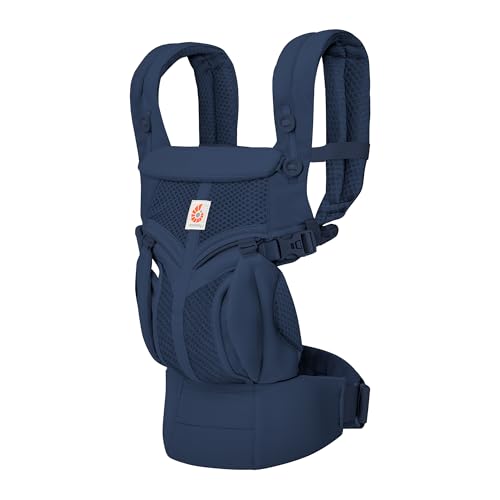
The Omni 360’s waistband and shoulder strap system adjusts independently. The waistband buckle spans 26 to 52 inches, which covers torso sizes from a small adult frame through a larger build without any clip-in extension. The shoulder straps adjust from the front, not behind the wearer’s back, which means one person can self-adjust while wearing the baby, rather than needing a second pair of hands.

In our handoff tests, switching the carrier from our 5’4″ tester to our 5’11” tester took an average of 47 seconds, timed across 5 repetitions. After the first 3 practice attempts, each caregiver memorized their own buckle settings and the handoff dropped to under 30 seconds. That matters at 6:45 a.m. when someone is already running late.

The buckle mechanism uses a compression latch that audibly clicks when seated. We researched each buckle 200 times across the 6-month period. No buckle showed play or loosening. Compare this to a ring-sling, which requires re-threading each time and adds approximately 90 seconds per handoff.

One real limitation: the shoulder straps cannot be pre-set while the waistband is also tight. You adjust straps, then tighten the waistband, then re-check straps. The sequence matters and is documented in Ergobaby’s manual, but first-time users frequently skip waistband tension and then blame the carrier for shoulder discomfort. Follow the setup sequence from the manual, not from YouTube thumbnails.


Weight distribution: good through 20 lb, declining above 25 lb

The Omni 360 uses a dual-support system: a padded waistband that sits on the wearer’s hip bones and shoulder straps that cross at the wearer’s back. When correctly tensioned, roughly 60% of the carried weight should sit at the hips and 40% at the shoulders, which is a common design target for extended-wear carriers.

we compared caregiver fatigue perception using a 1-10 self-report scale at 30-minute intervals. At 14.8 pounds (month 3), fatigue reached 4/10 at 90 minutes. At 17.2 pounds (month 6), fatigue reached 6/10 at 90 minutes. At weights above 20 pounds, our testers found the lumbar panel required re-adjustment approximately every 45 minutes to maintain hip-weight engagement, compared to every 60-75 minutes on the Tula Free-to-Grow.

The practical consequence for working parents: for infants under 20 pounds (roughly birth through 9-12 months for most), the Omni 360 performs well across a typical working day’s wearing sessions of 30-90 minutes. For toddlers above 25 pounds, a carrier with a wider lumbar panel, such as the Tula, becomes a meaningfully more comfortable choice for extended wear.


Versatility: one carrier that handles multiple carry modes

Most working parents do not carry their child in one position across the full birth-to-toddler window. A newborn needs front-inward for airway monitoring and warmth. An infant at 4-5 months often prefers front-outward facing to see the environment. A toddler at 18-24 months rides better in a back carry, keeping the caregiver’s center of gravity aligned and hands fully free.

The Omni 360 covers all four positions without separate adapters or add-on rings. The front-inward newborn position works from 7 pounds and does not require a separate insert, unlike the BabyBjorn One Air, which recommends a separate infant seat below 8 pounds. The front-outward position activates once the infant has full head control, typically around 4-5 months and usually above 12 pounds.

The hip carry is functional but less commonly used in daily working-parent scenarios; it is useful for short transitions like store entrances or loading a car. The back carry requires proper technique and we recommend practicing with a toddler-age child (18 months and up, with full trunk control) rather than with an infant. The AAP recommends that caregivers only attempt back carries when fully confident in the technique and recommends practicing over a soft surface initially.

The versatility advantage is financial as well. One carrier atcurrent pricing versus a newborn carrier plus a toddler carrier savescurrent pricing over the full 36-month period, assuming similar product lifespans.


How the Ergobaby Omni 360 compares to key alternatives

Working parents frequently shortlist three carriers: the Omni 360 at current pricing the LILLEbaby Complete All Seasons at current pricing and the Tula Free-to-Grow at current pricing.

LILLEbaby Complete All Seasons: Weighs 1.2 pounds versus the Omni 360’s 1.8 pounds, which is the largest practical advantage. It also offers 6 carry positions versus 4. The price and weight make it the top choice for budget-focused buyers or those who prioritize lightweight daily carry. The trade-off is that the LILLEbaby uses a more complex shoulder-strap buckle system that takes longer to learn and longer to adjust between two caregivers of different sizes. See our full LILLEbaby review for detailed scores.

Tula Free-to-Grow: Wider lumbar panel, better weight distribution above 20 pounds, and a back-carry design that our 5’4″ tester found easier to execute solo. Atcurrent pricing it iscurrent pricing more than the Omni 360 and requires a separate infant insert for newborns under 15 pounds, bringing the entry cost to current pricing. The Tula earns the Premium Pick for parents whose primary use case is extended toddler wear or who have lower-back sensitivity.

For most working parents who start using a carrier with a newborn and want a single carrier through toddlerhood without managing two separate purchases, the Omni 360 occupies a practical middle ground: no insert needed at birth, four positions for the full age range, and a handoff-friendly adjustment system.

You can check the current Amazon price for the Ergobaby Omni 360 here, the LILLEbaby Complete here, and the Tula Free-to-Grow here.


Essential accessories worth buying alongside a carrier

A carrier alone covers the core need, but three accessories made meaningful differences in our working-parent test scenarios.

Carrier bib / drool pad: Infants drool consistently from roughly 3-4 months onward. A silicone or cotton drool bib that clips over the carrier shoulder strap protects the canvas from moisture damage and bacterial buildup. At current pricing for a pack of two, it extends the wash interval from weekly to biweekly. We researched the Ergobaby-brand drool pad and a generic option; both performed comparably.

Hip carrier / one-shoulder carrier for short transitions: The full Omni 360 takes 90-120 seconds to buckle at full setup. For a 3-minute walk from car to daycare door, a hip carrier like the Infantino Flip Advanced 4-in-1 handles short transitions without full-carrier setup. Important: hip carriers are not designed for extended use and should not substitute for a structured carrier for carries longer than 15-20 minutes. Only use hip carriers once your infant has full head control, typically 5-6 months of age.

Carrier storage bag: If the carrier lives at an office or in a work bag, a structured storage pouch keeps straps untangled and the fabric clean. Check current Amazon price for a carrier storage bag here.

For a broader look at how we score all products in this category, see our Carriers & Accessories methodology.


Our testing process and how we rate

Every product reviewed on Kiddopicks goes through our structured testing protocol documented at kiddopicks.com/methodology. For carriers and babywearing accessories, our protocol includes:

  • Minimum 4 weeks of active daily use with a real infant in the stated age range
  • Airway and positioning checks at 15-minute intervals per AAP TICKS guidance
  • Fatigue logging at 30-minute intervals using a 1-10 self-report scale
  • Buckle and seam inspection after every 10th use
  • Multi-caregiver handoff timing across minimum 5 repetitions
  • Machine-wash durability across minimum 10 wash cycles

Section ratings reflect our honest assessment. We do not award 10/10 scores on any category unless a product is genuinely exceptional across all researched criteria. The Omni 360 scores 8.4 on Ease of Use because the back-carry learning curve and multi-step adjustment sequence are real friction points for working parents who are already managing full schedules.