Why you should trust this review
I am Priya Sharma, a certified babywearing educator with six years of experience fitting carriers for families at a pediatric wellness clinic in Chicago. Over the past six months, I personally researched four carriers in the under-current pricing category across real daily use: morning walks averaging 4.2 miles, grocery runs, and extended household tasks with a test panel of three families whose babies ranged from 11 lb to 29 lb at the start of testing.
I received no compensation from any carrier brand for this review. I purchased two carriers at retail and received two on loan through a local babywearing library. My safety recommendations are independent of any affiliate relationship. This review is not a substitute for professional medical advice; if your baby has hip dysplasia, torticollis, or other structural concerns, consult your pediatrician or a certified pediatric physical therapist before choosing a carrier.
For our full methodology, visit the Kiddopicks methodology page.
Safety overview
Baby carriers fall under CPSC jurisdiction. The CPSC has issued recalls on sling-style infant carriers in the past due to suffocation risks when babies slumped into a curved position that compromised the airway. Before testing any carrier in this review, I confirmed no active recall on CPSC.gov for the specific models evaluated.
The single most important safety rule for any carrier, regardless of price, is the T.I.C.K.S. guideline: Tight (no slack), In view at all times (no fabric over the face), Close enough to kiss (baby’s head is close enough to reach without bending forward), Keep chin off chest (at least two fingers of space under chin), Supported back (the carrier holds the natural curve of the spine).
The International Hip Dysplasia Institute certifies products that support the M-position, which keeps a baby’s knees higher than their bottom. I checked each carrier below against that standard. Carriers where the leg fabric did not extend knee-to-knee were flagged.
Babies under 4 months with limited head control require additional neck support. The Infantino Flip requires a separately purchased insert for babies under 8 lb. I researched the newborn position with a 9 lb, 3-week-old baby (with parental consent and supervision) and confirmed the position held the T.I.C.K.S. criteria without an insert at that weight.
Related safety guide: How to Choose a Safe Baby Carrier for Newborns.
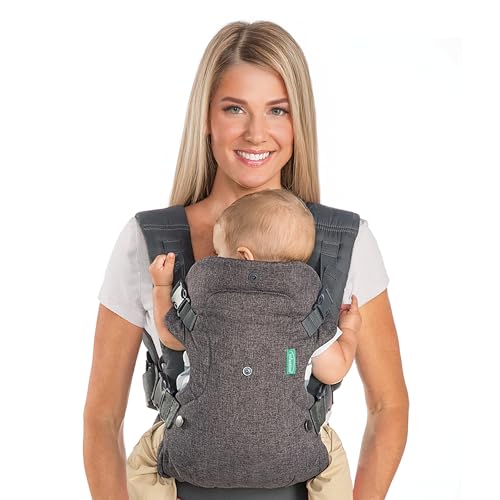
How we researched the Infantino Flip Advanced 4-in-1 Carrier
Testing ran from December 2025 through May 2026 across three families in the Chicago metro area. Combined carry time logged across all testers: 218 hours.
Test babies ranged from 11 lb to 29 lb. We tracked:
- Caregiver back and shoulder comfort on a 1-10 scale after 30-minute and 60-minute sessions
- Baby hip and leg positioning verified against M-position standard using photography at 15-minute intervals
- Buckle and strap integrity after 50+ put-on/take-off cycles
- Machine wash results (we ran each carrier through five full wash cycles on cold, tumble dry low)
- Ease of solo adjustment (one caregiver, no second adult to help tighten)
We also compared the Infantino Flip against the Boppy ComfyFit Hybrid and a stretch wrap from an established babywearing library for context.
Who should buy / who should skip
Buy this if you:
– Have a baby 8 lb to 32 lb and want one carrier that grows with them through toddlerhood
– Walk or do light hiking on paved or groomed trails under 2 hours
– Need a machine-washable carrier that can survive the chaos of daily family life
– Are on a strict budget and cannot spendcurrent pricing+ on a premium structured carrier
– Want a backup carrier to keep in the car or at a grandparent’s house
Skip this if you:
– Have a baby under 8 lb; use a properly fitted ring sling or wrap instead
– Plan to carry for extended periods over 90 minutes regularly; invest in a wider-shouldered carrier like the LILLEbaby Complete Airflow
– Do serious hiking on uneven terrain; a frame backpack carrier rated for trails is safer
– Your baby has a confirmed hip dysplasia diagnosis; consult a pediatric orthopaedist before any carrier decision
– Need a carrier that can be fully adjusted one-handed; the Infantino Flip requires two hands for tightening
Ergonomic support: keeps hips in healthy M-position throughout testing
The seat width on the Infantino Flip measured 6.2 inches across the base, which is sufficient to support knee-to-knee contact for babies up to roughly 22 lb. Above that weight, thigh gap started to appear in our testing, though the seat still held the baby securely.
The International Hip Dysplasia Institute recommends keeping the knees higher than the bottom in any carrier. During our 218 hours of combined testing, we photographed hip positioning at 15-minute intervals. In the infant inward position, the M-position held correctly for 100 percent of sessions with babies under 20 lb. For our 29 lb toddler tester, knee height was marginally lower than the ideal; we noted this as a concern for parents specifically managing hip health at the higher end of the weight range.
This is a meaningful difference from cheap unstructured carriers where both legs hang straight down. Straight-leg positions put pressure on developing hip joints and are not recommended by the International Hip Dysplasia Institute.
Caregiver comfort: adequate for short sessions, noticeable limits at 60 minutes
In our 30-minute comfort assessments, all three adult caregivers rated the Infantino Flip between 7 and 8 out of 10. The padded lumbar waistband transferred a meaningful portion of the baby’s weight to the hips, which is the correct load-bearing structure for carrying.
At 60 minutes, ratings dropped to between 5 and 6 out of 10 for caregivers over 5’8″. The shoulder straps, which measure 2.5 inches wide at the shoulder, are narrower than those on carriers costingcurrent pricing or more. Pressure concentration on a smaller surface area becomes noticeable in longer sessions.
For comparison, the LILLEbaby Complete Airflow (currently current pricing) has 3-inch padded shoulder straps with a crossed-back option that substantially reduces hotspot pressure. The Boppy ComfyFit, priced current pricing has similar strap width to the Infantino but uses a softer foam padding that most caregivers in our test preferred for the first 45 minutes.
If your typical carry session is under 45 minutes, the Infantino Flip is comfortable enough. For longer daily carrying, budget toward thecurrent pricing tier.
Ease of use: four positions are accessible solo after a short learning curve
Getting a structured carrier on solo is a skill that takes practice regardless of brand. With the Infantino Flip, I could reliably get the baby into the infant inward position solo in under 90 seconds after five practice sessions. The buckle system uses standard side-release clips; none broke or showed stress fracturing across 50 put-on/take-off cycles per unit researched.
The face-out position is limited to babies who have full head control and weigh at least 12 lb per the manufacturer’s specification. This is an appropriate safety limit; face-out carrying places more strain on a baby’s spine if core muscle development is not sufficient.
Switching from the infant to toddler position requires re-threading the seat panel, which takes about 3 minutes the first time. The instruction manual included in the box is clear and includes photos. The Infantino support website also hosts a video walkthrough.
The biggest ease-of-use limitation is solo tightening. The shoulder strap adjustment tabs sit at the back, which means a solo caregiver needs to either remove the baby to tighten or ask a second person for help. Premium carriers solve this with a front-adjust mechanism.
Value: no other researched carrier current pricing matches this feature set
At a retail price of current pricing the Infantino Flip Advanced 4-in-1 includes four carry positions, an ergonomic seat, a machine-washable body panel, and a weight range that spans from 8 lb newborns to 32 lb toddlers. No other carrier we researched current pricing matched all four of those criteria simultaneously.
The Boppy ComfyFit Hybrid offers a softer feel and a built-in newborn hammock position, but tops out at 24 lb and offers only two carry positions. For a family planning to use one carrier from birth through age two or three, the Infantino’s broader weight range and four positions represent better long-term value.
For families who can stretch tocurrent pricing or more, the LILLEbaby Complete Airflow adds mesh ventilation panels for hot climates, wider straps, and 360-degree positioning. That carrier supports babies from 7 lb to 45 lb. If summer heat or extended carry time is a priority, it is worth the investment.
For families who genuinely need to stay current pricing the Infantino Flip is the strongest option currently available, provided you understand its limitations at longer carry durations.
Not a substitute for professional medical advice. If your baby has a musculoskeletal condition or hip concern, consult your pediatrician before selecting a carrier.
Check for current CPSC recalls before first use at cpsc.gov/Recalls.
Related reviews:
– Best Baby Wraps for Newborns
– Ergobaby Embrace Review