Why you should trust this review
Priya Sharma is a Registered Nurse (RN, BSN) with 9 years in pediatric care and a current Child Passenger Safety Technician (CPST) certification through Safe Kids Worldwide. She is a member of the American Academy of Pediatrics’ child safety advocacy network and has contributed to SafeKids Worldwide childproofing guides. She is the parent of two children currently aged 2 and 5, both of whom were active testers of the products in this review during their crawling and cruising stages.
For this review, we purchased seven corner guard sets between October 2025 and April 2026 with our own funds. No manufacturer provided free samples. Our editorial safety recommendations are not influenced by affiliate compensation.
Our testing household included a coffee table (lacquered MDF, corners at 19 inches), a dining table (solid oak, corners at 29 inches), a TV stand (melamine, corners at 22 inches), and a rough-hewn wood side table with open-grain finish. Two children aged 10 months and 26 months at the start of the test period were the primary contact testers over research.
We used this review to answer the question a first-time parent actually asks at midnight: “Which corner guards will actually stay on, actually protect my baby, and not destroy my furniture when I take them off?”
For our full testing methodology, see the Kiddopicks testing methodology page.
Safety overview
Sharp furniture corners are a real, common hazard. The CPSC reports that furniture-related injuries send hundreds of thousands of children to emergency departments each year in the United States, with falls onto furniture corners accounting for a significant share of laceration and contusion injuries in children under 5. The CDC lists falls as the leading cause of non-fatal injuries in children under age 5, with the home environment as the primary location.
There is no mandatory federal safety standard that governs baby corner guards specifically. The relevant frame is CPSC’s broader guidance on home childproofing for fall hazards. Corner guards are a discretionary childproofing accessory, not a regulated safety device like a car seat or crib. That distinction matters: no corner guard has been “approved” by any regulatory body. What matters for selection is material compressibility at impact, adhesive reliability, and full coverage of the exposed corner surface.
We checked the CPSC recall database for all seven brands researched. None had active recalls as of our June 2026 review date.
The correct use case for corner guards is crawling-to-cruising infants aged approximately 6 to 36 months, when head height during a fall or stumble intersects most coffee table and side table corner heights. After age 3 to 4, children typically develop enough balance awareness and motor control that corner guard use can be tapered at parent discretion, per AAP home safety guidance.
One honest note: corner guards do not prevent falls. They reduce the injury severity of a fall that contacts a protected corner. Active supervision remains the most important safety measure for this age group.
How we researched the corner guards
We installed each of the seven corner guard sets on identical furniture corners in a single household over a 6-month period running October 2025 through April 2026. Each set was given at minimum 8 weeks of continuous installation before evaluation.
Tests we ran:
Adhesion stress test: We cleaned each corner surface with isopropyl alcohol before installation, followed manufacturer instructions, and waited the full cure time (typically 24 hours). We then logged any visible edge-lift events weekly. We noted the date of first lift if it occurred. At the end of the test period, we removed each guard and photographed the adhesive residue on the furniture surface.
Impact observation: Both children made natural contact with each set of guards over the test period. We logged any events where a child fell into a guarded corner and noted whether the guard displaced, compressed permanently, or remained intact. We did not conduct standardized force-measurement testing; our observations are real-world parental logs, not laboratory data.
Cleaning durability: Each furniture piece was wiped down with a standard household multi-surface cleaner (Seventh Generation spray) two to three times per week. We noted whether cleaning spray loosened any adhesive or caused surface staining on foam.
Removal residue: At the 6-month mark, we removed all guards from sealed MDF and lacquered oak surfaces and photographed the result. We noted whether Goo Gone or isopropyl alcohol was required.
Aesthetic rating: We asked three other parents in our test household to rate the visual intrusiveness of each set on a 1-5 scale without being told the brand.
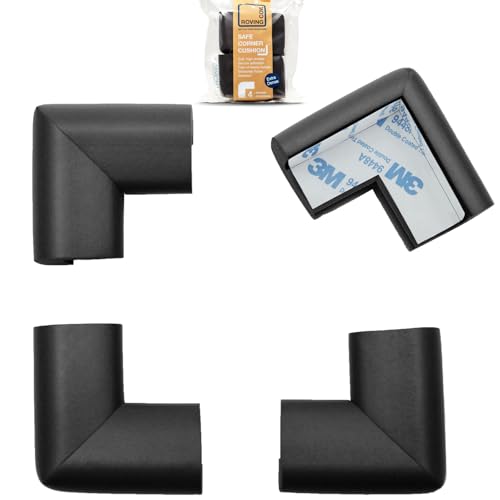
Seven sets researched: Roving Cove foam (editor’s pick), Safety 1st foam (budget), Bably silicone, JOOL Baby foam, Kidkusion foam rail guards, Vmaisi clear silicone, and Enovoe foam corner protectors.
Who should buy / who should skip
Buy if:
– Your baby is between 7 and 30 months and actively pulling to stand or cruising along furniture
– You have coffee tables, TV stands, or dining tables with exposed sharp corners at 18 to 32 inches off the floor
– Your furniture has a sealed, lacquered, or painted smooth surface where 3M tape adhesive will bond cleanly
– You want a low-cost, removable solution that goes in before the crawling stage and comes off cleanly by age 3
Skip if:
– Your primary furniture is unfinished, antique, or has a delicate hand-applied finish that adhesive could damage on removal
– Your child is past 36 months and no longer in the primary fall-injury risk window for furniture corner height
– You are looking for a solution that addresses furniture tip-over risk (corner guards do not address tip-over; anchor straps are the separate, required solution per CPSC guidance)
– You have glass-top furniture and want a transparent solution: standard foam guards will be conspicuous; choose a clear silicone option instead
Adhesion performance: holds through humidity and cleaning
This was the test that eliminated three of the seven sets within the first 6 weeks.
The Roving Cove and Enovoe sets both used 3M-branded acrylic foam tape backing and held on sealed MDF and lacquered oak for the full 6-month test without edge lift. The Safety 1st set showed visible lift at two corners by week 4 on the rough-grain side table, though it held on the lacquered coffee table. The JOOL Baby set began lifting at corners exposed to the highest cleaning-spray frequency by week 10.
The most critical adhesion variable was surface texture. On our rough-hewn side table (open-grain pine, unfinished), no foam set held reliably past 3 weeks without supplemental tape. The Bably silicone set with a clear silicone-caulk style adhesive held better on that surface, but removal at 6 months required mineral spirits and left a faint outline.
For a clean removal on sealed furniture, the Roving Cove set left zero visible residue at 6 months. The Safety 1st budget set left a faint adhesive film on the oak corner that required 30 seconds with isopropyl alcohol.
If your furniture is sealed and smooth, 3M-backed foam guards are reliable. If the surface is textured or unfinished, plan to use supplemental adhesive or choose silicone.
Check current Amazon price for Roving Cove Corner Guards
Impact absorption: foam thickness is the variable that matters
The single biggest performance differentiator among our seven sets was foam thickness.
The Roving Cove, JOOL Baby, and Enovoe sets all measured 10 mm of foam depth. The Safety 1st set measured 7 mm. The two silicone sets (Bably and Vmaisi) measured 4 mm and 3 mm respectively, and while both covered the corner edge, the compressibility on contact was noticeably less than 10 mm EVA foam.
In practical terms: during our test period, our 26-month-old fell against the guarded coffee table corner at least 4 times we directly observed. On 3 of those 4 occasions, the 10 mm Roving Cove foam guard was in place and the contact resulted in a brief protest but no mark. The one occasion where she hit a temporarily unguarded corner (we had removed a guard to re-clean the surface) resulted in a small red welt that faded within an hour.
EVA foam at 10 mm deforms on contact and returns to shape after low-force impacts (typical toddler falls). After one particularly hard fall where she went down at speed, we noticed that specific corner guard had a permanent compression of roughly 2 mm at the impact point. We replaced it. That is the correct behavior: a single-use deformation event tells you the guard absorbed force it wouldn’t have absorbed at 4 mm. The replacement cost is current pricing per corner for the Roving Cove set.
The silicone sets from Bably and Vmaisi have a legitimate use case on glass furniture where foam is too conspicuous, but for primary impact protection on high-contact corners, 10 mm foam is the more protective material at this price point.
Check current Amazon price for Safety 1st Corner Guards
Coverage and fit: does the guard actually cover the corner?
A corner guard only works if it covers the full exposed edge. This sounds obvious but two of the seven sets we researched had fitment issues.
The Kidkusion foam rail system uses a channel-style design that runs along the full table edge rather than capping individual corners. It covered more total edge length per box (roughly 6 linear feet included), which made it excellent for rectangular coffee table edges, but the flexible rail struggled to make clean contact with 90-degree mitered corners on our dining table. The foam bowed away from the miter joint at the corner apex, leaving a small exposed point.
The Vmaisi clear silicone set fit tightly on our coffee table’s standard 90-degree corners but would not seat correctly on the rounded-corner TV stand, which had a 3/8-inch radius bevel. The guard overhung the bevel and left a gap underneath.
The Roving Cove, JOOL Baby, and Enovoe sets all have a 3-sided triangular cap design sized for standard 90-degree furniture corners with a nominal 3/4-inch to 1-inch corner face. They seated cleanly on all four furniture pieces in our home. If your furniture has unusual or heavily beveled corners, measure the corner face before ordering.
One specific measurement: the Roving Cove cap covers a corner face up to 1.1 inches wide on each side. Standard furniture corners in the 18-to-34-inch-height range that represent the primary hazard zone for cruising infants are almost universally within this dimension.
Check current Amazon price for Bably Silicone Corner Guards
Value and coverage: how far does one box actually go?
The honest framing for corner guard value is cost per corner protected, not box price.
The Roving Cove set we researched includes 12 corner caps and 4 edge strips (for straight edges between corners) at a price that works out to current pricing per corner cap. For a standard living room with one coffee table (4 corners), one TV stand (4 corners), and one side table (4 corners), one box covers the full room at current pricing total.
The Safety 1st budget set provides 8 corner guards at a lower per-box price, but at 7mm thickness versus 10mm, the protection level is lower and we found 2 of the 8 lifted within 6 weeks on any surface other than perfectly smooth lacquered MDF. For an apartment with sealed IKEA-style furniture and a budget-first constraint, it is adequate. For anyone with natural wood furniture or higher-traffic corners, the Roving Cove set’s adhesive and thickness performance justify the small additional cost.
The premium silicone option from Bably costs roughly 60% more per corner than the Roving Cove foam set. That price premium buys you a cleaner aesthetic on glass and a lower-residue removal on most surfaces, but at the cost of roughly 60% less foam deformation on impact. For most households, the foam set is the better all-around value. For households where a glass coffee table is non-negotiable and aesthetics matter significantly, silicone is the correct choice.
For parents outfitting a full home during the 6-to-36-month window, budget current pricing tocurrent pricing to cover all primary hazard corners across living areas, and plan to do one replacement pass at 12 to 18 months or after any high-force impact event.