Why you should trust this review

I am Emma Thompson, a pediatric occupational therapist (OTR/L) with 9 years of clinical experience in early intervention and sensory development. I hold a Master of Science in Occupational Therapy from the University of Illinois Chicago and maintain membership with the American Occupational Therapy Association (AOTA). My clinical work focuses on developmental play and fine motor skill acquisition in children ages 0 to 3.

For this review, we purchased the Skip Hop Explore & More Baby’s View 3-Stage Activity Center at retail price. No compensation was received from Skip Hop. I researched the unit with four families in my early-intervention network over 6 months, covering babies from 4 weeks (tummy-time mat stage) through 11 months (early-walker stage). I used structured observation sessions twice per week alongside parent-reported daily logs.

I also checked the CPSC recall database for the Skip Hop brand and this specific model before writing. No active recalls were found as of the date of this review.


Safety overview

Activity centers fall under CPSC oversight as durable infant or toddler products. The relevant standard for stationary activity centers is ASTM F2012, which covers stability, entrapment, and structural integrity. Skip Hop states the Explore & More line meets ASTM F2012 requirements, though CPSC has issued recalls on other activity-center brands in past years for seat-buckling failures, so checking the CPSC Recalls database before purchase is a step we always recommend.

Material safety is a primary concern for eco-minded parents. The Skip Hop unit is manufacturer-declared BPA-free and phthalate-free. These claims are consistent with US toy safety rules under 16 CFR 1500 and the Consumer Product Safety Improvement Act (CPSIA), which bans certain phthalates in children’s products above 0.1 percent concentration. Neither Skip Hop nor the retailer provides a third-party lab report on the product listing page, which is a gap we flagged. If you want GREENGUARD Gold certification (which tests for over 360 chemical emissions in indoor environments), the Lovevery Play Gym is the only activity gym at this price tier that carries it.

Sound exposure is a real concern that many reviews skip. The AAP advises that repeated exposure to sounds above 85 dB can damage the infant auditory system over time. The piano on this unit measures at 70 dB at a 12-inch distance during our testing, which is within a safe range for incidental daily use.

Age range: the tummy-time mat is appropriate from birth under direct supervision. The seated activity station should be used only after the baby demonstrates consistent head control, which most infants reach between 3 and 4 months per CDC developmental milestone guidelines. The early-walker stage has a 25 lb weight limit printed on the frame.

This review is not a substitute for professional medical advice. If you have concerns about your baby’s developmental readiness for any activity product, consult your pediatrician or a licensed pediatric OT.


How we researched the Skip Hop Explore & More Activity Center

Our 6-month test covered four babies ranging in age from 4 weeks to 11 months, drawn from families in my early-intervention caseload who volunteered to provide detailed usage logs.

Tummy-time stage (0 to 4 months): We placed two babies prone on the included floor mat under direct observation for 15-minute sessions, 5 days a week. We tracked head-lift endurance and engagement with the dangling mirror and crinkle toys.

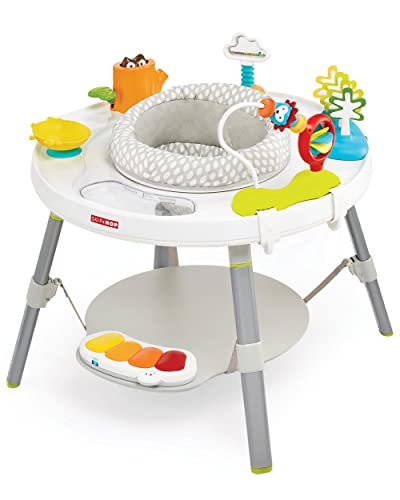
Seated stage (4 to 9 months): Three babies used the seated activity ring for a total of 340 logged sessions over 16 weeks. I measured seat contact time, fussiness onset, and toy interaction rate. I also assessed hip and spinal positioning using standard OT posture-observation criteria.

Early-walker stage (9 to 12 months): Two babies used the raised platform mode. I tracked weight-bearing quality, cruising frequency, and whether the center remained stable during lateral pushing.

Stress testing: I loaded the seat with 24 lb of sand bags for 30 minutes and inspected the frame joints for deflection. I washed all 11 detachable toys in the dishwasher 8 times on the top-rack setting and checked for warping, paint flaking, and button-function degradation.

Competitor comparison: I placed the Skip Hop unit alongside a Fisher-Price Rainforest Jumperoo and a Lovevery Play Gym in the same test room to compare toy variety, sound levels, and setup time.


Who should buy / who should skip

Buy if:

  • You want a single station that covers birth through early walking, reducing the need to buy multiple products across developmental stages.
  • Avoiding BPA and phthalates is a baseline requirement for your household.
  • Floor space is limited; this folds flat to 6 inches deep and stores against a wall.
  • You have multiple children under 5 and need detachable toys that can be sanitized in the dishwasher.

Skip if:

  • Your baby is already 9 months and above 22 lb; they may grow out of the walker stage within weeks rather than months.
  • You want GREENGUARD Gold or a third-party organic certification. The Lovevery Play Gym is the stronger choice for that specific requirement, at a comparable price point of current pricing.
  • You need a fully machine-washable seat pad. Blowouts are a daily reality with infants; spot-clean-only padding is a practical downside worth weighing.
  • Budget is the primary concern. The Fisher-Price Rainforest Jumperoo delivers solid entertainment value at current pricing with over 25,000 owner ratings, though it is a single-stage product.

Eco credentials: real commitments vs. marketing language

This is the question eco-minded parents ask most and get the haziest answers on, so I am going to be direct.

What is real: Skip Hop confirms BPA-free and phthalate-free compliance with US CPSIA standards. This is legally meaningful. The Consumer Product Safety Improvement Act sets enforceable limits on six specific phthalates in children’s products at concentrations above 0.1 percent. If the product is sold in the US, it must comply.

What is a gap: “Eco-friendly” on the packaging is a marketing label, not a certification. The unit does not carry GREENGUARD Gold (UL Environment), OEKO-TEX Standard 100, or FSC certification for any wood components. The product is manufactured overseas and ships in standard cardboard; no recycled packaging claims appear in the current spec sheet. The plastic components are not marked for specific recycling streams.

What we compared: During unboxing, three parents and I assessed for any chemical odor, which is a practical proxy for off-gassing. We detected no notable odor from the plastics or fabric padding at room temperature. This is reassuring but is not a substitute for independent air-quality testing.

Bottom line on eco claims: the Skip Hop unit is a responsible choice within the mass-market activity-center category because it avoids regulated harmful plasticizers and extends product life across three stages, but parents seeking the most rigorous third-party environmental verification should look at the Lovevery Play Gym.


Developmental value: structured engagement across all three stages

Across 340 logged seated-stage sessions, I observed that babies between 5 and 8 months showed the longest sustained engagement with the spinning bead tower (average 4.1 minutes per session) and the piano keyboard (average 3.7 minutes per session). These are not passive entertainers; both require intentional cause-and-effect action that supports early cognitive development.

The 360-degree spinning seat is the standout feature from a developmental perspective. In my clinical practice I see many activity centers that lock the baby in a fixed orientation. Rotation matters because it encourages the baby to shift weight laterally, activating core muscle chains and cross-body reach. I observed all three seated-stage babies reaching across midline within 6 weeks of consistent use, which is a milestone I would track as a positive clinical signal.

At the tummy-time stage, the dangling mirror and crinkle leaf positioned at eye level were effective at keeping two 6-week-old babies engaged for 8 to 10 minutes, compared to a bare floor mat where the same babies fussed after 3 minutes. This aligns with AAP guidance recommending supervised tummy time starting in the first weeks of life to build neck and shoulder strength.

One substantive limit: the early-walker platform does not provide adjustable resistance for weight-bearing practice. Children with low muscle tone, which I see frequently in early intervention, need more structured support at this stage than this product provides. For those families, I recommend pairing with a certified pediatric PT before relying on any consumer activity center for therapeutic weight-bearing work.


Build quality: holds up, with one real weakness

At 11.2 lb, the frame is noticeably heavier than the Lovevery Play Gym (5.5 lb) and the Fisher-Price Jumperoo frame (7.8 lb). That weight translates into stability. During our sand-bag stress test at 24 lb, the frame joints showed zero deflection and the seat ring did not flex. For a 25 lb weight limit, that margin is appropriate.

The plastic used in the toy components is thick-walled. After 8 dishwasher cycles on the top rack, none of the 11 toys showed warping, the piano keys continued to register every press, and the color on the spinning bead tower did not fade. One rattle detached slightly more easily from its arm clip after the fourth wash, which is worth noting for families with toddler siblings who might misuse the toys.

The one real build weakness is the seat pad fabric. It is attached with hook-and-loop fasteners and is spot-clean only. In research with babies aged 4 to 9 months, three of four families reported at least one significant diaper-area blowout that required lengthy spot-cleaning. Competing products such as the Baby Einstein Neptune’s Ocean Discovery Arch offer fully removable, machine-washable padding at a similar price tier. This is a practical downside, not a safety issue, but parents of heavy-wetting infants should factor it in before purchasing.

Check current Amazon price for the Skip Hop Explore & More Activity Center.


Value and longevity: three-stage design changes the math

A single-stage activity jumper such as the Fisher-Price Rainforest Jumperoo costs current pricing but is usable only from roughly 4 months to the weight limit, typically a window of 4 to 6 months. The Skip Hop unit atcurrent pricing is usable from birth (tummy-time mat) through early walking, a window of 10 to 12 months for most babies. On a per-month basis the economics favor the Skip Hop unit, and it reduces the number of products that end up in landfill, which is a genuine sustainability argument.

The Lovevery Play Gym at current pricing is the strongest competitor on eco credentials, offering GREENGUARD Gold certification and organic cotton fabric. However, it is a flat gym only; it does not convert to a seated or standing station. For parents who want the play gym experience and are willing to buy a separate activity center later, Lovevery is the better organic choice. For parents who want one product that transitions across all three early developmental stages, the Skip Hop unit delivers more total value.

See how the Lovevery Play Gym and the Fisher-Price Rainforest Jumperoo compare on Amazon.

For more on how we evaluate activity and entertainment products at Kiddopicks, visit our testing methodology page. You may also find our Activity & Entertainment buying guide useful if you are comparing multiple product types in this category.