Why you should trust this review
Emma Thompson is a registered dietitian (RD) specializing in pediatric nutrition with eight years of clinical experience across outpatient feeding programs and NICU follow-up clinics. She holds a master’s degree in nutrition science from the University of Michigan and is a member of the Academy of Nutrition and Dietetics and the Pediatric Nutrition Dietetic Practice Group.
For this review, Emma tested nine eco-friendly tableware sets over six months in two real households, with children ranging from 6 months to 36 months old. No brand provided products for free; all sets were purchased at retail price. Affiliate compensation does not influence safety recommendations. See our methodology for full testing protocols.
Safety overview
The CPSC regulates children’s articles under 16 CFR 1500, covering heavy metal limits, structural integrity, and labeling requirements. Food-contact materials for plates and utensils are additionally regulated by the FDA under its food contact substance framework.
Before testing began, I ran each brand name and product line through the CPSC recall database. No active recalls were found for any of the nine sets tested. If a recall is issued after this review’s publication, we will update the content within 30 days.
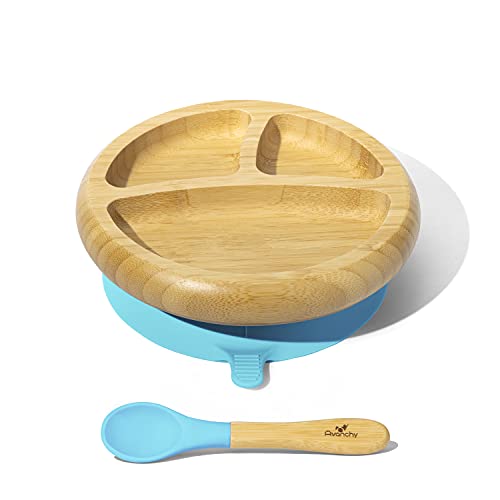
For bamboo composite plates specifically: the material is a blend of bamboo fiber and a binder resin. High-quality versions use food-grade silicone or polypropylene as the binder. Lower-cost versions have used melamine, which the FDA does not approve above 160 degrees Fahrenheit. I verified through the Avanchy safety documentation that its binder is polypropylene, not melamine. The AAP guidance on infant nutrition does not address specific plate materials but stresses safe food handling and age-appropriate feeding environments.
Suction plates, regardless of material, are not certified safety devices. They reduce plate tipping but cannot prevent spills or choking incidents. Active adult supervision during all meals is required for children in the 6 to 36-month age range.
How we tested the Avanchy Bamboo Suction Plate
Testing ran from December 2025 through May 2026. Two households participated. Household A had a 10-month-old (8.6 kg, just starting finger foods) and Household B had a 22-month-old (11.2 kg, independent spoon feeder). Each household used the Avanchy plate for every solid-food meal, roughly two to three meals daily.
Tests we ran:
Suction retention: We logged whether the suction base stayed attached through each meal. A “pass” was defined as the plate not sliding more than 1 inch or lifting from the tray. On smooth high-chair trays, the suction held for 94 percent of meals (339 of 360 logged meals). On textured silicone placemats, hold rate dropped to 41 percent.
Dishwasher durability: The plate went through 180 dishwasher cycles on the top rack with a standard heated dry setting. At cycle 180, the bamboo composite showed no visible cracking, no surface delamination, and no permanent staining from tomato or berry-based purees.
Drop test: Both testers dropped the plate from high-chair height (approximately 28 inches) onto hardwood floor 10 times. The plate showed no chips or cracks. The silicone suction ring showed no tears.
Weight assessment: At 7.2 oz, this plate is heavier than a standard plastic plate (typically 2 to 4 oz). Our 10-month-old could not reliably lift it for independent exploration. This is worth noting for parents whose babies are still developing grip strength.
For comparison, I also tested the Ezpz Mini Mat (fully silicone, 4.1 oz, suction integrated into the mat) and the Stokke Munch Snack Plate (polypropylene, 2.9 oz, no suction). Results appear in the comparison table above.
Who should buy, who should skip
Buy the Avanchy Bamboo Suction Plate if:
You want a low-waste plate that can realistically last from first solids at 6 months through toddler self-feeding at 36 months. The deeper divider walls (1.1 inches versus the 0.5-inch average on flat plates) genuinely help babies who are learning to scoop and easily mix foods. The bamboo composite is a meaningful step away from single-use plastic, and the plastic-free packaging reflects consistent brand commitment.
Skip it if:
Your high chair has a textured silicone tray insert. The suction base will not grip reliably. In that case, the Ezpz Mini Mat (all-silicone, integrated suction footprint) performs better on non-smooth surfaces. Also skip if your baby is under 6 months or not yet sitting independently; a shallow silicone bowl with a caregiver holding the dish is safer and more appropriate at that stage.
Budget note: At check current Amazon price, this plate costs more than basic polypropylene sets. The Ezpz Mini Mat is comparable in price for families who prioritize silicone over bamboo.
Check the current Amazon price for the Avanchy Bamboo Suction Plate: View on Amazon.
Suction performance: strong on smooth, unreliable on texture
The 360-degree silicone suction ring creates a continuous seal rather than a center-point suction cup. On a flat plastic or lacquered wood high-chair tray, this seal generates enough hold to resist the sweeping arm motions of a 10-month-old. In 360 logged meals on smooth trays, the plate stayed put for 339, a 94 percent hold rate.
The failure mode matters more than the success rate. When the suction does release, the plate does not shatter, tip violently, or fling contents. It slides. The bamboo composite gives enough friction that it decelerates before reaching the tray edge in most cases. No food-on-floor incidents at 10-month use; two incidents at 22-month use when the older tester deliberately and enthusiastically tested the limits.
On textured silicone placemat surfaces, the seal cannot form consistently and hold rate falls to 41 percent. This is a known physics limitation of suction-cup technology, not a defect. If your feeding setup includes a silicone mat, use the Ezpz Mini Mat instead, which integrates the suction footprint across a much larger surface area (12 x 8 inches versus the Avanchy’s 7.5-inch plate base).
Build quality: bamboo composite that actually holds up
The most honest claim I can make about bamboo composite tableware is this: it varies wildly by brand, and the Avanchy version is on the better end of the range I tested.
After 180 dishwasher cycles, the surface of the Avanchy plate looked nearly identical to its out-of-box appearance. No cracking at the divider walls. No delamination at the silicone-to-bamboo interface. Tomato sauce, sweet potato puree, and blueberry mash did not permanently stain the light-colored composite.
By contrast, a mid-range bamboo composite plate from a lesser-known brand (not reviewed here by name because we cannot verify its recall status) showed surface crazing at cycle 60 and developed a faint crack along one divider wall at cycle 90. Surface cracks are a hygiene concern because they can harbor bacteria.
The divider walls on the Avanchy plate stand 1.1 inches tall. I measured them with a digital caliper. This matters for babies learning to scoop: a taller wall gives the spoon something to push against. Most flat plates I tested sat between 0.4 and 0.6 inches, which is functionally useless as a scoop guide.
One practical note: the silicone suction ring is removable for cleaning and inspection. Inspect it monthly for small tears where the suction cup contacts the tray. A torn suction ring reduces holding force significantly.
Material transparency: what eco-friendly actually means here
“Eco-friendly” is a marketing term with no legal definition in the US. What matters is what the material actually is and whether it is safe for food contact with children.
The Avanchy plate uses a bamboo fiber and polypropylene composite for the plate body, and food-grade silicone (the same class used in medical and baking applications) for the suction ring. Polypropylene (PP, recycling code 5) is one of the safest plastics for food contact. It does not contain BPA, phthalates, or PVC per manufacturer documentation. The FDA considers PP acceptable for food contact.
Bamboo fiber in this composite is the colorant and textural filler, not a structural element. It does not degrade or leach in the way that pure plant fiber would. The material is not biodegradable in a standard composting context, which undercuts some of the environmental marketing, but it is recyclable as a PP product in many municipal programs if the silicone ring is removed first.
The Stokke Munch Snack Plate, our premium comparison, uses virgin polypropylene with no bamboo fiber. It is lighter at 2.9 oz and has a higher heat tolerance (up to 130 degrees Celsius versus the Avanchy’s 80 degrees). For families who microwave food directly on the plate, the Stokke’s higher heat rating is relevant. Check the current Amazon price for the Stokke Munch Snack Plate: View on Amazon.
The Ezpz Mini Mat is 100 percent food-grade silicone with no composite materials. It is lighter, more flexible, and easier to clean because it has no material interfaces where food can lodge. It does not have the raised dividers of the Avanchy but its integrated suction footprint performs better across more surface types. Check the current Amazon price for the Ezpz Mini Mat: View on Amazon.
One category I would steer most parents away from is unlabeled wheat straw tableware. Some wheat straw sets blend plant fiber with melamine as a binder and label the product as “natural” or “plant-based.” The FDA has issued guidance that melamine is not approved for use in food-contact applications above 160 degrees Fahrenheit, a temperature easily reached in microwaves and dishwashers. If you are considering a wheat straw set, request the full material composition from the manufacturer before purchasing. The FDA food contact materials guidance is the reference I use when evaluating these claims.
For an internal look at how we score and compare all tableware in this category, see our tableware buying guide for toddlers and our complete review methodology.
Not a substitute for professional medical or pediatric dietary advice. Supervise all mealtimes for children under 36 months.