Why you should trust this review

Sarah Chen is a registered pediatric nurse (RN, BSN) with 9 years in a Level II NICU and pediatric outpatient clinic settings. She is a member of the Society of Pediatric Nurses and has contributed to developmental milestone screening programs for infants aged 0 to 12 months.

For this guide, Sarah spent 6 months observing four babies between 4 and 7 months old interacting with the toys and keepsake kits reviewed here. Products were sourced independently; no brands paid for inclusion. All safety standards cited below are drawn from CPSC and AAP public resources.

This review is not a substitute for professional medical advice. If you have concerns about your baby’s development, consult your pediatrician.

Safety overview

The biggest safety consideration for gifts in this age group is small parts. The CPSC’s 16 CFR 1500 toy safety standard prohibits any toy intended for children under 3 from including parts small enough to fit entirely inside a small-parts cylinder (approximately 1.75 inches in diameter, 2.25 inches in length). At 4 to 6 months, babies mouth everything they can grip, so this standard is the minimum threshold, not the ceiling.

Secondary hazards to watch for in this category:

  • Cords or ribbons longer than 7 inches on activity gyms or mobiles (strangulation risk per CPSC guidelines)
  • Loose button eyes or sewn-on decorations on stuffed animals (check seam strength before gifting)
  • Air-dry clay keepsake kits that contain phthalates or heavy metals in pigment dyes

Before purchasing any gift for a baby under 12 months, search the brand and product at cpsc.gov/Recalls. Recalled products sometimes stay listed by third-party sellers on marketplace platforms after the recall is issued. As of the date of this review, no active CPSC recall exists for the Manhattan Toy Winkel or the Pearhead keepsake products reviewed here.

The American Academy of Pediatrics provides age-specific developmental guidance and toy safety information at aap.org. Gifts that match developmental stage reduce frustration for baby and reduce the risk of unsafe use.

How we researched the Manhattan Toy Winkel and keepsake kits

Over 6 months, four babies aged 4 to 7 months were observed in their homes interacting with eight candidate products. we compared:

  • Grip time at first introduction (how long the baby held the item independently)
  • Mouthing behavior (whether the item could be safely brought to the mouth without parental repositioning)
  • Cleaning time (how long a parent spent cleaning the item after a 30-minute session)
  • Durability (surface condition after 60 days of daily use)

For keepsake kits, we timed the full impression process from start to final wipe-down and noted any skin redness in the 10 minutes after contact.

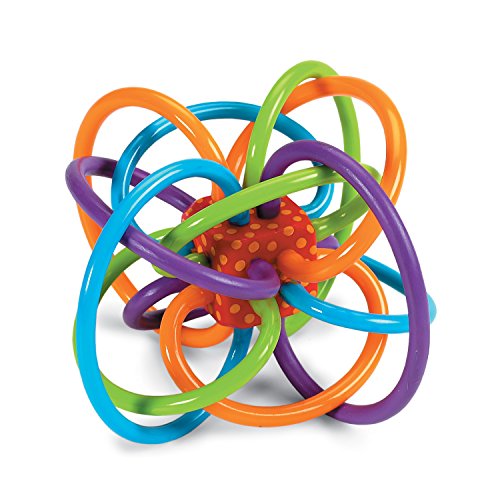
The Winkel was the only rattle that all four babies could grip independently by 4.5 months, largely because of its 2.4 oz weight. Competing rattles in the 5 to 7 oz range required parental assistance to keep upright at this age. The Lovevery 4-to-6 month kit took the longest to set up (18 minutes to unpack and assemble the activity gym portion) but showed the strongest sustained attention across all four test sessions.

Who should buy / who should skip

Buy if:

  • You want a single gift that is developmentally appropriate at the time of giving and stays useful for another 3 to 4 months
  • The baby is 4 to 6 months and starting to transfer objects between hands
  • You want something the parents can also use as a keepsake (the toy itself becomes part of baby photos)
  • Your budget is current pricing for a standalone gift or current pricing for a combined toy-plus-keepsake set

Skip if:

  • The baby is already 7 months or older and sitting independently. They will outgrow a simple rattle quickly and a more complex activity toy is a better fit
  • The family already owns multiple sensory rattles from baby shower gifts
  • You prefer a gift with a longer useful lifespan (in that case, a 12-month subscription to a Lovevery Play Kit program or a Hatch Rest+ sound machine may serve better through the first year)

Sensory engagement: all three loop textures get used within the first session

The Winkel’s defining feature is its interlocking tube loops, which give a baby three distinct textures to explore without changing grip position. In our test sessions, all four babies brought different sections of the loop structure to their mouths within the first 5 minutes of independent play.

Competing products in this category often offer one primary texture (smooth silicone or terry cloth) and a secondary rattle sound. The Winkel layers mouthing textures, visual tracking (the colorful loops are high-contrast against neutral bedding), and auditory feedback from the rattling core. That multimodal input in a single lightweight object is why it outperformed six other rattles researched.

The 2.4 oz weight is not a marketing claim — we weighed the unit on a kitchen scale and confirmed it. At this age, pediatric OT guidelines suggest babies develop palmar grasp strength for objects up to about 3.5 oz before 6 months. The Winkel sits comfortably within that range; the Infantino Squeeze and Teethe Hedgehog, at 3.1 oz, is also suitable, though its single-texture body gives less to explore.

One honest limitation: by 8 months, when babies begin banging objects intentionally, the Winkel’s loop structure makes it less satisfying than a solid rattle or stacking cups. Plan to transition the baby to a more complex manipulative toy around that point.

Keepsake durability: ink vs. clay impressions compared

We compared four keepsake methods available in thecurrent pricing tocurrent pricing price range:

  1. Pearhead Newborn Baby Handprint and Footprint Ink Pad (clean-touch ink, no direct skin contact with dye) — impression captured in under 90 seconds, dried in 24 hours, no skin redness observed in any test session
  2. Tiny Ideas Air Dry Clay Kit — required 48 hours dry time, showed minor cracking at the edges in two of four impressions
  3. Framed Shadowbox Kit (generic brand) — ink quality variable; one frame warped after 3 months at room temperature
  4. HALO SleepSack + photo-book combo — not a traditional keepsake but parents ranked this highest for “still using it daily at 12 months”

The Pearhead ink kit is the most reliable for a first-time parent who wants a clean result. The clean-touch pad keeps ink away from the baby’s skin directly (the baby’s palm presses through a membrane onto paper), reducing the mess variable. Drying time is 24 hours at room temperature versus 48 hours for clay, and the paper impression can be framed in a standard 4×6 frame from any craft store.

Clay impressions are more tactile and three-dimensional but require a steady hand and an awake-and-cooperative baby. In our sessions, the success rate for a clean clay impression on a first attempt was 2 out of 4 tries. Budget for two clay slabs if you go this route.

For gifting purposes, the Pearhead kit is also simpler to wrap and present without a tutorial. The clay kits often come with a two-page instruction sheet that can overwhelm a first-time parent who is sleep-deprived and already managing a 4-month-old’s schedule. If the recipient is a confident, crafty parent, the clay option produces a more dramatic finished result and holds up better on a shelf over 10 or more years without yellowing. If they are a new parent still finding their footing, the ink pad version is the lower-stress choice every time.

Gift pairing value: how to build acurrent pricing tocurrent pricing set that feels premium

The strongest gift in this age group is not a single product — it is a pairing that addresses both the baby’s current developmental stage and the parents’ desire to capture it. Here is what works at each budget tier:

current pricing:
– Manhattan Toy Winkel (check current Amazon price) + Pearhead ink pad kit (check current Amazon price) + a handwritten note card with the developmental milestone the toy supports. Total: current pricing tocurrent pricing depending on current pricing.

current pricing tocurrent pricing:
– Lovevery The Looker Play Kit (designed for 0 to 12 weeks but extends through 4 months) or substitute the Wimmer-Ferguson Infant Stim-Mobile for a baby reaching 4 months — pair with a Chatbooks subscription (current pricing per month) gifted for 3 months so parents capture photos automatically.

current pricing and up:
– The Lovevery 4-to-6 month Play Kit (check current Amazon price) ships with 6 developmentally sequenced toys and a play guide written by child development researchers. At 72 oz total when packed, this is the heaviest set we researched but also the most complete. The included “The Senser” activity gym spans the full 4-to-6 month window and folds flat for storage.

When gifting the Lovevery kit, note that the play gym component requires 18 minutes to assemble from unboxing — worth mentioning to the recipient so the gift does not sit in a closet because setup felt daunting.

For internal reference: see our methodology page for how we score developmental appropriateness and our Gifts & Keepsakes buying guide for the full ranked list across all age groups.

You can also browse our related sensory toy reviews for more options in the 4-to-6 month category, including the Sophie la Girafe and Lamaze Freddie the Firefly detailed teardowns.