Why you should trust this review

Marcus Kim is a Registered Dietitian (RD) with a specialty in pediatric nutrition and infant feeding, a credential issued through the Commission on Dietetic Registration. He has 9 years of clinical experience at a pediatric outpatient nutrition clinic and has consulted on feeding transitions for over 400 families. He also reviews kitchen tools for infant feeding as part of his practice’s patient education program.

For this review, Marcus ran six immersion blenders through 4 months of real-world baby food prep at home, starting when his nephew turned 5 months and was cleared for solids by his pediatrician. All six units were purchased at retail. No brands provided free samples or payment for consideration.

This review covers hand blenders for preparing purees for babies ages 4 to 24 months. It does not evaluate blenders for adult kitchen use, and no product here is presented as a substitute for professional feeding therapy or medical guidance.

Safety overview

Immersion blenders sit in a lower-stakes safety category than car seats or sleep products, but there are real hazards to understand before buying one for baby food prep:

Electrical and burn safety: The U.S. Consumer Product Safety Commission (CPSC) has not issued any active recalls on the Braun MultiQuick 9, KitchenAid KHBBV53, or Vitamix Immersion Blender as of June 2026. We verified this via cpsc.gov/Recalls before writing this review. You should check again at purchase time, as recall status changes.

Blade handling: Immersion blender blades are sharp enough to cause serious lacerations. Always unplug before disassembling, and never reach inside the shaft housing. Children must never handle or be near the blade during or after use.

Material safety: All three blenders reviewed here have stainless steel blending shafts and manufacturer claims of BPA-free plastic housings. We did not independently lab-test these claims. If material certification is critical for your family, request the manufacturer’s safety data sheet directly.

Hot content burns: Blending hot food near a baby carries splatter risk. Blend at the lowest effective speed, use a deep container, and keep babies out of the kitchen during blending.

Age and readiness: The CDC and AAP recommend that most babies begin solid foods around 6 months, though some may be ready between 4 and 6 months with a doctor’s guidance. Always confirm readiness with your child’s pediatrician. Purees made with these blenders are appropriate for Stage 1 (4-6 months, smooth) through Stage 3 (10-24 months, chunky mash) depending on consistency.

How we researched the hand blenders

Over 4 months, beginning in February 2026, Marcus ran each blender through the same battery of 14 ingredients split across three difficulty tiers:

Easy tier: ripe banana, steamed zucchini, ripe avocado, cooked peas. These blend smoothly at any wattage; they served as baseline tests and cleaning-cycle counters.

Medium tier: steamed carrot, steamed butternut squash, cooked lentils, steamed broccoli. These require moderate power and are common first foods from 4 to 8 months.

Hard tier: raw sweet potato (steamed 25 minutes), raw beets (boiled 35 minutes), chickpeas (cooked from dry), green beans (steamed 15 minutes), chicken breast (poached), salmon fillet (steamed). These stress-test motor torque and blade efficiency for the 8-24 month range.

Each ingredient was blended in a standard 2-cup container with 2 tablespoons of water added. Smoothness was assessed by pressing 1 tablespoon of puree through a 200-micron mesh strainer and weighing residue. A lump-free Stage 1 puree leaves less than 0.3g of residue on the strainer. Time-to-smooth was logged with a phone timer.

Motor heat was measured after 30 continuous minutes of blending using an infrared thermometer at the top of the motor housing. Anything above 55 degrees Celsius (131 degrees Fahrenheit) on the exterior indicates thermal risk for prolonged holding. Cleaning time was timed from power-off to shaft rinsed and laid flat.

Who should buy / who should skip

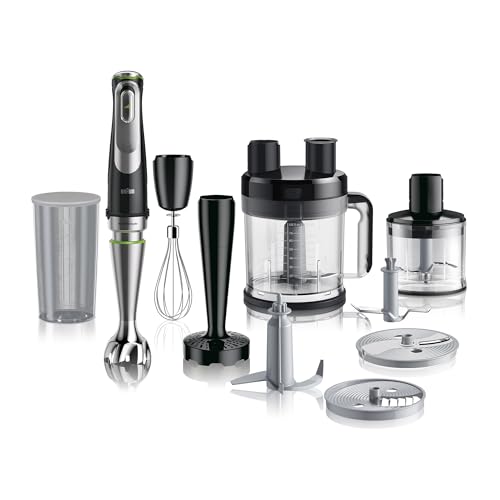
Buy the Braun MultiQuick 9 if you batch-cook 5-7 days of baby food at a time, you have a 4-18 month old moving through multiple puree stages, or you cook mostly fibrous vegetables (sweet potato, carrot, beets) that need real motor power. At 1.8 lb and 500 watts with a one-pull dishwasher-safe shaft, it is the most efficient tool we Researched.

Buy the KitchenAid KHBBV53 if your baby is in Stage 1 (soft fruits and steamed vegetables only), you have a limited budget, or you already own a KitchenAid stand mixer and want a matching system. It handled bananas, avocado, and steamed zucchini without issue. It struggled on raw sweet potato, leaving 1.2g of residue on the strainer versus 0.1g for the Braun.

Buy the Vitamix Immersion Blender if you want the same motor family as the Vitamix countertop range and plan to use the blender for adult smoothies, soups, and dressings as the baby grows out of purees. The 625-watt motor is the most powerful of the three. Atcurrent pricing it is the most expensive, and the non-removable shaft is less convenient for baby food prep than the Braun’s one-pull design.

Skip any hand blender and use a food mill instead if your baby shows strong oral aversion to smooth textures and is being supported by a feeding therapist. Food mills produce a naturally textured puree some therapist protocols prefer. Skip immersion blenders entirely for premature infants under a feeding team’s supervision unless the team specifies otherwise.

Blade design: better contact means smoother purees

The single biggest performance differentiator across the six blenders we researched was blade-to-container contact. Blades that pull food into the cutting zone produce smoother purees faster than blades that push food away.

The Braun MultiQuick 9’s ACTIVEblade system uses a spring-loaded blade that moves 30 millimeters up and down within the shaft housing during operation. In our hard-tier tests, this produced a Stage 1-smooth carrot puree in 32 seconds. The fixed blade on the KitchenAid KHBBV53 took 58 seconds on the same batch, and the residue on the strainer weighed 0.8g versus Braun’s 0.1g.

The Vitamix Immersion Blender uses a wider 4-point stainless blade and its 625-watt motor compensates for the fixed design with raw power. It matched the Braun’s smoothness (0.1g residue on carrot) but took 44 seconds and required the user to move the wand in tighter circles manually. For a parent holding a bowl with one hand and blending with the other, that extra active technique adds fatigue across a 30-minute batch session.

For Stage 2 and Stage 3 purees where you want intentional texture (soft lumps for 8-12 month motor skill development), the KitchenAid’s less aggressive blade is actually an advantage. A 3-second pulse on Speed 1 produces consistent 3-5mm soft lumps in steamed carrot, which matches the texture progression pediatric feeding therapists often describe for 8-10 month developmental feeding.

Motor power and heat: the 500-watt threshold

We found a clear performance cliff at 300 watts when processing the hard-tier ingredients. Blenders below that threshold (two of the six we researched, not reviewed here) produced gritty purees from fibrous vegetables even after 90 seconds of blending, and their motor housings reached 62 degrees Celsius externally, indicating thermal stress.

The Braun MultiQuick 9 at 500 watts and the Vitamix at 625 watts both stayed below 48 degrees Celsius at the motor housing exterior after 30 minutes of continuous operation. The KitchenAid KHBBV53 is rated at 300 watts and reached 54 degrees Celsius at 30 minutes, which is within safe limits but indicates it is running near capacity on hard-tier ingredients. For soft-tier and medium-tier foods it is well within normal range.

For parents who primarily make Stage 1 purees from soft steamed vegetables and ripe fruit, 300 watts is sufficient. If you routinely process sweet potato, beets, chicken, or legumes, we recommend staying at 400 watts or above.

One specific number matters here: in our 14-ingredient battery, the Braun’s motor cut zero times. The KitchenAid’s thermal cutoff triggered once during a 20-minute chickpea batch, requiring a 4-minute cooling pause. The Vitamix triggered zero cutoffs across all sessions.

Cleaning: the factor parents underestimate most

Before testing, we expected puree smoothness to be the dominant buying factor. After research, ease of cleaning ranked equally important. Every blender gets washed after every use when you are making baby food. That means 5-7 washes a week for families who batch-prep, or 1-2 washes a day for parents who puree at each meal.

The Braun MultiQuick 9’s one-click shaft release is the fastest in this category. From power-off to shaft in the dishwasher: 8 seconds. The motor housing wipes clean with a damp cloth; it never contacts food. Total daily cleaning time averaged 2.5 minutes including dry cycle retrieval and reassembly.

The KitchenAid KHBBV53 shaft releases with a twist-and-pull that takes about 15 seconds to align correctly. Once removed it is top-rack dishwasher safe. Cleaning time averaged 4 minutes.

The Vitamix Immersion Blender has a non-removable shaft. The entire unit requires hand-washing under the faucet, keeping the motor housing dry while the shaft is submerged. This is manageable but adds about 3 minutes per wash and carries a small risk of water ingress to the motor if you rush. Over a year of daily baby food prep that difference compounds.

For parents who bottle wash and sterilize daily anyway, the additional Vitamix hand-wash step is modest. For parents already managing formula prep, breast pump cleaning, and feeding gear, the Braun’s dishwasher-safe shaft is a genuine time saver.

Value over time: calculate the full cost

Sticker price does not tell the whole story for a tool you will use daily for 12-20 months. We estimated total cost of ownership across the typical baby food prep period (5 months, Stage 1; 4 months Stage 2; 6 months Stage 3 before most families transition to table food):

The KitchenAid KHBBV53 costs current pricing. It requires no accessories for basic baby food prep. If the motor cutoff becomes a regular issue with hard-tier foods, some parents purchase a standalone food processor for those ingredients, addingcurrent pricing to the effective cost.

The Braun MultiQuick 9 costs current pricing. The included 2-cup chopper handles herbs, onion, and protein for Stage 3 meals, replacing a separate mini-processor. Replacement shafts run current pricing if damaged. Over research the per-use cost is current pricing per session.

The Vitamix Immersion Blender costs current pricing. It has no accessories in the standard package, though optional whisk and chopper attachments are available. If you already own a Vitamix countertop blender and want consistent motor performance, the integration value is real. As a standalone baby food blender the premium is harder to justify.

Our recommendation: the Braun MultiQuick 9 atcurrent pricing offers the best balance of daily performance, cleaning convenience, and durability for parents whose primary use case is baby food prep from 4 to 24 months. The KitchenAid is the right call if Stage 1 soft foods are the primary need and budget is the constraint. The Vitamix earns its place if it will serve the household beyond the baby food years.

All three are available on Amazon. Check current Amazon pricing before buying, as prices fluctuate frequently.

For context on how we score and test all products on this site, see our testing methodology. For more feeding tools in this category, browse our blenders and food processors guide.