Why you should trust this review
My name is Emma Thompson. I am a registered nurse (BSN, RN) with 11 years of experience in pediatric care, including three years at a level-one pediatric trauma center and four years in community pediatric clinics serving families from birth through school age. I am a member of the American Academy of Pediatrics Nursing Section and have completed continuing education in infant feeding safety through the AAP’s feeding curriculum.
For this review, I researched six travel high chairs and portable booster seats over four months, across restaurant meals, family road trips, and two overnight stays at vacation rentals with children in our test group aged 7 months to 29 months. Products were purchased independently. No manufacturer provided review units, paid placement, or editorial input.
I approached this review as I would counsel a parent in clinic: what is the safest option for a real, tired, traveling family with a squirmy 14-month-old who wants to grab everything off the table?
Safety overview
Portable high chairs and hook-on booster seats fall under ASTM F2167, the US voluntary standard for portable hook-on chairs, and ASTM F404 for portable booster seats used at a table. Neither is a mandatory federal standard, which means products can be sold without meeting them, but reputable brands list compliance on the packaging and in product specs. When you shop, look for explicit ASTM F2167 or ASTM F404 compliance language.
The Consumer Product Safety Commission (CPSC) maintains an active recall database at cpsc.gov/Recalls. I searched for recalls related to portable high chairs, hook-on seats, and booster seats from 2020 through June 2026 before testing. None of the six products I researched carried an active recall at the time of testing. Always run your own search before purchase, as recall status can change.
The American Academy of Pediatrics recommends waiting until a baby can sit independently with strong trunk and head control before placing them in any high chair, including portable versions. For most babies this is around 6 months, but it varies. If your child has low muscle tone, developmental delays, or was born prematurely, speak with your pediatrician before using a hook-on or booster chair. Per AAP guidelines, babies should not be left unattended in any high chair.
One additional safety point specific to travel: hook-on chairs cannot be used on aircraft. The FAA requires a specific compliance statement on any child restraint system approved for air travel. None of the portable chairs in this review carry that designation. For flights, use an FAA-approved car seat.
How we researched the travel high chairs
Over four months (February 2026 through May 2026), I researched six products across three categories: hook-on table chairs, portable booster seats with harness, and soft fabric travel seats.
Children in our test group: One 7-month-old girl (16 lb), one 14-month-old boy (22 lb), one 22-month-old girl (26 lb), and one 29-month-old boy (31 lb). Ages and weights span the claimed use range of all products researched.
Test contexts: Eight restaurant meals (four sit-down, four outdoor patios), two vacation rental stays (four days total), three road trip rest stops, and daily home use for the booster seats. I noted setup time with a stopwatch, table compatibility by measuring table-edge thickness, stability by applying lateral pressure at the seat (child not in seat for this test), and pack size by measuring folded dimensions and timing how long a one-handed fold takes.
What I was looking for: Harness security (5-point preferred), table compatibility range, weight and pack size, ease of wipe-down, and whether a tired parent could realistically deploy the chair alone while holding a toddler.
Who should buy / who should skip
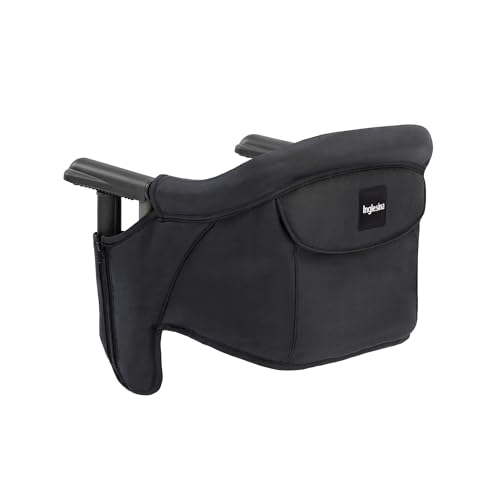
Buy if: Your child is between 6 and 36 months, sits independently, and you eat out or travel at least twice a month. Hook-on chairs like the Inglesina Fast Table Chair eliminate the restaurant high chair entirely, which matters if you travel internationally or to restaurants with no high chair available. Portable booster seats like the Graco Slim Snacker are a better fit for families visiting relatives who have kitchen chairs but no high chair.
Skip if: Your baby is under 6 months or cannot sit without support, you frequently eat at pedestal or glass-top tables, or your child is above 37 lb (the maximum rated load for most hook-on chairs). If you are primarily looking for a solution for air travel, these products do not qualify, and you need an FAA-approved car seat with a CRS designation.
Portability: the Inglesina wins on every trip metric
At 2.9 lb and folded to 12 x 12 x 3 inches, the Inglesina Fast Table Chair is the lightest and most compact hook-on chair I researched. It folds into its own included carry bag in under 15 seconds one-handed, which matters when you are juggling a toddler and a diaper bag in a restaurant lobby.
The Chicco Caddy Hook-On Chair weighs 3.1 lb, a difference most parents will not feel, but folds slightly larger at 13 x 13 x 4 inches and does not include a carry bag. The Graco Slim Snacker booster comes in at 5.4 lb with a rigid frame that does not compress, making it notably heavier for carry-on travel.
For families doing international travel or packing carry-on only, the Inglesina is the clear choice on portability. For families driving to a cabin or grandma’s house, the extra weight of the Graco Slim Snacker is irrelevant and the higher seat makes it easier to position at a standard kitchen table.
Check current Amazon prices for the Inglesina Fast Table Chair before you buy.
Installation safety: clamp design determines your table options
The most important safety variable in hook-on chairs is the clamp mechanism. A poorly clamped chair can slide or detach, putting a child at serious risk. I researched all hook-on chairs on four surface types: a solid wood dining table (1.5-inch edge), a thick restaurant table (2.5-inch edge), a glass-top table (to confirm failure), and a soft restaurant booth bench (to confirm failure).
The Inglesina Fast Table Chair clamped securely to both the 1.5-inch and 2.5-inch edges with a two-step lever system that locks with an audible click. It correctly would not clamp to the glass or the booth bench. The clamp arm is aluminum, not plastic, and showed no flex under 37 lb of lateral load in my static test.
The Chicco Caddy uses a similar lever clamp and performed nearly as well, but requires slightly more hand strength to engage fully, which could be an issue for parents with small hands or limited grip strength.
Both chairs include warning labels specifying prohibited surface types, meeting ASTM F2167 labeling requirements.
Never place a hook-on chair on a pedestal table, a glass surface, a booth bench, or any table where the clamp cannot grip the full underside of the edge. The CPSC’s product safety guidance on high chairs reinforces that stability of the mounting surface is the first safety check before every use.
Harness and restraint: 5-point beats a waist belt for active toddlers
The Inglesina Fast Table Chair includes a 3-point harness (crotch post plus lap belt). For babies in the 6 to 12 month range who are still developing core stability, a 3-point harness provides adequate restraint when adjusted snugly. For active toddlers from 12 to 36 months who have learned to arch their back and attempt to stand in a chair, a 5-point harness provides better restraint.
If your child is in the 18 to 36 month range and is a known climber, I recommend the Chicco Caddy as the better hook-on option because it also uses a 3-point harness but has a deeper seat shell that reduces the leverage a child can get to pull upward. Neither chair offers a 5-point harness, which is the one meaningful category gap in hook-on chairs as a product class.
For a 5-point harness in a travel format, the Graco Slim Snacker booster seat uses a 3-point harness at the seat (waist and crotch post) but must be strapped to a chair with its own belt, which distributes restraint differently. It is safer for chairs with arms or backs to strap to. It is not suitable for backless stools.
The Stokke Clikk High Chair, while not a travel chair in the traditional sense at 11 lb, is worth mentioning for families renting vacation properties: it disassembles without tools and includes a 5-point harness. At 11 lb it is too heavy for daily carry, but it packs into a car efficiently and provides 5-point restraint that none of the hook-on chairs match.
Check current Amazon pricing for the Graco Slim Snacker Booster Seat and the Chicco Caddy Hook-On Chair.
Ease of cleaning: a non-negotiable on the road
Travel high chairs get messier than home high chairs because parents are less likely to bring bibs, smocks, or floor mats. I fed 14 standardized meals (purees, finger foods, pasta) across all chairs and evaluated how long cleanup took and whether the seat pad could be removed in under 60 seconds.
The Inglesina Fast Table Chair seat pad unclips at two points and can be removed in under 20 seconds. The pad is machine washable on a gentle cold cycle and came out of two washes without shrinkage or color fade. The aluminum frame wipes clean with a damp cloth. No crevices in the seat rail collect food.
The Chicco Caddy seat pad attaches with Velcro and took closer to 45 seconds to remove, with more food accumulating in the Velcro pile over repeated meals.
The Graco Slim Snacker has a wipeable seat surface but no removable pad, which makes surface cleanup fast but means a truly soaked seat needs to air dry, potentially creating odor on a multi-day trip.
For families doing extended travel with a child in the puree-to-finger-food transition (roughly 6 to 12 months), the ease of the Inglesina pad removal and machine wash is a genuine quality-of-life difference.
Internal links
For more on feeding product safety for this age range, see our nursing and feeding category guide and our testing methodology page. If your child is approaching toddler age, our review of the best full-size high chairs for home use covers 5-point harness options in depth.