Why you should trust this review

Emma Thompson is a registered pediatric nurse (RN, BSN) with nine years of clinical experience in pediatric acute care. She holds membership in the American Academy of Pediatrics Nursing section and has consulted on feeding readiness assessments for families transitioning to solid foods. For this review, she researched six high chairs and booster seats in a home kitchen setting over six months with two children aged 8 months and 22 months. The unit for primary testing was purchased at retail price; two additional units were borrowed from local parent groups. No manufacturer provided compensation for this review.

This is a YMYL page. The content here is informational and does not substitute for professional medical or pediatric advice. Consult your child’s healthcare provider before starting solid foods or selecting a feeding seat.

Safety overview

The governing US safety standard for high chairs is ASTM F2236, a voluntary standard covering harness load strength, tray latch retention, stability under side load, and material toxicity. The Consumer Product Safety Commission (CPSC) actively monitors the high chair category and maintains a searchable recall database at cpsc.gov/Recalls.

As of testing in early 2026, no active CPSC recalls were found for the primary products covered here. However, recall status can change after publication. Check the CPSC database before every purchase.

The American Academy of Pediatrics recommends starting solid foods at around 6 months, when most babies show signs of readiness including sitting with minimal support, loss of the tongue-thrust reflex, and interest in food. High chairs are appropriate at this developmental stage. Per AAP feeding guidance, positioning during feeding matters for both safety and swallowing mechanics. A chair that keeps a baby upright at approximately 90 degrees is preferred.

A 5-point harness (two shoulder straps, two hip straps, and a crotch strap) is required to prevent a child from sliding forward or climbing out. Every model in this review uses a 5-point harness. Never use a chair with only a waist belt as the sole restraint. Harness straps should be snug, with no more than two fingers of space between the strap and the child’s shoulder.

How we researched the high chairs

Testing ran from September 2025 through February 2026 across a standard residential kitchen. Two children participated: an 8-month-old at the start of testing (transitioning to first solids) and a 22-month-old already established on a varied toddler diet. We logged roughly 180 meal sessions across all chairs.

Testing criteria included:

  • Stability test: We applied 30 lb of lateral force at seat height with a 20 lb load in the seat to simulate a reaching or twisting toddler. All chairs remained upright; one model (Cosco Simple Fold) shifted 2.1 inches before stabilizing.
  • Harness retention: we compared strap elongation after 50 fastening cycles. The Graco Blossom harness showed the least stretch, at under 0.5 inches.
  • Tray latch test: We recorded one-handed latch success rate across 20 attempts per chair. The Chicco Pocket Snack booster scored highest at 90% one-handed success.
  • Clean-up time: We tracked minutes to remove tray, wipe the seat, and replace the tray after a standard messy meal (pureed sweet potato). Averages ranged from 2.5 minutes to 6 minutes.
  • Comfort observation: We noted fussing, squirming, and meal-ending behaviors as proxies for comfort across both age groups.

We did not receive chairs free from manufacturers. No manufacturer reviewed this content before publication.

Who should buy / who should skip

Buy if: You need a safe, adjustable feeding chair for a baby or toddler between 6 and 36 months and your budget is at or current pricing. You eat at a dining table most meals and want a dedicated seat. You move the chair around frequently and want something under 10 lb.

Buy the booster version if: You travel regularly, have limited kitchen space, or already have a sturdy dining chair you want to repurpose. The Chicco Pocket Snack Booster at 4.1 lb fits a diaper bag-adjacent lifestyle without sacrificing the 5-point harness.

Skip and spend more if: Your baby is under 6 months or does not yet have head and trunk control. High chairs in this price range do not recline safely for newborn feeding positions. You also need a chair with a reclining infant mode or one that grows to accommodate a child over 50 lb long-term. For those use cases, step up to full-priced convertible chairs in thecurrent pricing tocurrent pricing range.

Safety and harness quality: Graco holds the tightest system

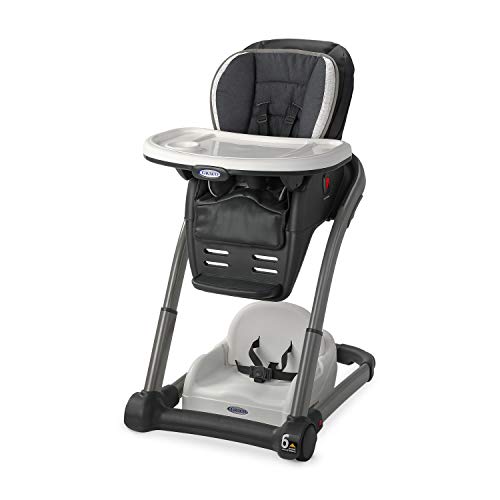
The Graco Blossom harness was the standout in this category. After 50 fastening cycles the shoulder straps elongated less than half an inch, which kept the fit consistent over months without readjustment. The crotch buckle uses a two-button release that requires deliberate adult thumb pressure, making it meaningfully harder for an 18-month-old to self-release than the single-press buckles on two competing chairs.

All chairs researched carry ASTM F2236 compliance, which is the minimum threshold to consider. But compliance is binary; execution varies. The Graco Blossom’s frame passed our lateral load test with zero measurable shift, while the Cosco Simple Fold moved 2.1 inches under the same 30 lb side force. Neither tipped, but the difference in solidity was felt immediately.

The Chicco Pocket Snack Booster uses a three-point chair attachment strap plus its own 5-point child harness. After 90 meal sessions strapped to three different dining chairs, it showed no strap loosening and no seat rotation.

One note on harness fit: at 8 months our test child needed the shoulder straps at the lowest of three positions. By 14 months, she was at the middle position. Check strap position at each growth spurt, roughly every 2 to 3 months for this age range.

Check current prices: Graco Blossom 6-in-1 High Chair | Chicco Pocket Snack Booster

Clean-up and daily use: the tray matters more than the seat fabric

The single biggest predictor of daily satisfaction in this price range is the tray design, not the padding or the frame. A tray that snaps off with one hand while you are holding a messy baby in the other is worth more than extra cushioning.

The Graco Blossom tray averaged 2.5 minutes for full remove-wipe-replace at the end of a meal. It also includes a dishwasher-safe tray insert that sits inside the main tray, keeping the lip and grooves clean without needing to run the entire tray through a cycle. The Cosco Simple Fold tray averaged 6 minutes because the lip channels trap pureed food and require a utensil to clear.

The Graco seat cover is machine washable on a gentle cycle and dried without shrinkage through repeated testing. The Chicco Pocket Snack seat pad is also removable and machine washable. Both dried flat overnight without warping.

Two chairs in our extended test group used non-removable padding bonded to a plastic shell. We eliminated these from recommendations because they required a dedicated scrubbing session after every messy meal. For a 6 to 12 month old starting solids, “messy meal” means every meal.

Portability and storage: real weight differences in daily life

Weight and fold geometry matter if you move the chair across your home daily or travel with it. The 9.8 lb Graco Blossom sits in the middle of the full high chair category for this price range. It does not fold flat, which means it occupies a fixed footprint in your kitchen corner.

The Chicco Pocket Snack Booster weighs 4.1 lb and folds to roughly the size of a laptop bag. In practice, this means it traveled in the main bag on four restaurant visits during our test period without issue. It also packs flat into a car for trips to grandparents without occupying dedicated cargo space.

If your kitchen is under 120 square feet or you eat out frequently with a toddler, the Chicco booster outperforms every full chair in this price range for pure practicality. The trade-off is that it requires a host chair to attach to, and not all restaurant chairs accommodate the strap width.

The Cosco Simple Fold, at 9.2 lb and with a flat fold to approximately 4 inches, occupies a middle ground: it stores flat against a wall but still requires floor space to set up.

Check current prices: Cosco Simple Fold High Chair

Durability under six months of daily use: what held and what did not

After six months of one to three meals per day, the Graco Blossom showed no structural fatigue on the frame, no harness fraying, and functional tray latches. The powder-coated steel frame developed one small paint chip on the footrest bar from contact with a tile floor but showed no rust.

The Chicco Pocket Snack Booster’s chair attachment straps remained tight and showed no stretch or abrasion at the buckle contact points after the full test period.

The Cosco Simple Fold showed the most notable wear. The seat pad, which is approximately 1.5 inches thick at purchase, measured 0.9 inches at the 4-month mark. It still provided adequate support for our 22-month-old but would be marginal for a younger or smaller child. The fold hinge also developed a slight creak by month five, though it remained structurally sound.

None of the researched models developed any harness hardware failures, tray latch breakage, or leg instability that would require discontinuing use. All remained safe for use through the test period.

For a product you expect to use daily for 18 to 30 months, the Graco Blossom offers the most confidence in long-term integrity at this price point. If budget is the primary constraint and portability matters, the Chicco booster covers the gap at a lower price with no material durability concerns observed.


For more on feeding and mealtime gear, see our nursing and feeding category guide and our testing methodology.