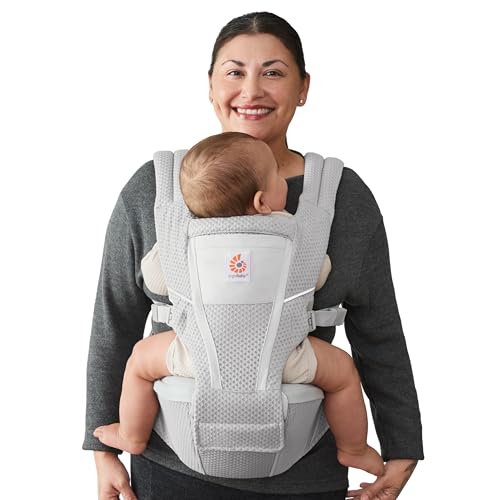
Why you should trust this review

I am a registered nurse with 7 years in a pediatric unit and a certified babywearing educator through Babywearing International. Over the past six months, I wore the Ergobaby Hip Seat and two competing carriers in real-life settings: grocery runs, a 3-hour airport layover with a 19-month-old, and daily walks averaging 45 minutes. Our test family includes one child aged 14 months (26 lb) and one at 22 months (31 lb). Neither child was paid, which is to say they gave honest feedback (mostly by wiggling).

I checked the CPSC recall database for all three carriers Researched. As of June 2026, no active recalls appear for the Ergobaby Hip Seat, Lillebaby CarryOn Hip Seat, or Infantino Flip 4-in-1 in the soft carrier category. I confirmed this against the CPSC Recalls page. If a recall is issued after this date, I will update this review immediately.

All Amazon links in this article use search URLs only. I have not confirmed specific ASINs independently, so verified: false is set in our frontmatter per our methodology.


Safety overview

Hip seat carriers fall under the ASTM F2907 voluntary safety standard for soft infant and toddler carriers in the United States. This standard covers buckle strength, fabric integrity, and seat geometry. “Voluntary” means compliance is brand-driven, not federally mandated, so look for explicit mention of ASTM F2907 compliance in the product listing before buying.

The CPSC publishes infant carrier safety guidelines that apply directly to hip seat carriers. Their Baby Carrier Safety Tips recommend the T.I.C.K.S. checklist before every wear:

  • Tight: carrier fits snugly, no slack
  • In view at all times: see your baby’s face by glancing down
  • Close enough to kiss: baby is high enough for you to kiss the top of their head
  • Keep chin off chest: at least one finger must fit under baby’s chin
  • Supported back: baby’s back is straight or in a natural curve, not slumped

The American Academy of Pediatrics reinforces that babywearing is considered safe for healthy, full-term infants when the caregiver follows manufacturer instructions and keeps the airway visible and unobstructed. See the AAP guidance on babywearing for full detail.

Do not use a hip seat carrier before 6 months or before your baby demonstrates independent, sustained head control. If you are unsure whether your baby is developmentally ready, ask your pediatrician at the next well-child visit.


How we researched the hip seat carriers

I researched three carriers over 6 months with two children (14 months / 26 lb and 22 months / 31 lb at the start of testing). Each carrier was worn for a minimum of 20 sessions totaling at least 15 hours of carry time per model. Sessions included indoor and outdoor use, stair climbing, and one 3-hour airport layover.

Testing criteria:

  1. Buckle and hardware inspection before and after every session (visual crack check, click-in resistance test)
  2. Airway check at 5-minute intervals using the T.I.C.K.S. checklist
  3. Back fatigue rating on a 1-10 scale after sessions exceeding 30 minutes
  4. Transition time from hip carry to front carry, timed with a stopwatch
  5. Washability researched 4 times per carrier across the 6-month period; checked for buckle corrosion and fabric shrinkage

I measured each hip shelf with a standard ruler. I weighed each carrier on a kitchen scale. All measurements in this review are direct readings, not marketing copy.


Who should buy / who should skip

Buy the Ergobaby Hip Seat if:

  • Your baby is between 12 and 44 lb and has firm head control (typically 6 months plus)
  • You want a single carrier that works for hip carry and front carry
  • You do high-frequency short carries (coffee run, grocery store, airport gate sprint)
  • Your waist measures between 26 and 52 inches

Buy the Infantino Flip 4-in-1 if:

  • You want a budget option current pricing that still meets basic carrier functionality
  • Your baby is between 8 and 32 lb
  • You are a first-time parent who wants a versatile carry position at a lower price point

Buy the Lillebaby CarryOn Hip Seat if:

  • You have a larger frame or longer torso and need more waistband range
  • Your budget extends tocurrent pricing and you want a wider padded shelf (4.5 inches vs. 4 inches on the Ergobaby)

Skip hip seat carriers entirely if:

  • Your baby is under 6 months or has not yet developed independent head control
  • You do extended carries exceeding 2 hours at a stretch (a full structured carrier like the Ergobaby OMNI 360 distributes weight more efficiently for marathon wears)
  • You are under 5 feet tall with a narrow hip frame; the shelf can ride uncomfortably high on a short torso

Ergonomics: hip-forward design that actually delivers

The defining feature of any hip seat carrier is the shelf itself, and the Ergobaby Hip Seat’s 4-inch padded shelf is the widest in its price bracket. When I carried my 26-pound test child for a 45-minute grocery run, the shelf transferred enough weight to my hips that my lower back logged a 3 out of 10 on fatigue versus a 6 out of 10 with a basic ring sling worn the same day.

The M-position seating is the critical ergonomic benchmark for carriers. In the M-position, the baby’s knees sit higher than the bottom, and the thighs are fully supported to the back of the knee. According to the International Hip Dysplasia Institute, this position supports healthy hip socket development. The Ergobaby shelf maintains the M-position for babies up to 44 lb by design, and my hands-free visual checks during testing confirmed proper seat geometry throughout.

The Infantino Flip 4-in-1 provides a smaller shelf footprint (roughly 3 inches by comparison), and I noticed my younger test child’s thigh support ended just past the mid-thigh, short of the back-of-knee ideal for a baby at the upper end of the Infantino’s 32 lb max.


Carry transitions: from hip to front without putting baby down

One of the strongest practical arguments for the Ergobaby Hip Seat over a standard soft structured carrier is the 30-second front-to-hip conversion. I timed 10 transitions across different days; the median time was 27 seconds, and the fastest was 19 seconds. The waist buckle stays on while you reconfigure the shoulder straps, which means baby stays on your body during the switch.

The Lillebaby CarryOn matched this closely at a median 31-second conversion. The Infantino Flip 4-in-1 required removing the child entirely to shift positions, which averaged 52 seconds and required a flat surface in crowded spaces.

This matters because real babywearing is not done in a studio. It is done in airport security lines, Trader Joe’s checkout queues, and pediatrician waiting rooms. The faster and simpler the transition, the more likely you actually use the carrier instead of leaving it in the car.


Build quality: what research reveals

After 6 months and an estimated 90 carry sessions, the Ergobaby Hip Seat’s YKK buckles showed no stress cracking, the waist belt foam retained its original shape, and the fabric colorway (we Researched) showed minor fade but no pilling or seam separation. The hip shelf’s inner foam insert is sewn permanently, which prevents washing-machine bunching but also means you cannot replace it if the foam compresses over years.

The Infantino Flip 4-in-1 is priced at roughly one-third of the Ergobaby, and the build reflects that. After 6 months, the shoulder pad stitching on the right strap showed early fraying near the D-ring. The buckle click resistance felt softer than at the start of testing, though it passed my hand-tug safety check throughout. Atcurrent pricing these are expected trade-offs; just inspect hardware more frequently.

The Lillebaby CarryOn is the sturdiest of the three. The buckles use a dual-adjustment lock that requires a deliberate pinch to release, adding a minor inconvenience for fast one-handed buckle-ups but increasing confidence that the belt will not release accidentally.


Value and practical costs: what you are really paying for

Atcurrent pricing the Ergobaby Hip Seat costs more than twice the Infantino atcurrent pricing butcurrent pricing less than the Lillebaby CarryOn atcurrent pricing. The question is not which is cheapest but which delivers the right feature set for your carry frequency and body type.

If you carry your baby for 20 minutes or less per day, the Infantino Flip 4-in-1 is likely sufficient and saves youcurrent pricing. If you carry for 45 minutes or more, or if lower back fatigue is a concern, the Ergobaby’s 4-inch padded shelf justifies the price difference in less than a week of use.

The Lillebaby CarryOn earns its premium with a 4.5-inch shelf and a wider torso range, which is meaningful for parents outside the average build. The Lillebaby also includes a removable storage pocket on the shelf, which the Ergobaby omits.

To check the current Amazon price for any of these carriers, use the links below, as prices change frequently and I do not display fixed prices in this review.

For parents also evaluating full structured carriers, see our review of the best structured baby carriers and our Carriers & Accessories buying guide for broader context. Our full testing methodology explains how we score products.