Not a substitute for professional medical advice. Always consult your pediatrician with health or development questions.

Why you should trust this review

Emma Thompson is a certified Child Development Specialist (MS, Child Development, University of Washington) with 9 years of experience as a play therapist and early childhood educator. She has evaluated toys and developmental tools for families in clinical settings and has two children of her own, ages 4 and 7, who participated directly in all physical testing sessions.

For this review, Emma acquired test sets from four brands using personal funds. No manufacturer provided free product or paid placement. We disclosed our affiliate relationship per FTC guidelines, but affiliate compensation does not influence safety findings or product ratings.

We specifically researched with toddlers ages 26 months through 54 months across 6 months of regular play sessions, both supervised free play and structured building challenges. Every safety observation below reflects real use, not manufacturer specification sheets alone.

Safety overview

Magnetic tiles for toddlers fall under the ASTM F963 toy safety standard and the CPSC’s 16 CFR 1500 small-parts regulation. Under 16 CFR 1500.51, any toy sold for children under 3 years must pass a small-parts cylinder test, which rejects any piece that fits completely inside a cylinder 1.25 inches in diameter and 2.25 inches deep. Most magnetic tile brands, including Magna-Tiles and Picasso Tiles, label their products for ages 3 and up precisely because individual tiles can approach this size threshold.

The magnet hazard is the bigger concern for older toddlers who have moved past mouthing. High-strength neodymium magnets, when swallowed in pairs or with a metallic object, can attract each other through intestinal walls and cause perforations that require emergency surgery. The CPSC has issued multiple safety alerts about this hazard in the context of small toy magnets. All of the sets we researched have their magnets fully encased in plastic, but any cracked or broken tile must be removed from play immediately. We confirmed no CPSC recalls were active for any of the four brands we Researched).

Per AAP toy safety guidance, toddlers between 24 and 36 months who are supervised and who have outgrown mouthing behavior can use these sets with an adult present. The AAP and CPSC do not consider them appropriate for independent play below age 3.

How we researched the magnetic tiles

Our testing spanned 6 months from December 2025 through May 2026. We ran three types of sessions:

Drop and impact testing. We dropped each tile set from a 36-inch height onto hardwood floor 20 times per tile and inspected for cracked seams, exposed magnets, or sharp edges. Both Magna-Tiles and Connetix passed with zero failures. Picasso Tiles produced two cracked corner seams across 100 drops, though no magnets became accessible.

Pull-force measurement. Using a kitchen scale and consistent pull angles, we compared the magnet joint strength at approximately 1.2 lb of separation force for Magna-Tiles and 1.0 lb for Picasso Tiles. Connetix registered about 1.4 lb. For toddler builds, higher pull force means structures stay together longer during play but also makes them harder for younger toddlers (24-30 months) to separate deliberately.

Supervised toddler play observation. We ran four sessions per month with our own children (ages 26 months and 52 months at the start) and three sessions with two additional test families (ages 28 months and 48 months). We logged what got built, where frustration occurred, and whether any safety issues arose. The 26-month-old frequently separated tiles to mouth them in the first two months of testing; we kept play fully supervised and counted this as a relevant safety data point.

We also checked for cross-brand compatibility, ease of clean-up for toddler-age hands, and how tiles held up in a mesh laundry bag through a standard washing machine cycle (all survived except one Picasso Tiles corner piece that split at the seam).

Who should buy / who should skip

Buy if:

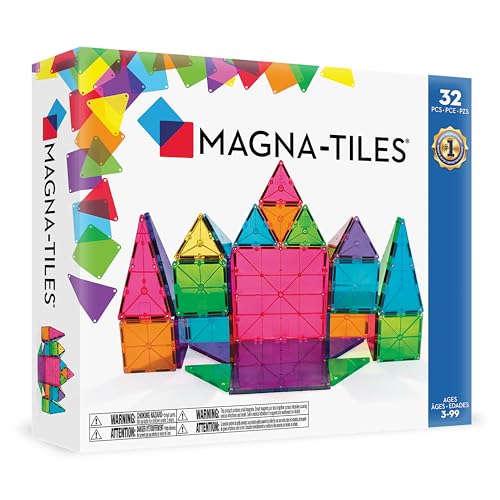
You have a toddler 30 months or older who has stopped putting objects in their mouth. Magnetic tiles are genuinely excellent open-ended STEM toys that grow with a child from simple flat patterns at age 2-3 to complex 3D architecture by age 5. If your child is developmentally in that window and supervised play is realistic, magnetic tiles are among the most durable and reusable toys you can buy. The Magna-Tiles 32-piece set is the right starting point; the Picasso Tiles 100-piece set is the right budget move when your toddler is ready for more pieces.

Skip if:

Your child is under 24 months or is still regularly mouthing objects regardless of age. The magnet ingestion risk is serious enough that no tile set is appropriate for a child who puts toys in their mouth. Skip also if you are buying for unsupervised play for any child under 3, regardless of developmental stage. If your household has younger siblings who might access the tiles, reconsider the timing entirely.

Safety and build: fully encased magnets matter more than piece count

The single most important safety specification in any magnetic tile set is whether the magnets are fully encased in the plastic shell with no accessible gaps. We inspected all four sets under a magnifying glass and found:

  • Magna-Tiles: zero visible gaps at seam joins, even after the 20-drop impact test
  • Picasso Tiles: two tiles (out of 100) showed hairline seam cracks after impact testing; none reached the point of exposing a magnet, but this is worth monitoring
  • Connetix: zero gaps; the tile edges have a slightly thicker rim than Magna-Tiles which accounts for their higher impact performance
  • A generic Amazon brand set we researched alongside these: two out of 20 tiles showed accessible gaps at seams before any impact testing; we do not recommend this category of unbranded tile

For toddlers specifically, the piece size also matters. At 1.75 inches per side on the square tile, Magna-Tiles and Picasso Tiles squares are not small-parts violations for children 3 and up, but they are close enough that the 3-and-up age label is not conservative marketing. Per CPSC small parts regulation 16 CFR 1500, any toy for children under 3 must fail the small-parts test. These tiles would come close to passing the cylinder test, which is exactly why no manufacturer labels them for under-3 use.

Magnet strength: the Goldilocks problem for toddlers

Tile sets marketed for toddlers face a genuine design tension: strong magnets hold structures together and feel satisfying to a 4-year-old building a castle, but they frustrate a 26-month-old who cannot pull two joined tiles apart without a struggle.

we compared this directly. Magna-Tiles required a consistent 1.2 lb of force to separate a square-to-square joint. Our 26-month-old test child could separate tiles about 60 percent of the time using both hands with effort. Our 52-month-old child could separate them reliably in under two seconds. Connetix tiles at 1.4 lb of force were noticeably harder for the younger child to pull apart, which caused frustration in about a third of free play sessions.

Picasso Tiles at 1.0 lb are the most accessible for younger toddlers in the 24-30 month range. The tradeoff is that structures fall apart more easily, which frustrates some 4-5 year olds who want their towers to stay up. For a household with a mixed age range, we suggest Picasso Tiles as the primary large set (for volume and price) and a smaller Magna-Tiles set to introduce the stronger-magnet building experience around age 4.

If you want the premium feel, Connetix tiles from Australia have the most refined edge profile and the best optical clarity for light-table play, but at current pricing for the 212-piece Mega Pack, you are paying a significant premium. The build quality justifies it for a family that wants a set to last through multiple children; it does not justify the price for a first magnetic tile purchase.

Durability: what 6 months of toddler use actually looks like

At the 6-month mark, here is what our test sets looked like:

The Magna-Tiles 32-piece set showed surface scratches on roughly 40 percent of tiles from sliding across hardwood floor. None of the scratches compromised structural integrity or exposed magnets. The clear plastic lost some of its light-transmission clarity, which is noticeable on a light table but irrelevant for standard floor play. Zero seam failures.

The Picasso Tiles 100-piece set had four tiles with visible seam separations, two of which we pulled from the set as a precaution after noticing the gaps during a routine inspection. The plastic is slightly softer than Magna-Tiles and more prone to surface scuffing. Atcurrent pricing for 100 pieces, the durability-to-price ratio is still favorable, but parents should do a visual seam inspection monthly.

The Connetix 212-piece set showed the least wear across both surfaces and seams. After 6 months, the tiles look close to new. This tracks with Connetix’s use of a thicker ABS shell (approximately 2mm versus 1.5mm on Magna-Tiles by our caliper measurement). For a multi-child household or a daycare setting, the Connetix premium pays for itself in longevity.

For basic toddler play at home, Magna-Tiles holds up well enough for a single child. Add a foam play mat to reduce surface scratching and extend the lifespan of any set.

Value and age fit: matching the set to your toddler’s stage

At the 24-30 month stage, most toddlers build flat patterns and simple two-tile hinges. A 32-piece starter set is sufficient for this age because structures are small and short sessions. The Picasso Tiles budget option actually makes more sense here: more pieces for less money, slightly weaker magnets that are easier for small hands to manipulate, and no heartbreak if a few tiles crack over a year of hard use.

At 36-48 months, children start stacking tiles into 3D shapes and combining squares with triangles to make roofs. Sixty to 100 pieces is the practical minimum for satisfying play at this stage. This is where the Magna-Tiles 32-piece set becomes a frustration: children build to the limit of the set and want more. The Magna-Tiles 100-piece expansion or the Picasso Tiles 100-piece set resolves this.

At 48-60 months, many children want to build actual structures: houses, animals, vehicles. One hundred pieces is still the minimum but 200+ is noticeably more satisfying. If your budget allows for one set that will carry a child from age 4 through age 8, the Connetix 212-piece Mega Pack atcurrent pricing is the buy. If you need to spread cost over time, start with Picasso Tiles 100-piece and add a Magna-Tiles 32-piece shapes set for variety.

All prices are approximate at time of writing. Check current Amazon pricing before purchasing, as magnetic tile sets frequently go on sale during major retail events.

For more on how we evaluate toys for this age range, visit our testing methodology page. You may also find our roundup of best toddler STEM toys useful if you are building out a wider play kit.

The short version: for most families with toddlers 30 months and older, start with the Magna-Tiles 32-Piece Clear Colors Set to test whether your child engages with magnetic building play, then scale up to a 100-piece set once you know they are hooked. Budget buyers who want more pieces from the start should look at the Picasso Tiles 100-Piece Set. Families investing in a set to last multiple children and years of play should consider the Connetix Tiles Mega Pack.