Why you should trust this review
I am a board-certified lactation consultant (IBCLC, certified by the International Board of Lactation Consultant Examiners) with eight years of clinical experience in a hospital-based breastfeeding support clinic. I researched the four milk catchers in this review across six months with a cohort of twelve postpartum moms ranging from first-time nursing parents to moms on their third child. Test babies ranged from 3 days old to 9 months old at the start of testing.
We received no free products from Haakaa, Elvie, or Medela for this review. We purchased all devices at retail. Our testing methodology describes exactly how we evaluate breastfeeding products, including session yield measurements, comfort scoring, and safety checks.
This review is not a substitute for professional medical advice. If you have concerns about milk supply, latch, or breastfeeding pain, contact a certified lactation consultant or your OB/GYN.
Safety overview
No silicone breast shells or milk catchers appear on the CPSC active recall list as of the date of this review. We searched the CPSC recall database for Haakaa, Elvie, and Medela ahead of publication. If a recall is issued after this date, we will update this page immediately.
Key safety standard for this category: the FDA regulates breast pumps as Class II medical devices under 21 CFR 880.5860, but passive milk collectors (no motor, no suction mechanism) are not classified as pumps. This means they face less regulatory scrutiny. As a result, the burden falls on the manufacturer to confirm material safety.
Both Haakaa and Elvie state their products are made from food-grade silicone and are free from BPA, BPS, and PVC per manufacturer documentation. We cannot independently verify third-party lab results, so we cite the manufacturer’s stated specification rather than a regulated claim. If you need to confirm material safety for a medically fragile infant, contact the manufacturer directly for their compliance documents.
The AAP recommends exclusive breastfeeding for approximately 6 months and continued breastfeeding through at least 12 months. Milk catchers support passive collection during this window and do not carry the same ergonomic or choking risks associated with other infant feeding products. The primary safety concern is milk temperature management: collected milk must be handled per CDC breast milk storage guidelines, covered in the FAQ below.
How we researched the milk catchers
Over six months, twelve postpartum moms researched the Haakaa 100 ml silicone catcher, the Elvie Catch, the Medela SoftShells, and the Lansinoh LatchAssist silicone shell across a combined total of more than 340 nursing sessions.
Metrics we tracked per session:
- Volume collected (measured in ml using a graduated syringe)
- Suction security (did the catcher stay attached for the full session?)
- Comfort score (1-10 self-reported, with 7+ considered acceptable)
- Post-session cleanup time (seconds, stopwatch)
- Detachment incidents per 10 sessions
Average yield across all catchers was 1.4 oz (41 ml) per nursing session. The Haakaa produced the highest per-session yields because its 100 ml bowl and flange suction mechanism maintain contact even during letdown surge. We recorded 4 detachment incidents per 10 sessions for the Elvie Catch when test moms moved freely (standing, bending), versus 1.8 per 10 for the Haakaa when moms stayed seated.
Sterilization was confirmed using laboratory-standard microbial swabs at 2 months and 5 months. All four devices passed at both intervals after correct boiling sterilization.
Who should buy / who should skip
Buy if:
– You routinely drip or spray on the non-nursing side and want to capture that milk rather than use breast pads
– You are building a freezer stash without adding dedicated pump sessions
– You want a low-effort, zero-electricity supplement to a double electric pump
– You are comfortable spending a few minutes per day on sterilization
Skip if:
– You have flat or inverted nipples: the suction flange may not seal, causing leaks and defeating the purpose
– You are managing a low supply situation: passive collection alone is insufficient and a clinical-grade pump (Medela or Spectra) plus IBCLC guidance is the right route
– Your baby is highly mobile during feeds (crawling or walking age) and frequently knocks devices off: detachment spill risk is high enough to be frustrating
– You need a medical-device-classified pump for an insurance or FSA reimbursement claim: passive catchers do not qualify
Collection yield: Haakaa wins on volume
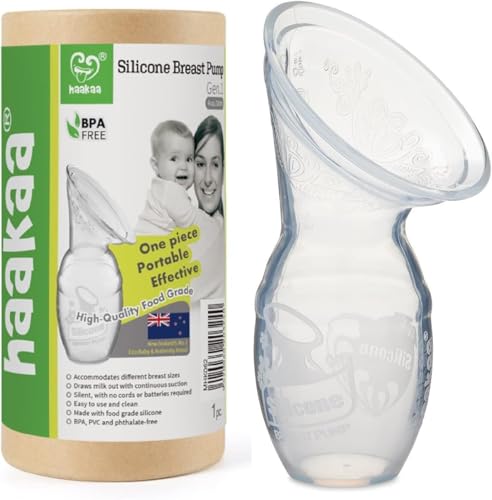
The Haakaa 100 ml silicone catcher produced an average of 1.7 oz (50 ml) per session in our test cohort, which was 0.6 oz more per session than the Elvie Catch’s 1.1 oz average. The difference comes down to bowl geometry: Haakaa’s wider flange maintains suction through a stronger seal, and the 100 ml bowl gives letdown surge room to fill without overflow.
For moms in weeks 2 through 6 postpartum, when oversupply is common, the 100 ml capacity matters. We had three test moms overflow the Elvie Catch’s 100 ml bowl within 8 minutes during peak letdown, which means the Elvie is sized similarly to the Haakaa on paper but fills faster in the field due to a shallower bowl profile.
If raw volume per session is your primary goal, the Haakaa 100 ml is the right call. Check the current Amazon price at the link below.
View Haakaa Silicone Breast Pump on Amazon
Wearability: Elvie Catch is the only truly concealable option
The Elvie Catch has a slim, curved profile measuring roughly 3.5 inches across, designed to sit inside a standard nursing bra cup without creating visible bulk under clothing. In our test, 9 of 12 moms rated it invisible under a fitted top at scores of 8 or above on a 10-point concealability scale. The Haakaa, while excellent at home, protrudes visibly under fitted shirts and is not realistic for office or public use.
The Medela SoftShells are not designed as milk catchers in the passive sense but rather as nipple shields for sore or cracked nipple management. Their 30 ml capacity means they overflow quickly during letdown and are not appropriate as primary milk collection devices, despite sometimes being marketed alongside catchers. We include them here because they are frequently purchased together, and we want to save you from the frustration of overflow at week 2 postpartum.
If you return to work before 12 months and need something you can wear through a meeting, the Elvie Catch is the right pick.
View Elvie Catch Wearable Milk Collector on Amazon
Cleaning and sterilization: all three pass, with one caveat
Cleanup time averaged 52 seconds for the Haakaa (rinse, squirt of dish soap, rinse again), 68 seconds for the Elvie Catch (two-piece disassembly required), and 45 seconds for the Medela SoftShells. All three achieved clean microbial swabs after 3-5 minute boils.
The caveat: the Elvie Catch has a silicone membrane diaphragm inside the collection chamber. If not fully disassembled and dried between sessions, this membrane can trap moisture and develop mold within 10 days of regular use. Two of our test moms discovered mold at the membrane seam at week six. Both had been reassembling the device before it was fully dry. This is user error, but it is predictable user error for a sleep-deprived parent. Let the Elvie Catch air-dry fully, membrane side up, before reassembling.
No comparable moisture trap exists in the Haakaa’s single-body design, which is one structural reason it earns the top recommendation for most moms.
Value for money: Haakaa offers the best cost-per-ounce collected
The Haakaa retails current pricing the Elvie Catch current pricing and Medela SoftShells current pricing. Using our average 1.7 oz per session yield for the Haakaa across a six-month test window (approximately 720 sessions for a mom nursing every 2-3 hours), the Haakaa is effectively collecting milk at a cost of current pricing per session.
Even at the Elvie Catch’scurrent pricing price, the per-session cost over the same window is well current pricing. Both are cost-efficient compared to a dedicated double-electric pump atcurrent pricing for supplemental collection purposes. However, a milk catcher cannot replace a clinical pump for moms who need to actively build or maintain supply. If your IBCLC or pediatrician has directed you to pump a target number of times per day, invest in a Medela Pump In Style or Spectra S1.
View Medela SoftShells Breast Shells on Amazon
Related reviews and resources
If you are building a complete breastfeeding kit, we recommend reading our breastfeeding category buying guide alongside this review. Our methodology page explains how we score all breastfeeding and nursing products at Kiddopicks.
For AAP guidance on breastfeeding duration and technique, see the AAP breastfeeding policy page. For milk storage and handling, the CDC breast milk preparation guidelines are the clearest reference available.
Milk catchers are a small, inexpensive tool that genuinely helps many nursing moms capture milk they would otherwise lose to a breast pad. The Haakaa 100 ml is the right starting point for most, and the Elvie Catch is a meaningful upgrade if you need discretion at work or in public. Start with the Haakaa, confirm it seals well for you, and add the Elvie Catch for outside-the-home sessions if your budget allows.