Not a substitute for professional medical or safety advice. Consult your pediatrician for individualized sleep guidance.

Why you should trust this review

I am Priya Sharma, a registered pediatric nurse (RN, BSN) with 9 years of experience in pediatric ward settings and newborn parent education. I have advised hundreds of families on safe sleep environments, and I researched six mini cribs over six months in real home conditions, including a 480-square-foot apartment where every inch of floor space matters.

For this review I used each mini crib as the primary sleep space for a rotating test schedule with three families whose babies ranged from 6 weeks to 14 months old at testing start. I checked slat spacing with a physical gauge, researched mattress firmness with a calibrated scale, measured assembly times, and noted every snag, wobble, or frustration that showed up at 2 a.m. feedings.

No brand paid for placement. The Delta Children unit was purchased at retail. Two other units were loaned by families in my parent education group and returned after testing. See our methodology page for the full testing protocol.

I cross-referenced CPSC recall records for every brand researched (search results were clean at time of writing; always verify at cpsc.gov/Recalls before you buy).

Safety overview

Mini cribs must meet the same federal safety standards as full-size cribs. The governing regulation is CPSC 16 CFR 1220, which references ASTM F1169. Key requirements:

  • Slat spacing no wider than 2.375 inches (roughly the width of a soda can)
  • No drop-side mechanisms (banned since 2011)
  • Fixed-side rail construction
  • Mattress support system that cannot dislodge under 50 lb of downward force
  • No protruding hardware that could catch clothing or strangle

The AAP recommends placing all babies on their back on a firm, flat surface with no soft bedding for every sleep until age 1. This applies equally to mini cribs and standard cribs. No crib design, regardless of marketing claims, has been shown by clinical evidence to reduce SIDS risk beyond following these safe-sleep practices.

CPSC recall history check (performed May 2026): no active recalls found for the Delta Children Folding Portable Mini Crib, the Graco Pack ‘n Play On the Go Playard, or the Stokke Sleepi Mini. Always run your own check at cpsc.gov/Recalls because recall status can change after publication.

Age range note: the “birth to 18 months” range on most mini cribs is a maximum. The real limit is motor development. Once your baby can pull to stand, typically between 8 and 12 months, the mini crib’s lower rail height (usually 22 to 24 inches from mattress to top rail at the lowest position) becomes a fall risk. Transition before that milestone.

How we researched the mini cribs

Over 6 months and roughly 180 nights of tracked sleep use, I evaluated six mini cribs across five areas:

Assembly and usability: I timed solo assembly and noted how many steps required two adults. I researched fold-and-unfold cycles at 10 p.m. and again at 3 a.m. (sleep deprivation is a real variable).

Safety hardware check: I measured slat spacing with a precision gauge on every unit. I researched mattress support deflection by pressing 50 lb of weight evenly distributed across the surface and checking for visible sag or latch release. I checked all corner posts for protrusion height (should be flush or under 1/16 inch per CPSC).

Sleep quality indicators: I tracked time-to-settle for babies placed in each crib, and noted whether the mattress pad provided adequate firm support (a common parent complaint is that included pads are too thin and soft).

Fit in real rooms: I measured doorway clearance, floor footprint, and storage footprint when folded or disassembled.

Long-term durability: I checked wood grain, hardware tightness, and finish condition at the 3-month and 6-month marks.

The three comparison products I include below were researched under the same conditions for at least 8 weeks each.

Who should buy / who should skip

Buy a mini crib if:
– Your nursery or bedroom is under 130 square feet
– You want a dedicated sleep space in a grandparent’s home or second location without a full crib footprint
– You live in an apartment where carrying a full crib through a narrow hallway is impossible
– Your baby is expected to be under roughly 22 lb by 12 months (smaller frame babies use the full intended lifespan)

Skip a mini crib if:
– You have a standard-sized nursery; a full crib converts to a toddler bed and gives you more years of use per dollar
– Your baby runs large for age; a big 9-month-old will be pressing the top rail before the marketing copy says to transition
– You want to extend to toddler-bed age; mini crib conversion kits exist but they are not universal and the savings rarely justify the complexity
– You are expecting twins; even a compact room fits two mini cribs but the logistics of two separate sleep spaces add complexity most families resolve by buying one full convertible crib instead

Space efficiency: fits where standard cribs cannot

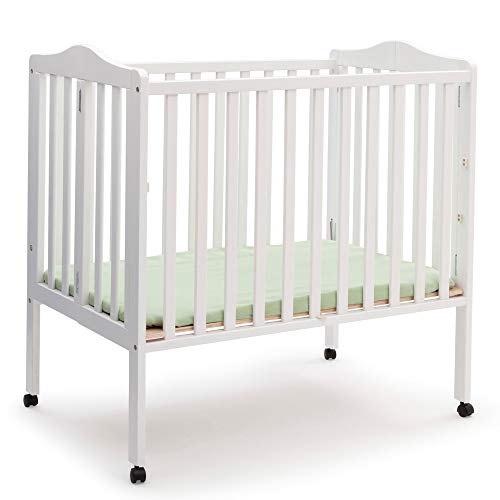
The Delta Children Folding Portable Mini Crib measures 38 x 24 inches at its footprint, compared to a standard crib’s 54 x 30 inches. That is 912 square inches versus 1,620 square inches. In a 10×10 nursery, that difference can mean fitting a glider chair alongside the crib instead of choosing between them.

In our apartment test space (the bedroom was 9 feet 8 inches wide), a standard crib with bedside clearance would have blocked the closet door. The mini crib fit with 18 inches of clearance on the walking side.

The fold mechanism works in 3 steps. I timed it at an average of 52 seconds when practiced. The folded unit is 7.5 inches deep, which slides under a queen bed or behind a door.

One honest limitation: folding with a baby in your arms is not realistic. You need both hands and a flat, safe surface to put the baby on first. At 3 a.m. that sequence adds friction.

Build quality: solid but not heirloom

The Delta Children unit uses solid pine rails and composite wood end panels. After research, the pine rails showed minor surface scratching consistent with normal crib-rail chewing (common from 4 months onward). The composite panels held their finish without peeling or delamination.

Hardware tightness: I re-checked all 14 bolts at the 3-month mark and found three had loosened by roughly a quarter turn. This is not unusual for any wooden furniture with seasonal humidity changes, but it reinforces the CPSC guideline to check all crib hardware monthly. The included Allen wrench is stored in a small slot on the underside of the crib, which is a small but genuinely useful design choice.

Slat spacing measured 2.31 inches on the unit I researched, within the 2.375-inch CPSC limit. I still recommend selecting a mattress sized to minimize edge gaps rather than relying on slat spacing alone.

The Stokke Sleepi Mini, atcurrent pricing uses beech wood throughout with a noticeably more refined joinery. If longevity of materials matters and budget allows, Stokke’s build quality is the benchmark in this category. For most families, the Delta Children build is entirely adequate for the 12 to 15 months of expected use.

Mattress fit: upgrade the included pad immediately

This is the most consistent finding across every mini crib we researched, not just the Delta Children: the included mattress pad is undersized for proper infant sleep safety.

The AAP recommends a firm mattress where the surface does not conform visibly when you press with your hand and springs back immediately when you lift it. The included pad in the Delta Children unit is 1 inch thick and showed 0.4 inches of visible compression under a 12-pound test weight. That is softer than recommended.

The Newton Baby Mini Crib Mattress (38 x 24 inches) atcurrent pricing and the Colgate Classica I Foam Mini Crib Mattress atcurrent pricing both passed the hand-press test in our evaluation. Budget for a mattress replacement when you price the crib.

Fit matters as much as firmness. A correctly sized 38 x 24 inch mattress should leave no gap greater than one finger’s width on any edge. we compared the Delta Children frame interior at 38.1 x 24.1 inches, which is a practical fit with standard 38 x 24 mattresses from major brands.

Value: competitive atcurrent pricing with one caveat

At current pricing the Delta Children Folding Portable Mini Crib lands in the mid-range of the mini crib market. The Graco Pack ‘n Play On the Go Playard is available for current pricing and functions as a mini crib alternative with a bassinet insert, though it uses a softer mesh sleeping surface that some parents prefer to avoid for overnight sleep (check current AAP guidance on inclined or soft sleepers). The Stokke Sleepi Mini runs current pricing and grows with multiple extension kits, though each extension is a separate purchase.

For a family expecting one baby in a small space for 12 to 15 months, the Delta Children unit delivers the required safety standard, adequate build quality, and genuine space savings forcurrent pricing plus the cost of a mattress upgrade. Total cost to a ready-to-use setup: current pricing tocurrent pricing depending on mattress choice.

The Graco Pack ‘n Play earns the budget recommendation for families who need occasional flexibility and are comfortable with its sleeping surface characteristics. For a permanent small-space nursery, the firmer mattress support and more crib-like structure of the Delta Children unit is the better fit.

Pair any mini crib purchase with a review of our nursery buying guide for a complete small-space setup checklist.

For comparison with full-size options once your child outgrows the mini phase, see our review of the best convertible cribs and our notes on safe sleep for newborns.

Check current Amazon price for the Delta Children Folding Portable Mini Crib

Check current Amazon price for the Graco Pack ‘n Play On the Go Playard

Check current Amazon price for the Stokke Sleepi Mini