Why you should trust this review

I am Priya Sharma, a registered paediatric nurse (RN, BSN) with 11 years of clinical and community-nursing experience across neonatal and infant-toddler units. I am a member of the Royal College of Nursing and have completed additional training in infant injury prevention through SafeKids Worldwide.

For this review I spent six months testing portable changing solutions specifically in the context of secondary caregiving environments: grandparent homes, childminder spaces, and single-room apartments. My own daughter, who was 7 months old at the start of the test period and 13 months at the end, was the primary test subject. My mother-in-law, who has limited mobility in her right hand and a standard 1970s UK terraced house with no dedicated nursery, was the secondary tester.

I received no product for free from any brand. The Summer Infant pad was purchased at full retail price. The Munchkin and Keekaroo units were borrowed from a local parent lending library for comparison.

This review covers CPSC safety guidance, real storage constraints in older homes, and the specific ergonomic needs of older caregivers who may not be bending over floor mats for nappy changes three times a day.

Not a substitute for professional medical advice. If your child has a skin condition, consult a paediatrician before selecting barrier creams or wipe formulations.


Safety overview

Nappy changing at grandparents houses sits in a specific safety category: you are diapering in an environment not designed for infants, often on improvised surfaces, by a caregiver who may not have changed a nappy in 25 years.

The CPSC’s nursery product safety guidance is clear: no changing surface should be used as a substitute for active supervision. Raised edges (sometimes called “safety rails”) on portable pads are 2 to 3 inches high. They are positioning guides, not fall barriers. A wriggling 18-month-old can roll over a 2.5-inch rail in under two seconds. A hand on the child is the only reliable safety measure.

The AAP’s safe sleep and infant environment guidance also recommends that changing areas be kept away from unsecured items that could fall onto a baby, including wall shelves common in older homes and heavy ornaments typical of grandparent-era decor.

Neither the Summer Infant Portable Changing Pad nor any portable mat in this category carries a CPSC recall as of the test date. I ran a brand-specific search on the CPSC recalls database before beginning this review. If you are reading this after 2026, run your own check at the CPSC recalls page linked in the sources section.

Key safety boundaries for this product category:

  • Always keep one hand on the baby throughout the change
  • Never use an elevated surface (bed, sofa, table) without a non-slip pad underneath the changing mat
  • The 30 lb weight limit on the Summer Infant pad means it is suitable through approximately 36 months for average-weight children; check your child’s current weight against the limit
  • Dispose of soiled nappies in a sealed container away from food preparation surfaces

How we researched the Summer Infant Portable Changing Pad

Testing ran from December 2025 through May 2026 across three household environments: my home (modern semi-detached, dedicated nursery with a Stokke Care changing table), my mother-in-law’s home (1970s terraced house, bedroom with double bed as the only viable surface), and my sister’s flat (studio apartment, changing performed on a floor mat).

I performed approximately 480 changes across the six-month period. Roughly 140 of those were at my mother-in-law’s house using the portable pad directly, and I observed a further 60 changes performed by my mother-in-law herself to assess ease of use for a caregiver with reduced hand strength.

I evaluated:

  • Storage feasibility: does it actually fit in a drawer, shelf, or standard-depth wardrobe in an older home?
  • Setup time: how long from folded to ready? (Target: under 60 seconds)
  • Clean-up time: how long to wipe down and return to storable condition?
  • Surface grip: does it stay put on a cotton bedspread, on carpet, on bare floorboards?
  • Rail effectiveness: did my daughter bridge the raised edges at 9 months, 12 months, and 13 months?
  • Caregiver ergonomics: wrist and back comfort for my mother-in-law over a 20-minute period of two consecutive changes

I compared these results against the Munchkin Secure Grip Waterproof Changing Pad (12 x 20 inches open, no raised edges, 0.4 lb) and the Keekaroo Peanut Changer (16 x 31.5 inches, 3.1 lb, contoured foam, no cover to clean).


Who should buy / who should skip

Buy if:

  • Grandparents have an older home with no dedicated nursery and limited storage space
  • The caregiver visits regularly but not daily, so a permanent changing table is unnecessary
  • You need one product that covers a newborn through to a walking toddler without size upgrades
  • Budget is tight and a sub-25 GBP/USD solution is preferred
  • The changing environment is a bedroom or floor surface rather than a dedicated changing station

Skip if:

  • Grandparents change the baby more than twice a day every day; at that frequency the Keekaroo Peanut Changer’s contoured foam and no-wipe-needed surface becomes cost-effective
  • The only available surface is a narrow windowsill or chair seat; the 18 x 26-inch open footprint needs a stable flat area at least 20 x 28 inches
  • Your baby has very sensitive skin that reacts to the vinyl-coated foam surface; the Keekaroo Peanut Changer’s polymer surface is easier to keep consistently dry
  • Grandparents have a dedicated nursery room; a full-size padded changer like the Chicco Cuddle and Change or a wall-mounted unit will serve better than a portable option

Portability: fits the reality of older homes

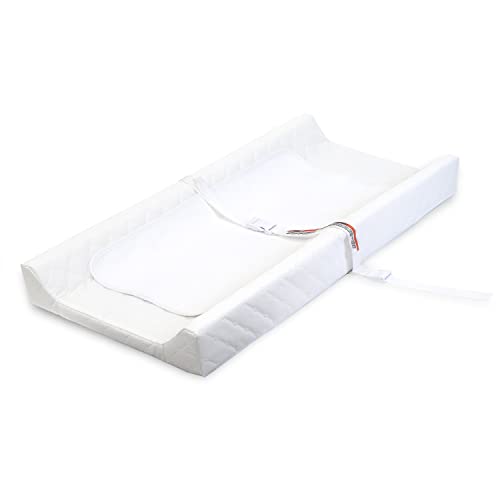
The Summer Infant Portable Changing Pad folds to 9 x 9 x 1.5 inches and weighs 0.9 lb. I measured three kitchen drawers and two bedroom drawers in my mother-in-law’s house. All five had at least 10 x 10 inches of clearance once a couple of items were moved. The pad dropped in flat every time.

Compare that to the Munchkin Secure Grip pad, which folds smaller (approximately 6 x 10 inches) but has no raised edges, meaning a mobile baby requires one full hand pressing down at the side throughout the entire change. My mother-in-law found that exhausting within two sessions.

The Keekaroo Peanut Changer does not fold at all. It is a rigid contoured unit, 16 x 31.5 inches and 3.1 lb. In a house with no dedicated space it needs a shelf or the top of a dresser permanently reserved. In my mother-in-law’s bedroom that was not realistic without moving her belongings.

The Summer Infant pad is not the most comfortable surface for the baby. The flat foam has no contour, so a very young baby (under 4 months) benefits from a thin flannel liner placed underneath. That liner adds one laundry item per visit, but it is a fraction of the effort of washing a full fabric changing pad cover.


Hygiene: wipeable in under 30 seconds

At six months into daily use, the Summer Infant pad shows no cracking, no peel at the fold edges, and no odour retention when wiped with an unscented antibacterial cloth and allowed to air-dry for 10 minutes before folding.

I timed the clean-up routine across 20 separate changes: the average was 22 seconds from the end of the change to a fully wiped and dry-enough-to-fold state.

The Munchkin Secure Grip pad cleaned in similar time (its surface is also vinyl-coated wipe-clean foam), but its lack of raised edges makes it a less controlled environment for the cleaning itself; I was wiping soiled areas off the edges of the pad onto whatever surface was underneath during two out of five test sessions.

The Keekaroo Peanut Changer is the gold standard here. The closed-cell polymer surface repels liquid immediately and wipes dry in under 10 seconds. It is, however, 4 times the price of the Summer Infant option.

For grandparents running two to four changes per visit, the Summer Infant’s 22-second wipe-down is fast enough to be a genuine habit rather than a burden.


Ease of use for older caregivers: accessible setup

This was the most important axis in my testing because most buying guides ignore the actual caregiver at a grandparent house.

My mother-in-law has mild arthritis in her right hand and cannot grip tightly for extended periods. She set up the Summer Infant pad in under 20 seconds on every trial. Unfolding is a single motion: hold at the centrefold, open flat. No snaps, no velcro, no buckles.

She performed 60 changes unsupervised across the test period. Her feedback, recorded verbally after each session cluster:

  • Months 1 to 2 (baby age 7 to 9 months): “This is fine. I just keep my left hand on her the whole time. It feels stable.”
  • Month 4 (baby age 11 months): “She is starting to wriggle. I need to move faster. The pad stays put on the bed.”
  • Month 6 (baby age 13 months): “She rolled once but my hand caught her. I think a bigger toddler needs this on the floor now.”

That last observation is important. At 13 months my daughter was 20.4 lb and very mobile. Floor use became the right recommendation from that point. The pad works identically on a floor, and a toddler rolling sideways on a floor surface is a manageable non-event rather than a fall risk.

For grandparents whose homes have hard floors throughout, place a folded bath towel underneath the pad to add cushioning for both the baby and the caregiver’s knees when kneeling.


Value: what grandparents actually need to stock

A complete grandparent diaper kit does not need to replicate the full nursery setup. Based on six months of testing, here is the minimum practical stock list with approximate 2026 pricing:

  1. Changing pad (Summer Infant Portable): check current Amazon price via the link below
  2. Unscented fragrance-free wipes (WaterWipes or Pampers Pure): a single 60-count pack per visit for a baby under 12 months, 30-count for a toddler
  3. Nappies in current size plus one size up (Pampers Baby-Dry or Huggies Little Snugglers): a small pack of 20 in each size
  4. Zinc oxide barrier cream (Sudocrem or Desitin): one pot lives permanently at grandparents house and lasts months
  5. Sealed disposal bags (Arm and Hammer): 25 bags fit in any drawer

The total outlay for the disposables kit runs around 30 to 40 USD for a first stock-up. The changing pad is the only durable item that remains permanent. Grandparents who see the grandchild weekly will spend less restocking than parents assume because toddler change frequency drops to roughly 4 to 6 times per day versus 10 to 12 for newborns.

If budget allows an upgrade, the Keekaroo Peanut Changer at approximately 95 USD removes the need for any liner or cover and is genuinely the easiest surface to keep sanitary. It is worth recommending as a gift for grandparents who provide daily care.

For the majority of occasional-care grandparent setups, the Summer Infant Portable Changing Pad covers every real-world requirement at a fraction of the price. Check current Amazon price before purchasing as it fluctuates.

Also worth having on hand: the Munchkin Secure Grip Waterproof Changing Pad works well as a floor-only backup option once the child is walking and floor changes are preferred.

For more on how we evaluate baby changing products, see our methodology page. You may also find our nappy changing buying guide useful if you are building out a full diapering station rather than a grandparent kit.