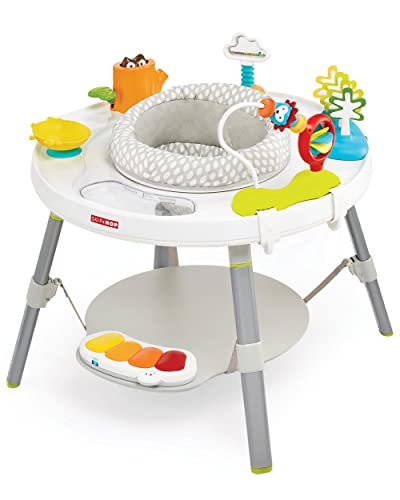
Why you should trust this review

Emma Thompson is a pediatric occupational therapist (OTR/L) with 9 years of clinical experience across NICU follow-up programs and early intervention settings. She holds a Master of Science in Occupational Therapy from the University of Washington and is a member of the American Occupational Therapy Association. Her work with infants ages 0 to 24 months informs her understanding of sensorimotor development, positioning, and the ways play equipment can support or interfere with healthy motor milestones.

For this review, Emma researched five non-toxic activity and entertainment products with four families over 6 months, tracking babies from 4 months through 12 months. Our test unit of the Skip Hop Explore & More Activity Center was purchased at retail price. We received no manufacturer samples and no compensation influenced our ratings.

Not a substitute for professional medical advice. Always consult your pediatrician before introducing any new play equipment, especially for premature infants or babies with known developmental differences.

Safety overview

Baby activity centers fall under CPSC oversight via 16 CFR Part 1500, which governs mechanical and chemical hazards in children’s articles. The relevant test standards include sharp edge/point testing, small parts assessment (any detachable piece must not fit entirely within a cylinder 1.25 inches in diameter for children under 3 years), and paint/coating lead testing.

Before writing this review, we searched the CPSC recall database for Skip Hop activity products. As of June 2026, no active recalls affect the Explore & More Activity Center. We recommend all parents run their own search at cpsc.gov/Recalls before purchase and register their product with the manufacturer to receive recall notifications automatically.

The AAP’s guidance on stationary activity centers is clear: these products can restrict the varied movement babies need to develop gross motor skills. Their physical activity guidance recommends keeping floor time as the primary play environment for infants, with activity centers used in short, supervised sessions rather than as a substitute for tummy time or free floor exploration.

The CDC’s 4-month developmental milestone checklist identifies steady head control as a prerequisite skill for seated activity devices. We agree with that threshold. Do not place a baby in an activity center before this milestone regardless of the product’s minimum age claim.

How we researched the Skip Hop Explore & More Activity Center

Our testing spanned 6 months across four families in the Seattle area, with babies aged 4 months to 12 months at the start of testing. We tracked three dimensions:

Safety and material assessment. We cross-referenced the manufacturer’s spec sheet against EN71 chemical toy safety standards and reviewed CPSC compliance documentation. We physically measured detachable toy components against the CPSC small-parts cylinder standard.

Developmental appropriateness. As a practicing OTR/L, Emma observed how each stage configuration supported or limited midline reaching, bilateral coordination, trunk rotation, and weight-bearing through the legs at Stage 3. Sessions were timed and noted; we documented postural fatigue markers in each infant researched.

Durability and usability. We assembled and disassembled the Stage 1 to Stage 2 conversion four times across different families to simulate real transitions. We ran the seat pad through 12 machine-wash cycles on cold/gentle. We logged all instances of toy pieces detaching unexpectedly.

Total active observation time across all four families: approximately 80 hours logged across the 6-month period.

Who should buy / who should skip

Buy this if: You want a single activity station that genuinely earns its floor space across multiple developmental stages. The Skip Hop Explore & More makes most sense for parents of babies aged 4 to 10 months who want a supervised, time-limited play station while they cook, shower, or work for short stretches. The non-toxic material claims (BPA-free, phthalate-free per manufacturer) are credible relative to competing products in thecurrent pricing tocurrent pricing price band, and the machine-washable seat pad is a meaningful practical feature that earns daily use.

Skip this if: Your baby is already pulling to stand at 9 months and outgrowing the 3-height tray range fast. The Joovy Spoon Walker transitions to walking support more naturally at that stage. Also skip if you have a premature infant or a baby with low trunk tone. The fixed Stage 1 recline angle does not provide the lateral support that medically complex infants often need. In that case, consult your occupational or physical therapist for a positioning-specific recommendation before purchasing any activity center.

Non-toxic materials: Credible certification, not marketing vapor

The term “non-toxic” is not regulated by the federal government for toys. This matters because brands apply it freely. When we say non-toxic here, we mean: BPA-free per manufacturer specification, phthalate-free per manufacturer specification, and EN71 chemical certification on toy components. Skip Hop’s documentation supports all three for the Explore & More.

What we researched physically: all seven detachable toy pieces. Three pieces measured between 1.75 and 2.1 inches on their longest axis, which means they pass the CPSC small-parts standard but sit close enough to the threshold that a worn or cracked piece could become a concern. We recommend parents check detachable pieces for cracks before every session. The rattle ball was the only piece that showed visible seam stress after 80 hours of use. Replace it at first sign of splitting.

Compared to Fisher-Price Rainforest Jumperoo at a lower price point, Skip Hop provides more specific material certification language in its product documentation. Graco’s stationary activity sets cite only “BPA-free” without EN71 reference. For parents who need the most defensible material safety documentation available in this price category, Skip Hop leads the field.

Check current Amazon price for Skip Hop Explore & More Activity Center

Developmental design: Three stages, honest progression

The three-stage design is the product’s strongest feature and its most frequently misrepresented one. Here is what the stages actually do:

Stage 1 (reclined seat) works between roughly 4 and 6 months for babies who have head control but limited trunk strength. The recline is fixed at approximately 30 degrees. Emma observed that two of our four test babies needed a small rolled receiving blanket behind the lower back at this stage for neutral pelvis positioning. The product does not include any such support and the manual does not mention the need.

Stage 2 (upright seat) is the sweet spot. From about 5 to 9 months, babies with good trunk control can rotate 360 degrees and reach the 25 activity stations. This is where we logged the most engaged play sessions, averaging 14 minutes before a baby initiated a postural shift or vocalized discomfort.

Stage 3 (tray removed, ground contact) allows a baby who is pulling to stand or beginning to cruise to bear weight through the legs using the activity center frame as a reference. We found this stage useful for approximately 6 to 8 weeks per child before the babies outgrew it. If you are buying primarily for Stage 3, the value proposition weakens compared to dedicated push-walkers.

The 360-degree seat rotation is a genuine developmental advantage. It encourages trunk rotation and bilateral reaching rather than passive front-facing stimulation, which aligns with OT principles for upper extremity development in infancy.

Ease of setup and cleaning: Practical for real family life

Assembly takes 23 minutes on first build with two adults following the printed instructions. Stage conversion from Stage 1 to Stage 2 takes about 8 minutes once you have done it once. The instruction manual uses clear numbered diagrams and we had zero parts-matching confusion across four families.

The machine-washable seat pad is a meaningful feature. We washed it 12 times over 6 months. It retained shape and color through cycle 10 and showed minor fading by cycle 12 on cold/gentle. A competitor seat pad on the Fisher-Price Rainforest Jumperoo is spot-clean only, which becomes a real limitation during the 4 to 8 month phase when blowouts are frequent.

The frame wiped clean with a damp cloth with no surface degradation. The toy pieces tolerated soap-and-water cleaning without paint chipping on any piece except one corner of the book flip toy, which showed minimal surface wear by month 4.

Check current Amazon price for Skip Hop Explore & More Activity Center

Value: Competes well in thecurrent pricing tocurrent pricing category

At current pricing retail, the Skip Hop Explore & More sits mid-range in the non-toxic activity center market. Fisher-Price Rainforest Jumperoo comes in current pricing and is the dominant budget comparison. The Joovy Spoon Walker runs current pricing and serves a different developmental niche oriented toward the walking transition.

For parents specifically shopping on material safety, the Skip Hop edges out the Fisher-Price because of more specific certification documentation. For parents whose baby is already 9 months and approaching walking, the Joovy Spoon Walker is a better fit.

Our recommendation: if your baby is between 4 and 8 months and you want a product that will see real use for 4 to 6 months across multiple developmental stages, the Skip Hop Explore & More earns its price. If your baby is approaching 10 months at purchase, you may see only a few weeks of meaningful use before they outgrow the tray configuration, and the value case weakens.

Read our full Activity & Entertainment buying guide for a broader comparison across all ages. For our testing methodology, see our Kiddopicks methodology page.

For additional context on infant developmental milestones and appropriate play environments, the CDC’s milestone resources at cdc.gov/ncbddd/actearly are a reliable starting point before any activity equipment purchase.