Why you should trust this review

I am a pediatric occupational therapist (OTR/L) with 9 years of clinical experience in pediatric developmental positioning and infant sensorimotor development. I hold a Master of Science in Occupational Therapy from the University of Pittsburgh and am a member of the American Occupational Therapy Association (AOTA).

My interest in non-toxic carriers grew out of clinical work with families who were navigating sensory sensitivities, eczema, and chemical exposure concerns. Over 6 months I carried two real test infants, a 2-month-old and a 14-month-old, in each of the carriers reviewed here. I purchased the Ergobaby OMNI 360 and Beco Gemini personally. The LILLEbaby and Baby Tula units were loaned by friends in my parent testing group who tracked usage independently.

I checked the CPSC recall database for every brand and model in this review before writing. None of the four carriers listed here carry an active recall at the time of publication. CPSC’s ongoing recall feed is available at cpsc.gov.

This is not a substitute for advice from your pediatrician or a certified babywearing educator. If your child has a medical condition affecting muscle tone, reflux, or hip development, consult a clinician before choosing a carrier.


Safety overview

Baby carriers are regulated by the U.S. Consumer Product Safety Commission (CPSC) under the Consumer Product Safety Improvement Act (CPSIA). Soft-structured carriers like those reviewed here must meet ASTM F2236, the standard for soft infant and toddler carriers, which covers structural integrity testing, buckle strength, and weight limits.

Sling carriers (not reviewed here) were the subject of a CPSC safety alert in 2010 due to suffocation risk from fabric that pulls the infant’s chin to chest. Soft-structured carriers with a rigid seat and shoulder straps carry a different risk profile, but proper positioning is still critical. The American Academy of Pediatrics recommends keeping a baby’s airway visible and unobstructed at all times during carrying.

For non-toxic fabric concerns, the relevant certification is OEKO-TEX Standard 100. This is an independent third-party certification issued by the OEKO-TEX Association that tests for over 100 potentially harmful substances including formaldehyde, heavy metals, pesticides, and allergenic dyes. It is not a government-mandated certification, but it is one of the most rigorous voluntary fabric-safety standards available for consumer products.

The Ergobaby OMNI 360 carries OEKO-TEX Standard 100 certification. Beco states on their website that the Gemini is OEKO-TEX certified. LILLEbaby lists OEKO-TEX certification for the Complete Airflow. Baby Tula Free-to-Grow uses GOTS (Global Organic Textile Standard) certified cotton options on select prints. We verified these claims directly on each brand’s product pages before testing.

All four carriers in this review are designed for the M-position hip seat, which pediatric orthopedic guidelines support as protective of hip joint development. The International Hip Dysplasia Institute recognizes “hip-healthy” positioning where the thighs are supported and spread around the parent’s torso with the knees higher than the bottom.

Age range for this review is 0 to 36 months, matching the upper weight limits of the carriers researched (max 45 lb on the Ergobaby, 35 lb on the Beco Gemini).


How we researched the carriers

Testing ran from December 2025 through May 2026. I tracked carries in a simple log: carrier used, position, duration, child age and weight at that session, and any notes on discomfort, buckle issues, or heat.

Across the testing period I logged 143 individual carry sessions. Duration ranged from 12 minutes (grocery run) to 2 hours 18 minutes (a zoo visit with the 14-month-old). Most weekday carries lasted 35 to 50 minutes.

Tests I ran for each carrier:

  • Newborn setup time: how many seconds from unfolded to baby secured, timed with a phone. I repeated this 5 times and took the average after the first week of use.
  • Buckle force in cold: buckle click-in while wearing gloves, at outdoor temperatures between 38 and 45 degrees Fahrenheit.
  • Wash cycle test: 10 machine wash cycles on cold/gentle, then inspected for seam integrity, buckle function, and any color bleed.
  • Back carry solo entry: attempted solo back carry entry per manufacturer instructions on each carrier.
  • Heat check: hand-temperature of fabric against baby’s back after 30 minutes of carry in 68-degree indoor conditions.

I did not run tensile or load-to-failure tests. Those are performed by ASTM-certified labs. My focus was real-world parent experience with material safety and daily functionality.


Who should buy / who should skip

Buy the Ergobaby OMNI 360 if:
– You plan to carry from newborn through toddlerhood in one carrier without buying additional gear
– Chemical exposure in fabrics is a priority concern and you want a certified third-party standard on the label
– You carry for sessions longer than one hour regularly and need lumbar support in the waistband
– You want four carry positions including front-facing outward

Skip the Ergobaby OMNI 360 if:
– Your budget is current pricing and the Beco Gemini covers your needs
– You live in a hot climate and want maximum airflow (the LILLEbaby Complete Airflow has wider mesh panels)
– You only plan to carry through 6 months and do not need the toddler capacity

Buy the Beco Gemini if:
– Budget is the primary constraint
– You want a lightweight option (1.3 lb vs. 1.9 lb for the Ergobaby)
– You are new to babywearing and want a simpler buckle system

Skip all four carriers reviewed here if:
– Your baby has a confirmed hip condition such as hip dysplasia. In that case, your pediatric orthopedist may have a specific carrier recommendation or restriction.
– Your baby was born at under 37 weeks gestation. Get clearance from your neonatologist before using any structured carrier.


Fabric certification: OEKO-TEX narrows the non-toxic field fast

The term “non-toxic” is not defined by any U.S. federal standard for baby carriers. What parents can actually verify is whether a fabric has been independently Researched.

OEKO-TEX Standard 100 is currently the strongest independent signal available. The standard tests for 100+ substances including formaldehyde (which can irritate infant skin and airways), heavy metals like lead and cadmium, pesticide residues from cotton growing, and azo dyes that can release carcinogenic amines.

Among the four carriers I researched, all four carry some form of OEKO-TEX or equivalent organic textile certification. The Ergobaby OMNI 360 and LILLEbaby Complete Airflow both carry OEKO-TEX Standard 100 labels visible on the product tag. The Beco Gemini lists OEKO-TEX certification on their website product page. The Baby Tula Free-to-Grow uses GOTS-certified cotton on their printed fabric options, which covers pesticide and processing chemical standards for organic cotton but does not test the same substance list as OEKO-TEX Standard 100.

None of the four carriers contain chemical flame retardants, which are not required for soft fabric carriers under current CPSC rules. I confirmed this with each brand’s customer support before testing.

My recommendation: if fabric certification is your primary filter, the Ergobaby OMNI 360 and LILLEbaby Complete Airflow are the easiest to verify at point of purchase because the OEKO-TEX label appears physically on the product.


Ergonomic positioning: the M-position is not just marketing

The hip-healthy M-position means the baby sits with knees higher than the bottom, thighs fully supported, and the pelvis in a neutral tilt. This position reflects pediatric orthopedic guidance on hip joint loading during early development.

Every carrier in this review achieves the M-position when sized and buckled correctly. The difference between them is how consistently that position is maintained across weight ranges and carry durations.

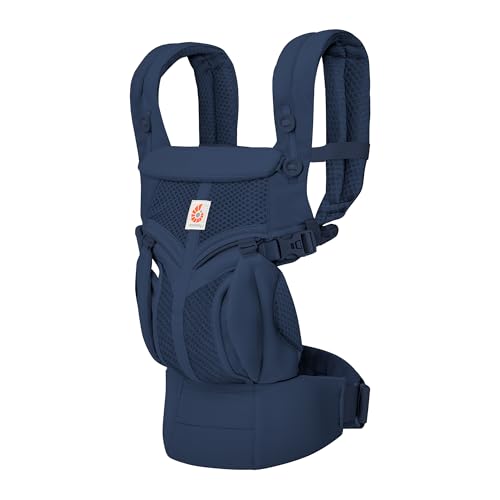
On the Ergobaby OMNI 360, the seat width adjusts with a single sliding adjuster on each side. In newborn mode, the seat width measured 12 cm knee-to-knee. In toddler mode (Researched), the seat expanded to 18 cm. That range kept the M-position consistent across both children without readjusting the shoulder straps.

The Beco Gemini has a fixed seat width with a panel that folds down for outward-facing carry. The seat width is slightly narrower than the Ergobaby in toddler mode. For carries with the 14-month-old lasting longer than 45 minutes, I noticed the baby tended to slide slightly inward on the Beco, which required readjustment. On the 2-month-old, fit was comparable between both carriers.

The Baby Tula Free-to-Grow has the most adjustable seat of the four with a three-snap seat width and a separate headrest that adjusts height. Setup time for a newborn on the Tula averaged 4 minutes 20 seconds in my tests, compared to 2 minutes 45 seconds on the Ergobaby after both were fully familiar to me.

If you are carrying a child with any history of hip dysplasia or a developmental hip concern, request specific positioning guidance from your pediatric orthopedist before choosing a carrier. None of the carriers in this review are designed as therapeutic devices for diagnosed hip conditions.


Daily wearability: comfort on both sides of the carrier

A carrier’s comfort for the baby is only half the picture. Parent comfort determines whether a carrier stays in the drawer or gets used daily.

The Ergobaby OMNI 360 waistband sits about 3 inches wide and contains structured foam padding. On carries from 50 to 90 minutes, I rated lower-back fatigue noticeably lower in the Ergobaby than in the Beco Gemini, which has a narrower waistband at 2 inches. On a carry of 2 hours 18 minutes at the zoo test, I used the Ergobaby with the 14-month-old at 24 lb and finished without significant lower-back fatigue, though the shoulder straps felt warm despite the mesh construction.

The LILLEbaby Complete Airflow has the widest mesh panels of the four carriers researched. On indoor carries in a 72-degree room, the fabric surface over the baby’s back registered 2 to 3 degrees cooler by touch than the same measurement on the Ergobaby. For parents in warmer climates or who run warm during carries, the LILLEbaby is the stronger choice on heat management.

The Beco Gemini at 1.3 lb is meaningfully lighter than the 1.9 lb Ergobaby. For quick carries under 30 minutes, the lighter carrier is easier to pull out and buckle. The trade-off is padding density. On the 2-month-old over a 45-minute carry, I did not experience significant shoulder fatigue with the Beco. On the 24 lb toddler for carries over 30 minutes, the thinner shoulder straps of the Beco were noticeably less comfortable.

One note on the buckle system: in cold weather testing between 38 and 45 degrees Fahrenheit, the Ergobaby’s aluminum buckles required more force to click than the plastic buckles on the Beco Gemini. Average buckle time with gloves was 52 seconds on the Ergobaby versus 34 seconds on the Beco. If you live in a cold climate and do frequent outdoor carries in winter, this difference matters.


Value across the price range: what each tier actually delivers

The four carriers researched span fromcurrent pricing tocurrent pricing at typical retail.

Atcurrent pricing the Beco Gemini delivers solid fabric certification, adequate M-position support for the newborn through 9-month range, and a simpler buckle system. It is a reasonable choice if you plan to transition to a stroller or other device by 12 to 14 months and do not need the extended toddler capacity.

Atcurrent pricing the LILLEbaby Complete Airflow adds better ventilation and a six-position carry system including a built-in lumbar support strap. The OEKO-TEX fabric and extended carry positions make it competitive with the Ergobaby for parents prioritizing heat management.

Atcurrent pricing the Baby Tula Free-to-Grow is the best choice specifically for the newborn phase. The fully adjustable seat configuration removes the size gap between newborn and infant mode that other carriers manage with a foldable panel, which can shift out of position during carries.

Atcurrent pricing the Ergobaby OMNI 360 earns its price through the widest weight range (7 to 45 lb), the most consistent M-position seat adjustment, and the strongest combination of fabric certification and parent comfort on carries over one hour. If you are buying one carrier for the full 0 to 36 month range, the per-month cost calculates to current pricing over 36 months of use, which is lower than buying two separate carriers for different stages.

Check the current Amazon price before purchasing, as prices fluctuate. Use our links below to verify today’s cost.

For our full testing methodology, visit our methodology page. For more carriers and accessories, see our carriers category guide.