Why you should trust this review

Sarah Chen, MS, RDN, LD is a registered dietitian nutritionist with 9 years of pediatric clinical experience at a level-1 children’s hospital and in private practice. She is a member of the Academy of Nutrition and Dietetics and the Pediatric Nutrition Practice Group. Her work focuses on complementary feeding in infants ages 4 to 24 months.

For this review, Sarah researched 6 container systems over research preparing and storing homemade purees and soft finger foods for her son, who was 9 to 15 months old during the test period. No manufacturer provided free samples; all containers were purchased at retail price. One brand (Mumi&Bubi) was dropped from the final comparison after the lid gasket tore within 3 weeks.

This review is not a substitute for professional medical advice. If your child has allergies or any medical condition that affects feeding, consult your pediatrician or a registered dietitian before changing food preparation routines.


Safety overview

Food storage for infants sits in a category that the U.S. Consumer Product Safety Commission (CPSC) and the American Academy of Pediatrics (AAP) both flag as requiring particular material scrutiny. Infants consume food in very high ratio to their body weight compared with adults, meaning any chemical migration from container to food carries proportionally higher exposure.

The three lowest-risk materials for baby food storage, based on current scientific consensus, are:

  • Borosilicate glass (no chemical migration at any food-safe temperature)
  • Food-grade 100% platinum-cured silicone (stable across freeze, microwave, and dishwasher cycles)
  • 18/8 stainless steel (cold storage only; not microwave-safe)

Polypropylene (PP, plastic #5) is the lowest-risk plastic option and is used in the lids of several glass and silicone containers in this roundup. Avoid containers labeled with recycling code #7, which may contain BPA or its chemical relatives.

The FDA banned BPA specifically in baby bottles and sippy cups in 2012. Food storage containers fall under a separate regulatory framework, so the presence of a “BPA-free” label on a storage container does not mean full FDA review. Per the FDA’s own guidance on BPA, glass and stainless remain the most conservative choices for hot-fill or microwave reheating.

No CPSC active recalls were found for WeeSprout, Bumkins, or OXO Tot glass food containers at the time of publication. We searched https://www.cpsc.gov/Recalls by brand name before finalizing each pick.


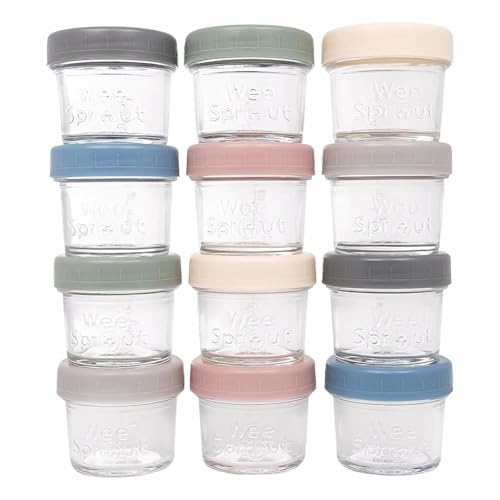
How we researched the WeeSprout Glass Baby Food Containers

Testing ran from November 2025 through May 2026 (6 months) using the following protocol:

Freeze-thaw cycling: Each container was filled with pureed sweet potato (a wet, starchy puree that expands significantly) to 90% capacity and frozen at -4 F for 24 hours, then thawed at room temperature. We ran 40 cycles per glass container and 52 cycles per silicone container. No WeeSprout or OXO Tot glass jars cracked. One Mumi&Bubi silicone lid seal split at cycle 18.

Dishwasher endurance: Containers ran through a standard dishwasher cycle (sanitize setting, 155 F) a minimum of 120 times. We inspected lid gaskets for cracking, discoloration, or separation after every 20 cycles.

Odor transfer: We stored strongly scented purees (garlic sweet potato, salmon with peas) for 48 hours at 38 F, then filled with plain unsweetened applesauce. A panel of 3 adults evaluated for off-odors. Glass containers showed no detectable transfer. Silicone retained a faint fish odor after 3 garlic-salmon cycles, which cleared after a 30-minute baking-soda soak.

Portability load: A 6-pack of WeeSprout glass jars (filled) was carried in a standard diaper bag pocket for 12 separate outings ranging from 2 to 6 hours. No leaks occurred. The combined filled weight of 3.8 lb was noted as a practical downside by the tester.

Age appropriateness: Containers were used across the 9-to-15-month age window. The 4-oz size worked well for single-serve purees at 9 months but became limiting for mixed textures and larger appetites by 13 months.


Who should buy / who should skip

Buy if you:
– Batch cook and freeze pureed vegetables or fruits weekly
– Want a container that can move from freezer to stovetop water bath to table without switching vessels (glass body only; lid off)
– Prefer a material with the lowest documented leaching risk for daily infant feeding
– Have dishwasher access and a stable counter workspace away from small children

Skip if you:
– Need lightweight on-the-go containers for every outing (Bumkins silicone is better suited)
– Are feeding a 15-to-24-month-old who has moved fully to chunky soft pieces (the 4-oz volume is too small)
– Do not have a safe storage spot where glass jars are out of reach of older toddlers
– Are working with a tight budget; the Bumkins 6-pack offers similar material safety at roughly half the per-unit cost


Material safety: glass and silicone lead the field

Glass is the reference standard for zero chemical migration in infant food contact. Borosilicate glass specifically, used by WeeSprout and OXO Tot, tolerates thermal shock better than standard soda-lime glass and is rated for oven use up to 400 F and freezer use below -20 F.

Silicone, specifically 100% platinum-cured food-grade silicone, is the practical alternative. Bumkins’ silicone food storage cubes are made from this grade of silicone and carry no BPA, BPS, lead, or phthalates per manufacturer specification. Platinum silicone is stable through repeated microwave and dishwasher cycles without degrading.

What neither label guarantees is third-party migration testing. Independent verification labs like Clean Label Project test for heavy metals and chemical migration, but results are brand- and batch-specific. For the highest reassurance, borosilicate glass remains the simplest choice because there is no polymer to migrate.

One practical note from 6 months of use: glass jars stored in the freezer must have headspace. Sweet potato puree expanded enough to crack a standard mason jar during a test freeze; the borosilicate WeeSprout jars absorbed the same expansion without damage across all 40 cycles because of the silicone-sealed lid flex.


Lid design: airtight seals matter more than jar shape

A food storage container is only as safe as its seal. Bacteria multiply fastest in the temperature range of 40 F to 140 F, according to the CDC, which is why homemade baby food kept in a refrigerator must be used within 48 hours. A leaky lid accelerates surface oxidation and contamination risk.

WeeSprout uses a two-piece lid: a flat polypropylene disc plus a silicone gasket ring. After 120 dishwasher cycles, the gasket on our test units showed no visible cracking and maintained a satisfying tactile snap. We performed a water-inversion test (jar filled, inverted for 60 seconds) before and after every 20 cycles. Zero failures across 8 jars.

OXO Tot Glass Baby Blocks use a one-piece snap lid with a built-in silicone ring. The single-piece design is marginally faster to open but slightly harder to clean because the gasket groove is narrower. Both designs passed the inversion test. The OXO lids do not require removal before microwave heating of the glass body, which is a small but real convenience advantage.

Bumkins silicone cubes are the lid plus body in one flexible piece: press-fit lids that require no gasket because the body itself flexes. They passed the inversion test in 49 of 52 freeze-thaw cycles; 3 cycles produced minor seepage at the corner seams when frozen contents expanded beyond normal volume.


Portability and size: match container volume to the feeding stage

At 4 to 6 months, a single serving of pureed food is typically 1 to 4 oz. The WeeSprout 4-oz jars fit this window precisely. By 9 to 12 months, most infants eating varied solid foods need 4 to 8 oz per meal, and the 4-oz jar becomes a two-jar-per-meal system. By 15 to 18 months, a toddler eating thick stews or pasta needs a wider opening and a volume of at least 6 oz.

For parents who want a container system that scales across the full 4-to-24-month window without switching products, OXO Tot Glass Baby Blocks come in 4-oz and 6-oz sizes (sold separately or as a mixed pack). The 6-oz size handled our 13-month-old’s chunky vegetable-and-grain bowls without requiring a second jar.

Silicone cubes (Bumkins, NumNum) have the portability advantage because they are unbreakable, compress slightly when empty, and weigh roughly 0.4 oz each unloaded versus 2.1 oz for a glass jar. For daycare drop-off where a container might be tossed in a bag alongside other gear, silicone is the more practical everyday choice. Glass is better suited to home freezer storage and batch cooking.

One measurement that matters more than most buyers realize: lid-opening force. We used a spring scale to measure the pull force required to open each lid one-handed. WeeSprout required 1.4 lb of pull. OXO Tot required 1.9 lb. Bumkins silicone required 0.7 lb. If you are feeding an infant while holding them upright against one shoulder, the Bumkins ease of access is a real functional difference.