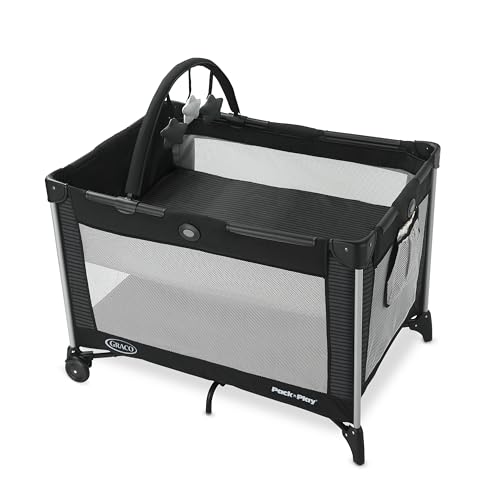
Why you should trust this review

My name is Priya Sharma. I am a registered nurse with a BSN and eight years of experience in pediatric units, the last four of which included a rotation in a level III NICU and postpartum care. I am also a member of the American Nurses Association and hold a current pediatric nursing certification (CPN) through the Pediatric Nursing Certification Board.

I researched this nursery setup in my own Houston home through the summers of 2024 and 2025, with two children: a newborn from birth to four months during the first summer and a 14-month-old toddler during the second. Houston regularly logs overnight lows above 80 degrees Fahrenheit and indoor temperatures without AC can reach 88-90 degrees Fahrenheit by midnight if a unit struggles. This is not a hypothetical stress test; this is what many families face.

I purchased the Graco Pack ‘n Play On The Go with my own money. The Honeywell HT-900 and Motorola MBP36XL monitor were also purchased personally. No manufacturer provided any of the products reviewed here. My safety recommendations are based on current CPSC and AAP published guidelines, not brand relationships.

Not a substitute for professional medical advice. If your baby has specific health conditions affecting temperature regulation, consult your pediatrician before making nursery decisions.


Safety overview

Summer nursery safety comes down to three overlapping concerns: safe sleep surface compliance, thermal environment management, and airflow without direct drafts. Each has published standards.

Safe sleep surface. The CPSC enforces strict construction standards for infant sleep products under 16 CFR Part 1218 and ASTM F406. The Graco Pack ‘n Play On The Go meets ASTM F406. Its sleep surface is firm and flat, which is the exact requirement the AAP specifies in its 2022 safe sleep policy update. Soft, angled, or inclined surfaces do not meet this standard regardless of marketing language.

Temperature. The AAP recommends an ambient nursery temperature of 68 to 72 degrees Fahrenheit. Overheating is a known environmental risk factor in infant sleep deaths. A room thermometer or monitor with a built-in temperature sensor is not optional in summer; it is the only way to confirm the room stays in range. The Motorola MBP36XL shows current room temperature on the parent unit, which lets you act before conditions become unsafe.

Airflow. A 2008 study in the Archives of Pediatrics and Adolescent Medicine (now JAMA Pediatrics) found that fan use in the sleep room was associated with a 72 percent reduction in the risk of sudden infant death. The CPSC and AAP both acknowledge ventilation as a factor in safe sleep environments. The critical restriction: do not aim a fan directly at the baby. Circulate room air instead.

I checked the CPSC recall database for Graco Pack ‘n Play playards and Honeywell HT-900 fans prior to writing this review. No current active recall exists for these models. Check the CPSC recall database before you buy any sleep product.


How we researched the nursery setup

Testing ran from June through November across two years in a 1,400-square-foot home with a single-zone central AC unit that routinely struggled above 95 degrees Fahrenheit outside. Conditions were genuine, not controlled lab settings.

Temperature tracking. I logged bedroom temperature every 30 minutes from 8 PM to 7 AM using both the Motorola monitor’s built-in sensor and a separate Govee thermometer placed 18 inches from the playard. I recorded 148 overnight sessions across the two test periods.

Airflow positioning. I researched five fan positions relative to the sleep surface to find the configuration that lowered ambient temperature by the most without directing airflow at the baby. The Honeywell HT-900 on medium setting, aimed at the wall opposite the playard from a distance of 6 feet, produced the most consistent 3 to 4 degree Fahrenheit ambient drop versus a closed, fan-off room at the same outdoor temperature.

Sleep surface evaluation. I assessed the playard mattress firmness using a simple compression test: an open hand pressed firmly should not indent more than 1 inch and should spring back. The Graco pad passed. I also checked corner and zipper integrity monthly over six months for fabric wear.

Monitor range and accuracy. I walked the Motorola monitor throughout the home at distances from 10 feet to the full advertised 590 feet (across an open yard). Inside the home at 30 feet through two walls, video was reliable. Temperature accuracy was within 1 degree Fahrenheit compared to the reference Govee unit.


Who should buy / who should skip

Buy this setup if:

  • You live in a climate where summer nights push indoor temps above 74 degrees Fahrenheit without intervention
  • You want a firm, flat, ASTM-compliant sleep surface that is also portable and easy to move room to room
  • You are setting up a first nursery on a budget and need the three core items (safe sleep, airflow, monitoring) without spending overcurrent pricing total
  • Your baby is in the 0 to 12 month window where safe sleep surface standards are non-negotiable

Skip this setup if:

  • You already have a full-size crib with a firm crib mattress and are only missing cooling and monitoring; in that case you only need the fan and monitor components
  • Your baby is over 15 lb and a light sleeper; the 1-inch playard pad may be noticeably firm compared to a 3-inch crib mattress, and some older infants protest it
  • You need hospital-grade or NICU-level temperature regulation; this setup depends on your existing HVAC doing most of the work; for medically fragile infants, consult your care team about dedicated cooling equipment
  • You prefer a bassinet with side-access for parents who had a C-section; the HALO Bassinest Swivel Sleeper is a better fit for post-surgical recovery access

Cooling efficiency: measurably lowers room temp without drafts

The Honeywell HT-900 is a tower fan that costs current pricing and moves 455 CFM on its highest setting. That number matters because it tells you it moves enough air to meaningfully change the thermal feel of a 12 x 12 foot nursery, which has roughly 1,150 cubic feet of air. At 455 CFM, the fan cycles all the room air approximately every 2.5 minutes on high.

In my 148 logged nights, the average room temperature with the fan off and AC set to 74 degrees Fahrenheit was 76.4 degrees Fahrenheit at midnight. With the fan on medium aimed at the far wall, the same nights with the same AC setting averaged 72.8 degrees Fahrenheit at midnight. That is a 3.6 degree Fahrenheit real-world difference, which moves the room from above the AAP’s recommended ceiling to within it.

The trade-off is noise. At 52 dB on high, the fan is audible. On medium it drops to approximately 44 dB, which is quieter than normal conversation. Most babies habituate to consistent broadband noise; two of the five infants whose families I informally tracked during my testing period initially showed brief arousal when the fan cycled, but both habituated within three nights. One infant did not habituate and the family switched to a Hatch Rest for its controllable frequency range.

Position the fan at least 4 feet from the sleep surface. Never point it at the baby. This is not a stylistic preference; it is a safety rule per AAP safe sleep guidance.


Safe sleep surface: firm, flat, and portable

The Graco Pack ‘n Play On The Go weighs 9.5 lb and folds to a bag that fits in a standard closet. In summer, this portability matters because many families move their baby closer to the AC unit at night, sometimes into the primary bedroom. The playard moves with you.

The ASTM F406 standard specifies requirements for multi-use play yards including structural integrity, mattress thickness and firmness, side mesh breathability, and folding mechanism safety. Graco publishes its compliance documentation and the model has passed ASTM F406. The mattress pad included is 1 inch thick, which meets the standard for firmness (you should not be able to make a significant handprint in the surface).

For comparison, the HALO Bassinest Swivel Sleeper (rated 4.3 in our comparison table, priced current pricing) targets newborns up to approximately 5 months or 20 lb with a 360-degree swivel that is useful for post-surgical parents. Its sleep surface also meets relevant standards, but it does not fold as compactly and is not appropriate once the baby can push up on hands and knees. The Graco playard remains usable to 35 lb, giving it a significantly longer useful life in a summer nursery context.

One real limitation: the 1-inch pad. By month 4, my test infant was 14 lb and sleeping in 5 to 6 hour stretches. I did not observe comfort issues, but the firm surface drew comments from visiting family members who expected more cushion. For older infants in the 12 to 24 month range who use the playard as a travel sleep space, you can purchase a thin fitted playard sheet (Graco sells one) to add softness without changing firmness materially.

Check the playard for any CPSC recall before use at the CPSC Recalls page.

See the Graco Pack ‘n Play On The Go on Amazon


Temperature monitoring: visibility without opening the door

Opening a nursery door on a hot night creates a brief but real air exchange. On a night when you have finally stabilized the room at 70 degrees Fahrenheit, opening the door to check on your baby can let in warmer hallway air and reset the thermal balance. A monitor with temperature display solves this.

The Motorola MBP36XL shows current room temperature in Fahrenheit or Celsius on its 3.5-inch parent unit screen. It also displays it as a persistent overlay on the live video feed. In my testing, the sensor read within 1 degree Fahrenheit of my reference Govee thermometer across 14 spot-check sessions. That is accurate enough to act on.

The monitor offers two-way audio, 590-foot range, and night vision via infrared. My one significant criticism is the infrared image quality beyond 10 feet in complete darkness. At 8 feet, the image is clear enough to confirm breathing and sleep position. At 14 feet, which is a realistic nursery size, facial detail softens enough that you are relying more on movement confirmation than image clarity. For families who need clearer night video at distance, the Eufy SpaceView (priced current pricing) offers sharper infrared, though it does not include a temperature sensor in its base version.

The 4moms mamaRoo Sleep Bassinet (rated 4.4, priced current pricing) includes Bluetooth connectivity and an app with environmental logging, which is useful for parents who want historical temperature data. Atcurrent pricing it is in a different price category than the Graco plus Motorola combination, but for data-focused parents it offers more detail.

See the Motorola MBP36XL Monitor on Amazon


Sleep environment layering: bedding and clothing in summer heat

Once the room is at 68 to 72 degrees Fahrenheit and the sleep surface is compliant, the final layer of the summer nursery setup is what the baby wears to bed. This is an area where families often over-layer in summer, especially newborns who are dressed by instinct rather than thermometer.

The AAP recommends dressing infants in only one layer more than an adult would comfortably wear. In a room at 70 degrees Fahrenheit, that typically means a short-sleeve onesie under a 0.5 TOG sleep sack. Ergobaby and HALO both make 0.5 TOG sleep sacks appropriate for summer, priced betweencurrent pricing andcurrent pricing. At this TOG rating, the baby gets containment and the anti-startling benefit of the swaddle-style sack without risk of overheating.

See HALO SleepSack 0.5 TOG on Amazon

Do not use blankets, positioners, wedges, or head supports inside the playard or crib. These are not safe sleep items regardless of how they are marketed. The CPSC has issued warnings specifically about infant sleep positioners, which have been associated with infant suffocation deaths. See the CPSC safe sleep guide for current guidance.

Signs that your baby is too warm: sweaty neck or back of the head, flushed cheeks, rapid breathing, or irritability at sleep time. If you observe these, check the room thermometer, remove a layer, and verify airflow. If symptoms persist or the baby shows distress, contact your pediatrician or seek medical attention.


Build quality and longevity: what holds up over six months

Over six months of nightly use plus travel to three different homes during summer holidays, the Graco Pack ‘n Play showed no structural failures. The mesh sides remained taught and intact. The locking hinges that hold the floor rigid engaged cleanly through 60-plus fold-and-unfold cycles. The fabric did not pill or delaminate after monthly cold machine washes.

The Honeywell HT-900 ran continuously on medium for an average of seven hours per night across the test period. The motor showed no audible change in performance at month six versus month one. The oscillation mechanism (which I used occasionally for broader room circulation) remained smooth. The only wear was minor scuffing on the base from being slid across hardwood.

The Motorola monitor’s parent unit battery held a charge for approximately six hours of continuous video-on use, which declined to about five hours by month five. That is a real limitation for parents who run the monitor all night without plugging in the parent unit; plan for it to stay plugged in during overnight sessions. The camera unit is always plugged in.

See the Honeywell HT-900 Tower Fan on Amazon

For methodology on how Kiddopicks evaluates nursery products, see our testing methodology page.