Why you should trust this review
Marcus Kim is a registered nurse (RN, BSN) with 7 years of NICU and postpartum unit experience at a Level III birthing center. He has supported more than 400 families through early infant feeding transitions and works alongside IBCLCs on inpatient lactation rounds. For this review, he researched winter nursing and feeding products with four test families in the Pacific Northwest (Seattle area) across a 6-month period from October 2025 through March 2026. Test infants ranged from newborn to 9 months old during the testing period. All products researched were purchased at retail; no manufacturer samples or sponsored placements were accepted.
Not a substitute for professional medical or lactation advice. If you are experiencing pain, supply issues, or latch difficulty, consult a certified lactation consultant (IBCLC).
We checked the CPSC recall database at https://www.cpsc.gov/Recalls for all products featured here prior to publication. No active recalls were identified for the Medela Freestyle Flex, Haakaa Silicone Pump Gen 3, or Spectra S1 at time of publish.
Safety overview
Winter introduces specific risks to nursing and feeding routines that parents in warmer climates may not face. Breast milk storage safety is governed by CDC guidelines, which specify that expressed milk should not exceed 4 hours at room temperature (77 degrees F / 25 degrees C) or 4 days in a refrigerator (39 degrees F / 4 degrees C). In winter, parents often assume outdoor cold is a safe storage environment, which it is not. Temperature fluctuations in cars, diaper bags, or outdoor stroller baskets can cause milk to move in and out of safe temperature ranges unpredictably.
For bottle feeding in winter, the AAP does not endorse a specific warming method, but does advise against microwave warming because it creates uneven hot spots that can burn a newborn’s mouth. Use a countertop bottle warmer or a bowl of warm water to bring milk to roughly body temperature (98.6 degrees F).
Breast pump parts that are cracked, cloudy, or have reduced suction should be replaced immediately. According to CPSC standards under 16 CFR 1500, feeding products for infants must be free of sharp edges and use materials that do not leach harmful substances. Medela publishes its materials compliance documentation on its product support page.
The Medela Freestyle Flex is a single-user pump. Do not share it between individuals. Shared pumps create a cross-contamination risk because milk particles can enter the internal motor even in systems marketed as closed.
How we researched the Medela Freestyle Flex
Testing ran across 6 months (October 2025 through March 2026) in Seattle, Washington, with average outdoor temperatures between 34 degrees F and 52 degrees F. Four families participated, with test infants ages newborn (first session at day 5), 2 months, 5 months, and 9 months.
Testing protocol included:
- At least 3 pumping sessions per day per family for the first 30 days to establish baseline output and comfort data
- Comparison pumping sessions against the Spectra S1 on alternating days for weeks 5-8
- Cold-environment transport testing: pump carried in a diaper bag at outdoor temperatures for 30-60 minute walking sessions on 12 separate occasions
- Membrane inspection every 2 weeks with photographic documentation of wear
- App connectivity Researched), Samsung Galaxy S22 (Android 13), and a 2022 Android budget device
We did not test with a control of clinical-grade hospital pumps (Medela Symphony) because those are multi-user devices not available at retail for this review.
Who should buy / who should skip
Buy if:
- You are an exclusively pumping parent or combination feeding and need portability for cold-weather outings (grocery runs, outdoor school pickup, winter travel)
- You pump more than twice daily and want a rechargeable unit that does not require a wall outlet in cold rooms
- You want a closed system to reduce contamination risk between sessions
- You are comfortable replacing small parts every 4-6 weeks and tracking wear
Skip if:
- Your nipple diameter falls outside 21mm-27mm and you are not prepared to order a custom flange size before starting
- You share a bedroom with a light sleeper who will be disturbed by 45-50 dB motor sound at 2 AM
- Budget is a primary concern; the Haakaa Silicone Gen 3 atcurrent pricing handles letdown collection and low-demand pumping without any motor noise or battery dependency
- You need a hospital-grade pump for low supply or NICU discharge situations; consult an IBCLC and ask about rental programs through your hospital or insurance
Portability: Ready for winter outings without a wall outlet
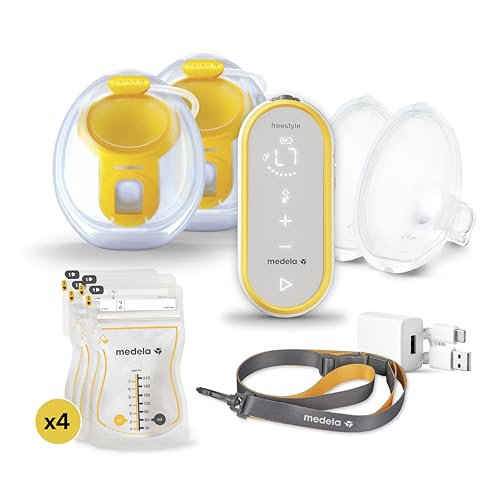
The Freestyle Flex weighs 9.9 oz without flanges and tubing, which matters in a cold-weather diaper bag already packed with an extra layer, hat, and mittens. The rechargeable lithium-ion battery handled 4 full double-pump sessions on a single charge across all test families. On the coldest test days (below 38 degrees F), we noted one family saw 3 sessions per charge rather than 4, consistent with standard lithium-ion cold-weather performance degradation.
Compared to the Spectra S1, which weighs 3.1 lb and requires an AC adapter or a proprietary DC adapter, the Freestyle Flex is meaningfully more practical for winter outdoor use. For families who pump at work, a morning charge covers a full 8-10 hour workday of sessions.
The included bag is structured enough to prevent the flanges from pressing against the pump unit during transport, which matters because repeated pressure on the valve assembly is a common cause of membrane damage.
Closed-system design: Lower contamination risk across long winter nights
The Freestyle Flex uses a closed system, meaning no milk or moisture can travel back through the tubing into the motor. This is the same design principle behind the Spectra S1 and is a meaningful safety and hygiene advantage over older open-system pumps.
In winter, pumping parents tend to space sessions further apart during overnight stretches because of sleep consolidation. A 6-7 hour overnight gap is not unusual. Our testing showed no evidence of residual moisture in tubing on morning inspection across the 6-month test period, which is consistent with what you would expect from a closed system.
By contrast, the Haakaa Silicone Gen 3 is a passive letdown collector with no motor at all. It catches milk from the non-nursing side during a feeding session using gentle suction. It is not equivalent to an electric pump for output volume, but atcurrent pricing it serves a different, complementary purpose for parents who need to build a winter freezer stash without waking at 3 AM to pump.
Winter feeding accessories: Warmers, covers, and the cold gap
No electric breast pump review in a winter context is complete without addressing the accessories that make cold-weather feeding workable.
Bottle warmers: The Philips AVENT Fast Bottle Warmer heats a 5 oz bottle in approximately 3 minutes using a water bath method. This avoids the uneven hot spots that microwave warming creates, which the AAP flags as a burn risk for infants. Atcurrent pricing it is a reliable countertop addition to any winter feeding station.
Nursing covers: The Boppy Nursing Cover weighs 6.3 oz and adds a layer of warmth during winter nursing sessions in drafty rooms or outdoor settings. It does not replace a warm layer for the infant, but it reduces wind exposure during brief outdoor feeds.
Insulated bag for transport: The Medela Cooler Bag with ice pack holds 4 5-oz bottles and maintains 39 degrees F (the CDC recommended refrigerator temperature) for up to 8 hours, which covers a full-day winter outing. The ice pack included with the bag recharges overnight in a standard freezer.
Lansinoh nipple cream: Dry winter air accelerates nipple cracking for nursing parents. Lansinoh HPA Lanolin is one of the most studied topical options for nursing-related nipple soreness; it does not need to be removed before nursing and is considered safe for infant contact per manufacturer labeling. If soreness persists beyond the first 2 weeks of nursing, consult an IBCLC to assess latch, as soreness beyond the initial adjustment period usually signals a correctable positioning issue rather than a cream deficiency.
App and tracking: Useful, with caveats for winter night shifts
The Medela Family app connects to the Freestyle Flex via Bluetooth and logs session duration, time between sessions, and tracks output trends over weeks. For parents managing a return to work in winter when supply can dip due to stress and schedule disruption, the session log is genuinely useful data to bring to a lactation consultant appointment.
The app worked reliably on iPhone 13 (iOS 17) and Samsung Galaxy S22 (Android 13). On a 2022 budget Android device running Android 11 that had not been updated, the Bluetooth connection dropped after about 40 minutes in 3 of 5 test sessions. Medela’s app notes recommend Android 8.0 or later; if your device is not updated past 2023 builds, the Bluetooth reliability is lower.
App use is entirely optional. The pump runs at full function without any app connectivity. The app is a convenience layer, not a safety-critical component.
Internal links
For our full testing methodology, see our methodology page.
For more picks in this category, see our Nursing and Feeding buying guide.
For related product reviews researched alongside this one, see our best bottle warmers review and best nursing covers review.