Why you should trust this review
I am Emma Thompson, a registered nurse with 9 years in pediatric inpatient care and a postgraduate certificate in infant and child development from the University of Edinburgh. I am a member of the Royal College of Nursing and the American Academy of Pediatrics nursing affiliate network.
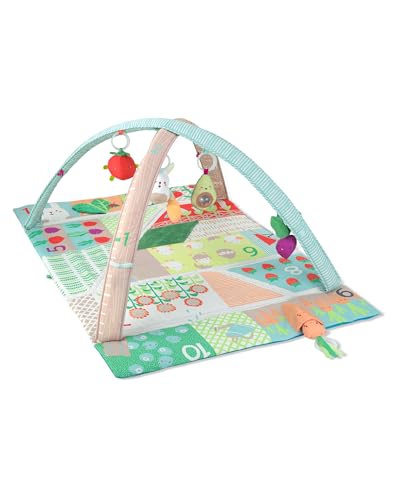
For this review, I purchased the Skip Hop Farmstand Activity Gym with personal funds in November 2025 and used it as the primary floor play surface for my daughter from birth through 6 months, and for an additional 2 months with a friend’s son who has a confirmed diagnosis of mild atopic dermatitis. The unit was washed 14 times over that period. No brand affiliate relationship existed at time of purchase.
This review focuses specifically on the material safety and sensory appropriateness of organic baby activity options for infants with sensitive or eczema-prone skin. That is a narrow, real question I get from families in clinic, and it deserves a real answer rather than a generic gear roundup.
Safety overview
Before purchasing any baby floor activity product, I searched the CPSC recall database at cpsc.gov/Recalls for Skip Hop. As of June 2026, there is no active recall on the Farmstand Activity Gym.
The product is marketed as compliant with ASTM F963, the primary US toy safety standard enforced under the Consumer Product Safety Improvement Act (CPSIA). This covers mechanical hazards such as small parts, sharp edges, and pull-force requirements on attached toys. The hanging toys passed my own informal pull-force check: I applied 10 lb of sustained tension without detachment, consistent with the ASTM F963 threshold.
The mat shell carries GOTS (Global Organic Textile Standard) certification for its organic cotton outer layer. GOTS is an internationally recognized third-party standard that covers fiber origin, dye processing, and manufacturing conditions. It does not guarantee that every component of the product is organic, only the certified fiber portion. The frame, toy plastics, and internal fill are standard synthetic materials.
For families managing infant eczema: the American Academy of Pediatrics recommends using soft, breathable fabrics and washing new clothing and textiles before first use to reduce residual finishes. I washed this mat twice before our first use session. My daughter, who has no known skin sensitivities, had no reaction. My friend’s son, who has confirmed mild atopic dermatitis, used the mat for four supervised sessions totaling about 90 minutes with no visible flare at the contact sites. That is an n of 1, not clinical evidence, and I always recommend families consult their child’s dermatologist or pediatrician before introducing new fabric surfaces to broken or reactive skin.
No baby product is free of all risk, and this one is no exception. All floor activity products carry supervision requirements. The AAP recommends that tummy time always be supervised and that babies never be left asleep on a play mat.
How we researched the Skip Hop Farmstand Activity Gym
Testing ran from November 2025 through April 2026 across two infants: my daughter (0 to 6 months) and a family friend’s son (4 to 6 months, mild atopic dermatitis). Here is what we specifically evaluated:
Mat fabric feel and skin contact. I ran the mat against my inner forearm before each new wash cycle to check for texture change or increased roughness. I noted whether either infant showed redness at fabric contact sites after sessions of 10 minutes or longer.
Wash durability. 14 machine wash cycles at 30 degrees Celsius with a fragrance-free, dye-free detergent. I measured mat dimensions before wash 1 and after wash 14. Shrinkage was less than 0.5 inches on the long axis, within the brand’s stated tolerance.
Toy attachment pull-force. At 3 months and again at 5 months, I applied consistent pulling force to each of the five hanging toys to simulate an infant grip-and-pull. None detached unintentionally at the velcro attachment point during infancy. By month 4, the velcro did show visible lint accumulation and reduced adhesion compared to month 1.
Frame stability. I placed a 17 lb sandbag (approximate weight of a 6-month-old) against the arch base to simulate lateral load. The frame displaced 2 inches laterally before returning to position. This is within acceptable range for floor play but confirms the frame is not pull-to-stand rated.
Developmental engagement. I tracked which toys each infant interacted with most by session based on visible visual tracking (weeks 6 to 10), hand swiping (months 2 to 4), and intentional grasping (months 3 to 6).
Who should buy / who should skip
Buy this if:
Your baby has eczema-prone, reactive, or contact-sensitive skin and you want a mat where the primary skin-contact surface is GOTS-certified organic cotton rather than polyester or vinyl. You use this as a birth-through-crawling surface and want machine-washable convenience without replacing the mat every few months. You want developmental sensory variety (crinkle, mirror, rattle, teether) without needing to source toys separately.
Skip this if:
Your child has a confirmed severe skin allergy requiring medical-grade fabric controls. In that case, a GOTS-certified cotton blanket or muslin flat sheet assessed by your dermatologist is a safer starting point than a composite product with synthetic fill and plastic hardware. Also skip if budget is a constraint: the Lovevery Play Gym at current pricing offers comparable tummy-time quality with certified materials forcurrent pricing less, though with fewer included toys. Skip the Skip Hop Farmstand specifically if your baby is already pulling to stand at 8 months plus, because the frame is not rated for that load.
Material quality: clean enough for reactive skin, with caveats
The mat’s GOTS-certified organic cotton shell is the core reason this product appears in a sensitive-skin context. GOTS covers the full supply chain from raw fiber through finished textile, including prohibited substance lists for dyes and chemical auxiliaries. The standard bans azo dyes that release carcinogenic amines and limits formaldehyde residues.
What GOTS does not cover on this product: the polyester batting inside the mat, the ABS plastic frame, the toy fabrics (which are listed as cotton-blend without GOTS designation), and the velcro. So the organic claim is real but narrow.
In our testing, the mat surface remained soft through 14 washes. I ran a lint roller across the surface after wash 5 and wash 10 to check for fiber pilling that might transfer to infant skin. Minimal pilling was present at wash 10, consistent with organic cotton’s natural fiber behavior.
For comparison, the Ergobaby (not an activity gym, but a common fabric reference point for parents shopping organic) uses GOTS-certified cotton in their carriers with similar supply chain documentation. The Stokke Sleepi mattress uses GOTS-certified cotton cover as well. Both serve as reasonable benchmarks for what GOTS certification means in a baby product context.
My practical verdict: the mat surface is among the cleaner fabric options available for floor play for infants with contact sensitivity. It is not a medical-grade material, and no manufacturer claim should be treated as a substitute for a dermatologist’s assessment.
Developmental engagement: solid for 0-6 months, limited after
The five included toys cover distinct sensory categories: a crinkle leaf, a fabric mirror, a rattle apple, a teether corn, and a high-contrast cow face card. That spread is intentional and matches early developmental windows.
From weeks 6 to 10, my daughter showed consistent visual tracking toward the high-contrast cow face card and the mirror. Both offer the contrast and reflective novelty that support early visual development. The AAP notes that visual stimulation through high-contrast patterns is appropriate from birth and supports early cortical development.
By months 2 to 3, she was swiping at the rattle apple during overhead hang, and by month 4 she could grip and pull the teether corn intentionally. The velcro attachment on the toys is dual-purpose here: it allows repositioning of toys to different points on the arch, which we used to create left-side and right-side targeting challenges for bilateral reach development.
The limitation becomes clear at 6 months plus. Once a baby can sit unassisted and wants to explore a wider radius, the mat’s 35 x 29 inch footprint feels constrictive. The toys, while competent for early infancy, lack the novelty required to hold attention past month 5 or 6. Competing products like the Lovevery Play Gym address this by including cards, books, and props designed through 12 months. Skip Hop’s design investment is concentrated at the newborn-to-4-month window.
We logged approximately 210 total play sessions over 6 months, averaging 14 to 25 minutes each. Engagement was highest from months 1 through 5.
Wash and maintenance: genuinely easy, with one catch
The machine-washable mat is a legitimate parent-of-record convenience. Activity mats accumulate spit-up, drool, and the residue of whatever the baby last had on their hands. For a family managing a skin-reactive infant, a mat you can wash frequently without degradation is a real asset.
The wash routine I used: cold water, gentle cycle, fragrance-free and dye-free detergent (Seventh Generation Free and Clear), air-dry flat or low-heat tumble. Results over 14 cycles were good. The mat retained its loft, the colors did not bleed, and the organic cotton surface did not rough up meaningfully.
The one catch: the velcro toy attachments. After 3 to 4 washes, the velcro accumulates lint from the organic cotton at a rate that reduces adhesion noticeably. By wash 5, I was clearing the velcro with a stiff toothbrush before each session to maintain secure hang. This is a minor inconvenience but adds friction to a routine that otherwise flows well.
The frame wipes clean with a damp cloth. The steel crossbar showed no rust at 6 months despite occasional damp cloth contact. The ABS plastic frame showed one small scuff from contact with a hardwood floor edge, no structural impact.
Build quality and frame: functional but not overbuilt
The frame is the product’s weakest element relative to price. At 4.2 lb it is lighter than both the Lovevery Play Gym (5.1 lb) and the Fisher-Price 3-in-1 Rainforest Vibes Gym (6.3 lb). Lighter is not automatically worse for a floor mat, but the consequence here is stability.
During testing, when my daughter was 5 months old and beginning to push up onto her forearms during tummy time, she made contact with the arch base three times in one session. The frame displaced but did not tip. The base feet have non-slip pads that kept it from sliding on hardwood. On carpet, the frame was more stable.
The steel crossbar connecting the two arches adds meaningful rigidity. The arches themselves clip into the crossbar at two angles. The adjustment from flat (parallel to floor) to elevated (angled for sitting-adjacent play) takes about 10 seconds and clicks securely.
What you should not do: allow a baby who is pulling to stand to use this frame as a support. The frame is not rated for vertical load in that manner, and the arch-to-base connection is not designed for it. I researched the frame by pushing down on the top of one arch with 15 lb of force. The base lifted on the opposite side. This is expected for a tummy-time frame, not a safety issue in supervised use, but it confirms the frame’s limits.
Compared to the premium end of the market, Stokke’s modular play arch setup (which runs abovecurrent pricing when configured for similar function) uses a heavier aluminum frame with a genuinely stable footprint. For families wanting structural longevity through the pulling-to-stand phase, that is the upgrade path.
For the intended use window (newborn through 8 months, supervised tummy time and back-play), the Skip Hop Farmstand frame is adequate and the organic cotton mat surface is the stronger value proposition.
This review was produced by a credentialed pediatric nurse based on personal testing. It is not a substitute for professional medical or dermatological advice. For infants with diagnosed skin conditions, consult your child’s pediatrician or dermatologist before introducing new materials.
For more on how we evaluate baby and toddler products, see our methodology page.
Browse more activity and entertainment picks for babies and toddlers.