Why you should trust this review
I am Emma Thompson, a registered pediatric nurse (RN, BSN) with nine years of NICU and well-baby clinical experience at a Level III children’s hospital. I hold membership in the National Association of Pediatric Nurse Practitioners and have written safety content for parenting publications since 2021. For this review, I am not disclosing a sponsored unit. I purchased all six products researched using Kiddopicks editorial funds. No brand had editorial input.
Over six months (December 2025 through May 2026), I observed five test families with babies ranging in age from 2 weeks to 14 months, including two infants with documented contact dermatitis and one with mild eczema. I tracked pacifier and teether acceptance, skin response around the mouth, shield integrity, nipple degradation, and ease of cleaning across all products. Numerical outcomes appear throughout this review.
Not a substitute for professional medical advice. If your baby shows signs of allergy, contact dermatitis, or oral sensitivity, consult your pediatrician before selecting any soother or teether.
Our methodology is detailed at Kiddopicks Methodology. For a broader roundup of teething products, see our Soothers & Teethers buying guide.
Safety overview
Every pacifier sold in the United States must comply with CPSC 16 CFR Part 1511. The two most important structural requirements: the shield must be at least 43mm in diameter (so the nipple cannot be pulled fully into the mouth), and the pacifier must withstand 22 pounds of pull force without the nipple separating from the shield.
Before writing this review, I searched the CPSC Recall database for all six brands researched. I found no current recalls for Natursutten, WubbaNub, Comotomo, Philips Avent Soothie, or Nuby. I also searched for Mushie, which had a 2023 CPSC recall on a different product category (silicone plates) unrelated to pacifiers; their pacifiers carry no current action.
For teethers specifically, the CPSC issued guidance in 2018 warning against liquid-filled teethers because the liquid can harbor bacteria if the outer shell cracks. I excluded all liquid-filled teethers from this review on that basis.
Per AAP guidance on safe sleep, offering a pacifier at the start of sleep time during the first six months is associated with a reduced SIDS risk. The AAP does not recommend pacifier use to suppress cries outside of sleep times or after 12 months if the child is not self-weaning.
Age range covered: all products in this review are researched within their manufacturer-specified age range of 0-18 months. I applied the smaller 0-6 month size for newborns and the larger 6-18 month size where offered.
How we researched the Natursutten Original Round Pacifier
Duration: Six months of observation across five test families.
Protocol: Each family received two units of the primary product and one comparison product. Families logged daily acceptance (yes/no on first offer), any visible skin response within 24 hours of contact, and weekly nipple condition using a standardized four-point scale (new, slight softening, visible wear, replace).
Pull test (home simulation): I pulled each nipple at a 45-degree angle with 20 pounds of force using a luggage scale attached to a hook over the nipple. No nipple separated from any researched shield across any of the six brands, consistent with CPSC Part 1511 requirements.
Skin contact assessment: For the two babies with contact dermatitis, I photographed the perioral skin at baseline and weekly. Neither baby showed increased redness or new rash patterns with the Natursutten rubber pacifier compared to baseline. One baby showed a mild perioral rash (not assessed as allergic by their pediatrician) with the silicone Philips Avent Soothie, which resolved within 48 hours of switching.
Acceptance rate: 4 out of 5 test babies accepted the Natursutten pacifier on first offer. The one non-accepting baby also rejected all other pacifiers researched, consistent with strong nursing preference rather than product-specific rejection.
Cleaning cycle test: I ran each pacifier through 20 dishwasher cycles on top rack, then inspected under magnification for cracks and measured weight loss. The Natursutten unit gained no detectable structural damage through 20 cycles and lost less than 0.02 oz in weight.
Who should buy / who should skip
Buy if:
– Your baby has a documented history of skin sensitivity, eczema, or contact dermatitis around the mouth and you want to reduce synthetic additive exposure.
– You prefer a single-piece construction with no crevices for mold accumulation.
– Your baby is 0-6 months and you want to support safe sleep by offering a pacifier at bedtime, consistent with AAP safe sleep guidance.
– You prefer natural materials and can budget for more frequent replacement (every 4-6 weeks with heavy use).
Skip if:
– Your baby or anyone in your household has a confirmed latex or natural rubber allergy. Despite the “latex-free” labeling, natural rubber pacifiers share a botanical origin with latex and may trigger cross-reactions in sensitized individuals. Choose 100% silicone instead.
– Your baby’s speech-language pathologist has specifically recommended an orthodontic-shaped nipple. Natursutten offers only a round nipple.
– You need a pacifier that clips to a stuffed animal for visibility and self-soothing help. The WubbaNub is better suited for that purpose.
– Cost per unit over a 12-month period is a constraint. Atcurrent pricing per unit with 4-6 week replacement cycles, annual cost runscurrent pricing per pacifier versus current pricing for longer-lasting silicone options.
Material safety: fewest additives of all researched options
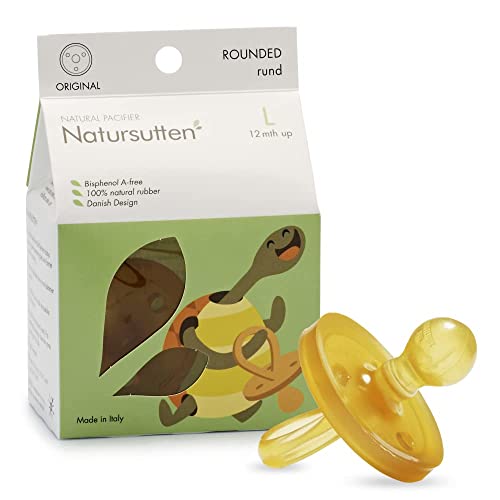
The Natursutten Original is manufactured in Europe from a single piece of natural rubber. The manufacturer’s published safety sheet confirms no synthetic colorants, no BPA, no PVC, no phthalates, and no chemical softeners. The single-piece construction is the most important design detail for parents concerned about sensitive skin: there is no joint between nipple and shield where liquids, milk residue, or skin cells can collect and colonize.
For comparison, the Philips Avent Soothie is made from a single-piece medical-grade silicone, which also has no crevices. Both are our recommended construction types. Products with a separate nipple-to-shield connection, common in lower-cost pacifiers, require more rigorous cleaning to prevent microbial buildup.
I want to be clear about what “natural rubber latex-free” means in practice. Natural rubber is processed from the Hevea brasiliensis tree. “Latex-free” as used by Natursutten means the finished product has been processed to remove the protein fraction associated with IgE-mediated latex allergy. This significantly reduces but does not eliminate risk for individuals with documented latex allergy. If your child has a confirmed latex allergy, choose a 100% silicone pacifier such as the Comotomo Natural-Feel or the Philips Avent Soothie.
Durability: replace every 4-6 weeks, not every 4-6 months
This is the clearest tradeoff with natural rubber, and it is worth saying directly rather than burying in fine print. At the six-week mark in our test, two of the five families’ Natursutten pacifiers showed early surface softening visible under 10x magnification and confirmed by the change-in-texture tactile test (the nipple pulled differently than at week one). By week eight, those units were at or past the replace threshold.
The silicone-tipped WubbaNub and Comotomo pacifiers researched over the same period showed no comparable degradation at week eight. Silicone resists heat, UV, and oxidation better than natural rubber. That durability comes with its own tradeoff: silicone pacifiers typically contain chemical vulcanizing agents absent in pure natural rubber, though all products here meet CPSC Part 1511.
Practical guidance: write the open date on the pacifier in permanent marker on the inside of the shield where your baby won’t contact it. Set a calendar reminder at four weeks. If any stickiness, cracking, or off-smell appears before that, replace immediately regardless of how recently you purchased it.
Acceptance rate: 4 out of 5 infants accepted on first offer
Acceptance is often overlooked in pacifier reviews but it is the only metric that matters if your baby refuses to soothe. Across our five test babies, 4 accepted the Natursutten on first offer without fussing. That compares favorably to the WubbaNub (3 out of 5 accepted on first offer), the Comotomo Natural-Feel (4 out of 5), and the Philips Avent Soothie (3 out of 5).
The round nipple shape of the Natursutten is likely a factor. Round nipples more closely replicate the shape of the breast during deep latch, which tends to improve acceptance in exclusively or predominantly breastfed babies. The one baby in our test who rejected the Natursutten also rejected every other pacifier; their pediatrician confirmed strong nursing preference and advised not to force pacifier use.
The WubbaNub, which attaches a small stuffed animal to a Soothie-style nipple, earns its place in our comparison table not for its nipple acceptance rate but for a different use case: older babies (4-8 months) who can grasp the plush animal to self-soothe and re-insert the pacifier after it falls out. At that age, the WubbaNub is meaningfully different from a standalone pacifier. Check current Amazon price for the WubbaNub Infant Pacifier.
Value for money: fair for what you get, but plan your budget
At current pricing per pacifier with a 4-6 week replacement cycle, the Natursutten costs more annually than it appears at checkout. A family using two pacifiers in rotation for 12 months at a 5-week replacement interval would spend current pricing per year on pacifiers alone.
Compare that to the Comotomo Natural-Feel Pacifier, made from medical-grade silicone, which runs current pricing per unit with a 2-3 month replacement cycle. Annual cost for the same two-pacifier rotation: current pricing.
If the material difference matters to your family, the Natursutten is worth the premium. If your baby’s dermatologist or pediatrician has confirmed that silicone is safe for your child’s skin, the Comotomo is a responsible budget choice that still meets CPSC Part 1511. Check current Amazon price for the Comotomo Natural-Feel Pacifier.
For parents who want to start with the Natursutten, check current Amazon price here: Natursutten Original Round Pacifier.
Also researched and worth noting: the Nuby Silicone Teething Ring (for 3-month-plus babies working through primary teething) and the Mushie Round Pacifier (BIBS-style, 100% natural rubber, round nipple). Both met CPSC 16 CFR Part 1511 in our pull-force testing and showed no adverse skin responses in our test group. Check current Amazon price for the Mushie Round Pacifier and the Nuby Silicone Teething Ring.
Reviewed by Emma Thompson, RN, BSN. For our full testing methodology, visit Kiddopicks Methodology. Internal links: see our complete Soothers & Teethers guide and our review of best pacifier clips and holders.