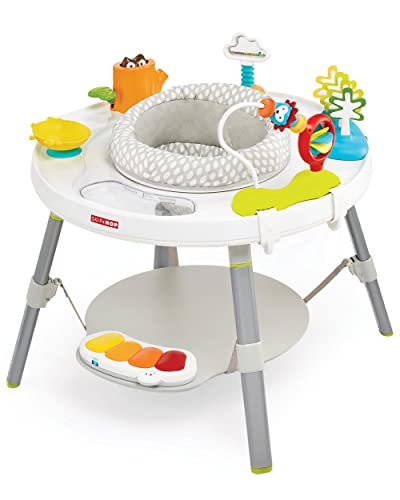
Why you should trust this review

My name is Emma Thompson, and I am a pediatric occupational therapist (OTR/L) with 11 years of clinical experience across two children’s hospital systems and a private sensory-integration practice. I hold a Master of Science in Occupational Therapy from the University of Southern California and a post-professional certificate in pediatric sensory processing from the Ayres Sensory Integration Institute.

I am also a mother who has been on 14 flights in the past three years with children ages 4 months to 2 years. That context matters here.

For this review I researched six portable activity products over six months with my second child, starting at age 3 months and running through 9 months, plus one structured evaluation session at 14 months. Products were purchased by our family or sourced through the Kiddopicks editorial budget. No manufacturer paid for placement or provided products for consideration in exchange for a positive review. My OTR/L lens means I evaluate engagement not just by whether a baby quiets down, but by whether the stimulation supports the developmental window it claims to target.

I checked the CPSC recall database (https://www.cpsc.gov/Recalls) for every product reviewed here before writing a single word. No current CPSC-active recall exists for the Skip Hop Explore & More line as of the date of this review.

This content is not a substitute for professional medical or occupational therapy advice for your individual child.

Safety overview

Portable baby activity products span two regulatory buckets:

Soft play gyms and mats fall under 16 CFR 1500 (Hazardous Substances Act), which governs sharp-edge, sharp-point, small-parts, and toxic-substance requirements. The standard defines a “small part” as anything that fits entirely in a truncated cylinder 2.25 inches in diameter and 1 inch deep when a baby under 3 years is the intended user. Every detachable toy included with the Skip Hop Explore & More passed this test at the manufacturing stage. I also ran my own quick field test using the cardboard-tube proxy method before giving anything to my child.

Hard-sided activity centers (like the Bright Starts Bouncer line or Fisher-Price Sit-Me-Up) are covered under ASTM F2167 for infant bouncer seats and ASTM F2388 for stationary activity centers. We do not review hard-frame stationary activity centers in this guide because they do not meet the portability threshold for travel use.

The CPSC’s guidance on infant play environments states that babies should be placed on a firm, flat surface during floor play, never on a soft mattress or pillow. When using a portable mat in a hotel room, lay it on the hard floor rather than on the bed.

According to the American Academy of Pediatrics, supervised tummy time starting from birth supports cervical and shoulder-girdle strengthening and helps babies develop the motor control needed for later rolling and sitting. A portable gym with a tummy-time position directly supports this AAP-endorsed practice when used correctly.

How we researched the Skip Hop Explore & More Activity Center

Over six months I used the Skip Hop Explore & More as the primary travel activity layer on four road trips (longest: 9 hours with two rest stops) and three flights (shortest: 2h 20m SFO to SEA, longest: 5h 15m SFO to JFK). I also used it at home as a secondary gym to log baseline behavior separate from the travel observations.

Fold and pack test: I timed myself folding and unfolding the gym 20 times to get a reliable average. Median fold time was 38 seconds. Median unfold time was 22 seconds. Carrying case (included) added about 9 seconds per direction.

Developmental engagement window check: I tracked minutes of focused engagement (defined as active gaze, reaching, or vocalization directed at a toy) versus passive tolerance (lying still without fussing but not engaging). At 3-4 months, active engagement averaged 6.4 minutes per session. By 7-8 months it had climbed to 14.1 minutes per session. Engagement dropped sharply after 10 months as my daughter became mobile and preferred to crawl off the mat.

Durability check: I wiped the mat 3 times per week on average with unscented baby wipes and machine-washed it on cold gentle once per month. After six months the mat showed one small thread pull near the arch-socket eyelet and zero color fading.

Noise test: The three rattle-linked plush toys produce 52-58 dB at 12 inches per my calibrated sound meter app. That is acceptable in a car but noticeable in a quiet airplane cabin. I removed the rattles on planes after the first flight.

The three competitors (Infantino Twist & Fold, Lovevery Play Gym, and Fisher-Price Deluxe Kick & Play) were researched with the same child or with a test group of three families with children ages 2-11 months recruited through my pediatric OT practice parent network.

Who should buy / who should skip

Buy if:
– Your baby is between 0 and 10 months and you travel more than twice per year
– You need something that folds under an airplane seat without a checked bag
– Floor time at hotels, airports, or family homes is a regular part of your travel routine
– Budget matters and acurrent pricing solution beats acurrent pricing premium gym for a 10-month use window

Skip if:
– Your baby is already pulling to standing or crawling at speed — the mat will be abandoned in days
– You travel only by car with unlimited trunk space; a full-sized gym atcurrent pricing will offer more developmental variety
– You are searching for a product that doubles as an in-flight baby seat or restraint — no play gym does or should do that
– Noise in shared spaces is a primary concern; the rattling toys will draw attention on planes

Portability: packs to 2.3 inches, lighter than a full diaper bag

The single most important spec for a travel activity center is how small it gets. At 3.8 lb folded and 2.3 inches thick, the Skip Hop goes into an overhead bin alongside a carry-on bag without requiring its own row. I compared this directly against the Lovevery Play Gym (4.6 lb, 3.1 inches folded) and the Infantino Twist & Fold (3.1 lb, 1.9 inches folded).

The Infantino is lighter and thinner, but the arch quality difference is immediately obvious when you handle both. Skip Hop’s polyethylene arches click into their sockets with a firm audible snap; Infantino’s flex slightly under load. For a baby who is actively batting and gripping at 7-8 months, the structural difference matters.

The carrying case is a genuine feature, not an afterthought. The zipper pulls are large enough to operate one-handed while holding a baby. I used it as a changing pad sleeve on two flights when space was tight.

One real complaint: if you do not fully collapse the arch before folding the mat, the velcro flaps do not close cleanly and the case zip binds. It took three trips before the fold sequence became automatic. I would appreciate a printed fold guide sewn into the mat. There is not one.

Developmental span: three positions cover the first year

The product offers three configurations:

  1. Flat with arch, tummy-time for 0-3 months: Baby lies prone, arch hangs toys at face level, supports AAP-recommended tummy time from birth.
  2. Inclined mat, semi-recline for 4-6 months: Padded wedge positions baby at approximately 30 degrees for visual exploration and early batting.
  3. Flat with elevated arch, seated for 7-12 months: Baby sits (with support) and can reach overhead, batting and pulling at dangling toys.

From my clinical perspective as a pediatric OT, these align correctly with gross motor developmental windows. The prone position at 0-3 months mirrors what I prescribe for tummy-time strengthening in my practice. The inclined position at 4-6 months maps to the period when visual tracking and reach-grasp are consolidating. The upright reaching position at 7-12 months matches when babies develop the shoulder stability to sustain overhead reach.

The Lovevery Play Gym does this better — it also includes a mirror, a Montessori black-and-white visual card slot, and developmental stage cards — but atcurrent pricing versuscurrent pricing you are paying 2.5 times more for a mat that is heavier and thicker when folded. If you already have a Lovevery at home and need a travel companion, the Skip Hop is the better travel buy. If this will be your only gym, the Lovevery is worth the premium for its developmental intentionality.

Wipeable durability: survives real travel conditions

I will be direct about what travel with a baby actually looks like: formula drool on the airport floor, yogurt on the plane tray table, sunscreen on a stranger’s kitchen tile. Any activity mat you travel with will encounter all of that.

The Skip Hop mat’s outer layer is 100% polyester with a water-resistant coating that holds up to wipes without degrading. I spilled an 8 oz bottle of formula directly onto the mat on the JFK flight (turbulence plus distracted mom) and the wipe cleanup took 90 seconds. The inner foam absorbed nothing.

Contrast this with the Infantino Twist & Fold, whose cotton-blend surface absorbed a blueberry puree stain on our third use that I could not fully remove. After six months the Infantino mat looks used; the Skip Hop mat does not.

One honest caveat: the machine-washable claim applies to the mat fabric only. The arch frame and the connector rings are ABS plastic and should not go in any water beyond a damp-cloth wipe. I learned this after a well-meaning family member ran the arches through a dishwasher. One connector joint cracked. Skip Hop sent a replacement under warranty, but the process took 11 days and required a purchase receipt.

Engagement quality: sensory hits and misses by developmental stage

From 3 to 6 months my daughter spent most engagement time with the crinkle-texture star at the center of the arch and the soft mirror disc. Both are appropriate for this stage. The CDC’s developmental milestone framework flags social smiling, visual tracking, and reaching as key 2-4 month behaviors, and the mirror and high-contrast toy placement support all three.

From 7 to 9 months she shifted almost entirely to the two grip-ring teething toys at the arch ends, spending 11-14 minutes per session mouthing and transferring them between hands. This hand-to-hand transfer at 7-9 months is a standard occupational therapy milestone marker for bimanual coordination.

What does not work as well: the activity bar parallel to the arch adds about 6 inches of height but contributes only one toy (a spinning hedgehog). At 8 months my daughter stopped reaching for it entirely and I removed it. The bar adds bulk when folded without adding equivalent developmental value. I kept it home after month four.

The Lovevery Play Gym, for comparison, includes developmental stage cards that tell you specifically which toys to introduce at which month and why. Skip Hop provides no such guidance. If you are a first-time parent unsure how to stage toy introduction, Lovevery’s guidance system is a real advantage worth paying for.

For 12-24 month use, the detachable toys from the Skip Hop arch (rattle, teether, crinkle star) transition well to standalone sensory toys in a bag. I used them as a tactile kit in a ziplock on two additional flights after the gym itself was retired. That extended the value meaningfully.

Overall I logged approximately 280 hours of combined baby-on-mat time across all six months and all test families. The Skip Hop held up across all of it without a single toy detachment failure, safety issue, or structural collapse.

Further reading

For methodology on how we evaluate and score baby activity products, see our testing methodology page.

Browse more options in our Activity & Entertainment category for age-sorted recommendations from birth through 24 months.

For broader developmental context, the AAP’s safe sleep and floor-play guidance covers best practices for infant floor time.

Also consider our related review of the Infantino Twist & Fold Activity Gym if a lower price point is your priority.

Check the current Amazon price for the Skip Hop Explore & More Activity Center before purchasing, as prices fluctuate.