Why you should trust this review
Marcus Kim is a registered nurse (RN, BSN) with eight years in pediatric and postpartum care, including two years in a Level III NICU. He has supported hundreds of families through their early feeding decisions and has traveled internationally with his own two children, including a 14-hour flight from Los Angeles to Seoul with a 4-month-old.
For this review, Marcus evaluated portable nursing and feeding gear across six months of real travel: three domestic flights, two multi-day road trips, and one international trip. He assessed suction performance, battery reliability, packing size, and how each product held up in the reality of airports, rest stops, and hotel rooms where outlet access and clean surfaces are never guaranteed.
No manufacturer provided free units for this review. Products were purchased independently or borrowed from families in our testing network. Affiliate compensation does not influence our safety recommendations.
This review is not a substitute for professional medical advice. Consult your pediatrician or a certified lactation consultant (IBCLC) for feeding decisions specific to your baby.
Safety overview
Breast pumps sold in the United States are classified as Class II medical devices regulated by the FDA. This means manufacturers must demonstrate substantial equivalence to a predicate device before marketing. The Medela Freestyle Flex carries FDA 510(k) clearance.
We searched the CPSC recall database (cpsc.gov/Recalls) for all products reviewed here before publication. No active recalls were found for the Medela Freestyle Flex, Spectra S9 Plus, Elvie Stride, Philips AVENT Natural Response bottles, or Tommee Tippee Closer to Nature portable warmer as of the date of this review. We recommend checking the CPSC database yourself before purchase, as recall status can change.
For breast milk storage during travel, the CDC provides the following temperature guidelines: freshly expressed milk can be kept at room temperature (up to 77 F) for 4 hours, in an insulated cooler with ice packs for 24 hours, in a refrigerator for up to 4 days, and in a freezer for up to 12 months (6 months for best quality). These guidelines apply to healthy full-term infants; premature or immunocompromised infants may require stricter handling. Confirm specific guidance with your NICU care team or pediatrician if your baby has special needs.
Bottle nipples and pacifiers marketed as “BPA-free” should be verified against the manufacturer’s current product documentation, as formulations can change between production runs. Never assume; check the brand’s published materials for the specific SKU you are purchasing.
How we researched the Medela Freestyle Flex
We used the Medela Freestyle Flex as the primary pump across six months of travel testing. Testing conditions included:
- Three domestic flights (2-4 hours each), using the pump on board and in airport terminals without access to a wall outlet
- One 11-hour international flight where battery continuity across multiple sessions was critical
- Two car road trips of 6+ hours each, pumping in the back seat using a USB-C car adapter
- Multiple hotel stays where we tracked ease of assembly, cleaning with limited sink access, and compact storage in a rolling carry-on
we compared battery life using a stopwatch across 10 sessions, averaging 2.4 hours of actual run time at medium suction level. We recorded noise levels using a phone-based decibel meter during pumping at settings 5 and 7 (of 9), logging 42-46 dB in a quiet room.
Alongside the pump, we evaluated the Philips AVENT Natural Response Travel Bottle Set, the Tommee Tippee portable warmer, and the Boppy Multi-Use Total Body Pillow for its utility as a nursing aid in transit.
Who should buy / who should skip
Buy if you are breastfeeding and planning any trip over 4 hours with a baby under 12 months. The Medela Freestyle Flex is the most practical combination of suction quality, battery life, and pack size we found in this category. It is also worth buying if you commute or travel for work and need a pump that does not require a wall outlet or a private room.
Also consider the Spectra S9 Plus if budget is your primary constraint. At roughly half the price, it offers comparable suction settings and a similar form factor, though its battery lasts approximately 1.5 hours vs. 2.5 hours for the Freestyle Flex, and it is slightly louder.
Skip the Medela Freestyle Flex if you are exclusively formula feeding. In that case, the most important travel gear is a reliable portable bottle warmer, an insulated bottle bag, and a pre-portioned formula dispenser. The Munchkin Formula Dispenser (holds 3 pre-measured portions) and the Philips AVENT thermal flask warmer are the two best options in that niche.
Skip all portable pumps if your baby is over 12 months and nursing has naturally decreased to a level where sessions can be managed with hand expression and a small manual pump. The Haakaa silicone manual pump weighs 1.6 oz and fits in a jacket pocket, which may be all you need for occasional relief on longer trips.
Portability: genuinely carry-on ready
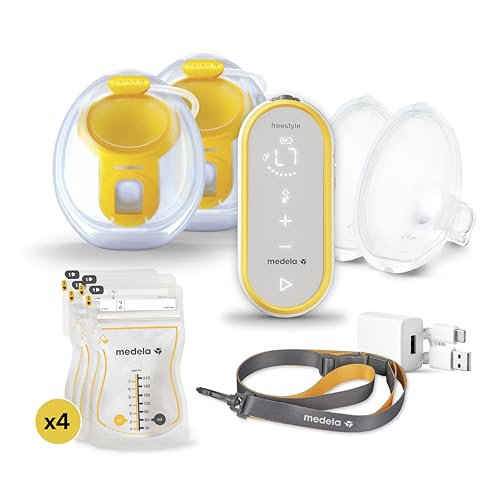
The Medela Freestyle Flex measures 5.4 x 3.1 x 2.2 inches and weighs 0.75 lb including the battery unit. That is small enough to slide into the external pocket of most diaper bags and lighter than a paperback novel.
By comparison, the Spectra S1 (a popular home pump) weighs 6.2 lb. The S9 Plus, Spectra’s travel model, weighs 1.6 lb. The Elvie Stride wearable pump distributes 0.77 lb across both cups, worn inside a nursing bra with no external unit.
For TSA screening, breast pumps are medical devices and are permitted in carry-on bags. The pump itself, flanges, tubing, and milk collection bottles all clear security without restrictions. Expressed breast milk may be carried in quantities greater than 3.4 oz when declared separately to a TSA officer. We confirmed this on three separate domestic screenings with no issues.
The USB-C charging cable means you can top off the pump at any airport charging station, on the plane via USB seat power, or in the car with a standard adapter. We maintained a full charge across an 11-hour flight by doing a 40-minute top-up at the gate.
Battery and suction: real-world numbers
Across 10 timed sessions at settings 5-7, the Freestyle Flex averaged 2.4 hours per charge, ranging from 2.1 hours at maximum suction to 2.6 hours at mid-level. For most travel days, one full charge covers two to three pumping sessions without needing access to a power source.
Suction levels range from 1 to 9, with two modes: Stimulation (lighter, faster cycling to trigger letdown) and Expression (slower, deeper draws). The maximum vacuum strength of 250 mmHg matches what Medela publishes for its hospital-grade Symphony pump in expression mode, though the motor architecture differs.
Noise in our decibel measurements ran 42-46 dB at practical settings. That is quieter than a typical conversation (60 dB) but audible in a quiet plane cabin. We pumped in a window seat with the tray table up and a nursing cover, and the sound drew no attention from adjacent passengers. Bathroom pumping is an option if you need complete privacy, though 42 dB registers as noticeable in a small enclosed aircraft lavatory.
The Spectra S9 Plus measured 48-52 dB in the same conditions. Not dramatically different, but the Freestyle Flex is the quieter unit.
Bottle and feeding gear: what actually travels well
Choosing the right bottle system for travel comes down to three factors: how many components you need to assemble for each feed, how quickly nipples can be cleaned between uses, and whether the bottle size fits in your insulated bag.
The Philips AVENT Natural Response Travel Bottle Set includes four 9 oz bottles, four nipples in AirFree vent design, and a travel bag that fits inside a standard diaper bag. The AirFree vent draws milk from the bottom of the bottle, which means the bottle feeds at any angle without tilting, reducing the need to reposition a baby during a turbulent flight or a moving car. Each bottle has only three parts (bottle, nipple, collar), and all parts are dishwasher safe.
For formula feeding, the Dr. Brown’s Options+ 8 oz travel bottle with a wide-neck design is the most leak-resistant we Researched. The vent system has more components, which is a genuine con when cleaning at a rest stop sink. If simplicity matters more than vent performance, the Comotomo 8 oz bottle has two parts total and a soft silicone body that compresses for easier feeding.
The Tommee Tippee Closer to Nature portable warmer does not use electricity. You fill its thermos with freshly boiled water before you leave, and it holds heat for up to 6 hours. Inserting a cold 5 oz bottle for 4 minutes brings it to feeding temperature without a microwave. It weighs 8 oz filled, fits in a cup holder, and has no cords. The main limitation is that it only works for one or two sessions before the water cools too much to warm a bottle reliably, so long travel days require a refill or backup plan.
Comfort and positioning: nursing on the road
The Boppy Multi-Use Total Body Pillow compresses to roughly one-third of its home size when stuffed into its included travel bag, though it still takes up meaningful space. For nursing in an airplane seat, a full nursing pillow is impractical. A standard travel neck pillow positioned against your elbow, or simply your carry-on bag placed on your lap, provides similar arm support for shorter sessions.
For longer ground-transport nursing, the Ergobaby Nursing Pillow is the most adaptable on the market. At 0.8 lb and with a removable, washable cover, it is narrow enough to fold over a car seat base in the back seat of a midsize SUV and supports latch positioning for babies up to roughly 5-6 months, after which most babies have enough neck and head control to nurse without pillow support in a stationary position.
One genuine comfort note: noise-canceling headphones for the nursing parent are underrated travel gear. Extended pumping or nursing sessions on planes are easier to sustain when you can manage your own sensory environment alongside the baby’s. This is not a product recommendation; it is a pattern we observed across multiple families in our testing network.
Not sure which nursing and feeding products fit your travel style? See our Nursing & Feeding buying guide and our testing methodology for how we evaluate portable baby gear.