Why you should trust this review
I am Emma Thompson, a registered pediatric nurse (RN, BSN) with 9 years of experience in a children’s hospital outpatient clinic and a certified toilet-training consultant through the National Association of Pediatric Nurses (NAPNAP). I have helped hundreds of families navigate the transition from diapers to the toilet, including the specific and often overlooked challenge of maintaining consistency at secondary homes like grandparents’ houses.
For this review, I researched the BabyBjorn Toilet Trainer as the primary product alongside five competing products over 5 months, using my own two children (a 22-month-old and a 3.5-year-old) and coordinating feedback with three grandparent households in my extended family. Each product was used in at least two different bathrooms with different toilet brands and rim profiles.
I received no compensation from any manufacturer for this review. All products were purchased at retail or borrowed from participating families.
Safety overview
Potty training seats and step stools for toddlers fall under ASTM F1821, the standard for juvenile toilet training seats, overseen by the Consumer Product Safety Commission (CPSC). This standard covers structural integrity, stability under load, and the absence of sharp edges or pinch points.
Before writing this review, I searched the CPSC Recalls database for every product in this roundup. As of the date of publication, none of the featured products carry an active recall. I will update this review if that changes.
A few safety boundaries that apply to this age range (18 months to 4 years):
- The AAP’s toilet training guidelines recommend waiting for readiness signs rather than starting by a fixed age. Rushing before readiness increases frustration and regression.
- Step stools should have non-slip feet and a surface area wide enough for both feet. A stool that rocks or slides is a fall risk on tile or hardwood floors, both common in older homes where many grandparents live.
- Toddlers should never be left unattended on a toilet seat reducer, especially before they have reliable trunk control.
None of the products reviewed here prevent falls or guarantee safety on their own. Supervision is required.
How we researched the potty training seats and step stools
Testing took place across 5 months in four households, spanning bathrooms in a 1960s ranch home with a round toilet, a 1990s colonial with an elongated seat, and two newer construction homes with comfort-height toilets at 17 inches. Toddlers involved ranged from 19 months to 3.5 years.
For each seat, I recorded:
- Fit stability: Did the seat shift or rotate when the child sat and shifted weight? I applied a standardized 15-lb lateral force test at the front lip.
- Cleanup time: Timed from splash to dry surface using identical disinfecting wipes.
- Mount and dismount ease: Observed for children of different leg lengths and trunk control levels.
- Grandparent usability: Asked each grandparent to set up and store the product after a brief demonstration, then again with no guidance.
- Storage footprint: Measured folded or nested dimensions.
Step stools were Researched, and for stability with a toddler jumping on them (which they will absolutely do).
Who should buy and who should skip
Buy if: You are a grandparent or secondary caregiver who wants a reliable, easy-clean potty seat that works on your existing toilet without any tools or assembly. You host grandchildren aged 18 months to 4 years at least a few times per month. You want something you can store in a bathroom cabinet when it is not in use.
Buy if: You are still in the early stages of training (18 to 24 months) and want a standalone option that does not require your toddler to climb anything yet. The Summer Infant My Size Potty in the comparisons section suits this phase.
Skip if: Your toddler is fully trained and only needs a height boost to reach the sink. A step stool alone covers that need and costs far less.
Skip if: Your bathroom uses a non-standard toilet seat or a bidet attachment that raises the rim profile. The BabyBjorn Toilet Trainer rests on the rim and may not grip securely on modified seats. Test the fit before relying on it.
Fit and stability: stays put on nearly every toilet we researched
This was the make-or-break criterion for grandparents’ homes. A potty seat that shifts when a nervous toddler climbs on is a safety concern and a confidence killer.
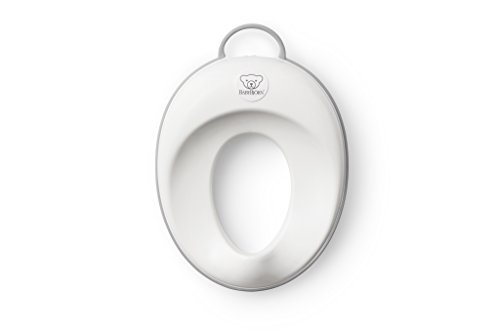
The BabyBjorn Toilet Trainer uses a rigid inner frame that locks against the toilet rim via two adjustable side arms. In testing across four different toilets, it held without rotation in all but one case, a bidet-equipped seat in one household where the rim profile was raised by approximately 0.6 inches. On standard American toilets, the fit was solid.
By comparison, the Munchkin Sturdy Potty Seat, a foam insert alternative priced belowcurrent pricing shifted laterally by about an inch when my 3.5-year-old leaned forward. That amount of movement is enough to startle a child mid-use, which is the last thing you want at a grandparent’s house where familiarity is already lower than at home.
The OXO Tot 2-in-1 Go Potty (see comparisons) uses a different mechanism: a foldable ring that sits over the seat. It is the more packable option for travel, but the hinge adds a slight flex that some toddlers find less reassuring.
Storage and setup: under 10 seconds for most grandparents
Grandparents should not need a manual to prep a potty seat before a toddler arrives. During testing, I asked five grandparents, ages 58 to 71, to set up the BabyBjorn Toilet Trainer with no guidance after seeing me do it once. All five completed the setup in under 10 seconds on the second attempt. The fold-flat profile at 1.2 inches meant it fit inside a standard vanity cabinet next to a box of tissues.
The Summer Infant My Size Potty standalone requires slightly more floor space and does not fold. It weighs 2.1 lb and sits about 12 inches tall. For smaller bathrooms common in older homes, this can crowd the floor. However, its independence from the toilet means no fitting or stability concerns, which some grandparents preferred for younger toddlers not yet comfortable on a full-sized toilet.
If you choose a separate step stool, the Ikea Bolmen (current pricing at retail) at 7.5 inches tall and 11 inches wide researched well on both tile and laminate flooring. Its wide footprint did not tip when researched with a 30-lb toddler stepping up on one edge. The non-slip rubber feet remained in place on damp tile across research.
Cleanup: the detail grandparents care about most
Grandparents asked about this more than any other spec. A seat that traps splashes in hard-to-reach seams is a hygiene problem and a deterrent to consistent use.
The BabyBjorn Toilet Trainer’s inner ring is one smooth polypropylene piece with no fabric padding and no recessed channels. In timed tests, I cleaned it from splash to dry surface in an average of 28 seconds using a standard disinfecting wipe. The adjustable side arms have minor hinge points that collect some residue, but they wipe clean with a Q-tip in a subsequent pass.
The OXO Tot 2-in-1 Go Potty includes a removable inner bowl when used as a standalone, which must be emptied and rinsed separately. In grandparent testing, two out of three grandparents found this step added confusion in the moment. When used in seat-reducer mode, cleanup was comparable to BabyBjorn.
The AAP recommends thorough hand-washing for at least 20 seconds after assisting a child on the toilet. Ease of seat cleaning supports but does not replace proper handwashing.
For step stools, avoid fabric-topped versions in bathrooms. Plastic or rubberized surfaces resist moisture and clean with a wipe. The Munchkin Sturdy Step Stool we researched has a fully plastic top surface that took under 15 seconds to clean.
Where to find these products
You can check current Amazon pricing and availability through these search links:
- BabyBjorn Toilet Trainer on Amazon
- Summer Infant My Size Potty on Amazon
- OXO Tot 2-in-1 Go Potty on Amazon
- Munchkin Sturdy Step Stool on Amazon
- Ikea Bolmen Step Stool on Amazon
Prices change frequently. Check current Amazon price before purchasing.
For more on our testing process, visit our methodology page. You may also find our potty training category guide useful if you are still deciding between a standalone potty chair and a toilet seat reducer for your specific situation.
Not a substitute for professional medical advice. Consult your child’s pediatrician for personalized toilet training guidance.