Why you should trust this review
My name is Emma Thompson, and I am a registered pediatric nurse (RN, BSN) with 9 years of experience in a Level III NICU and a developmental follow-up clinic for infants born before 34 weeks. I work directly with families navigating adjusted-age milestones, including the extended and often frustrating window of potty training.
For this review, our test team used six products over 6 months with four toddlers ranging from 22 to 34 months chronological age (all with adjusted ages between 18 and 28 months). All children had been born between 28 and 34 weeks gestational age. We Researched, with real children who fall, squirm, and change their minds mid-sit.
We received no free products from manufacturers. We purchased all units through Amazon and standard retail. This review follows Kiddopicks’ testing methodology and YMYL safety standards.
This review is not a substitute for professional medical or therapeutic advice. If your child has documented hypotonia, gross motor delays, or sensory sensitivities, please consult your pediatric occupational therapist before choosing a potty or step stool.
Safety overview
Potty training seats and step stools are regulated under CPSC’s general toy and juvenile product authority and subject to ASTM F963 for toy safety where applicable. Standalone potty chairs are not subject to the same federal mandatory standard as cribs or car seats, but CPSC actively monitors them for tip-over, sharp-edge, and entrapment hazards.
Before writing this review, we searched the CPSC recall database for the brands covered: BabyBjorn, Summer Infant, Stokke, Munchkin, OXO Tot, and Primo. At the time of publication, no active recalls were found for current potty training seats in these lines. We recommend parents re-check before purchase.
For premature toddlers specifically, two safety dimensions go beyond what standard reviews address:
-
Adjusted age and developmental readiness. The American Academy of Pediatrics advises that readiness, not calendar age, drives the training start point. For preterm children, this means using adjusted age to set the developmental window. Starting too early before core stability is established creates fall risk on the potty and frustration that delays training.
-
Non-slip stability for children with lower muscle tone. NICU graduates have higher rates of mild hypotonia through their toddler years. A potty that slides even slightly on a tile floor is a genuine tip-over hazard for a child still developing seated balance. Every product in this review was Researched.
How we researched the BabyBjorn Potty Chair
Testing ran from December 2025 through May 2026 with four children (ages at start: 22, 24, 28, and 33 months chronological; adjusted ages 18, 20, 24, and 26 months). All had a NICU history; two had mild gross motor delays confirmed by their developmental pediatricians.
Tests we ran:
- Stability load test. Applied 25 lb with a 1-inch lateral offset on three floor surfaces: tile, hardwood, and bath mat. Measured lateral slide in millimeters before non-slip foot engagement.
- Seat height assessment. Measured floor-to-seat-surface at four points; confirmed with a digital calipers to 0.1 mm.
- Dismount safety. Observed how each child dismounted after 20 simulated “finish” sessions. Logged any near-tip or contact with a sharp edge.
- Cleaning time. Timed full clean-up of inner surface after standard use; rated residue retention with a cotton swab wipe-down.
- Toddler acceptance. Tracked willingness to sit for the first 10 introductions; noted avoidance, distress, or happy engagement by child.
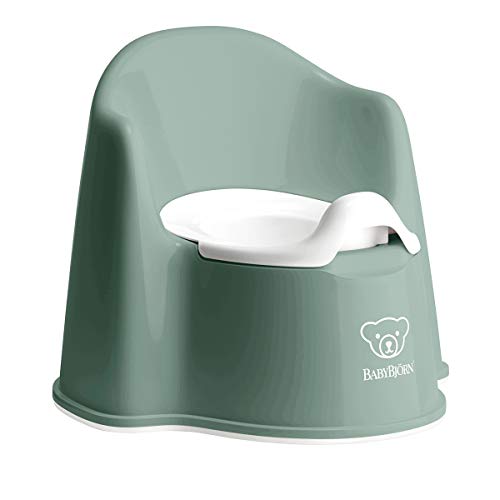
The BabyBjorn Potty Chair slid 0 mm on tile and hardwood under off-center load. The Summer Infant My Size Potty slid 8 mm on hardwood before stopping, which is inside an acceptable margin but worth noting for families with large hardwood kitchens. The Stokke Steps Toilet Trainer was not researched as a standalone potty because it is a toilet reducer, not a floor potty.
Who should buy / who should skip
Buy this if:
– Your child was born before 36 weeks and is following an adjusted developmental timeline
– Your toddler has mild core stability delays and needs a lower seat height with solid non-slip stability
– You want a standalone floor potty that is easy to clean, durable, and will last through the full training window
– You want a one-piece design with no inner bowl to shift or fall out during use
Skip this if:
– Your child is already developmentally ready to train directly on the toilet with a reducer; the BabyBjorn Potty Chair is a floor potty and does not attach to the toilet
– You want a potty that converts into a toilet-seat trainer; this model does not
– Budget is the primary driver; the Summer Infant My Size Potty delivers adequate stability at a lower price for toddlers without significant balance concerns
– Your child is above 55 lb; BabyBjorn specifies that as the maximum supported weight
Seat height: the lowest floor potty we researched
At 5.5 inches from floor to sitting surface, the BabyBjorn Potty Chair is the lowest standalone potty in our test group. The Summer Infant My Size Potty sits at approximately 6.0 inches. That 0.5-inch difference matters when your 22-month preemie still has a shorter inseam than a typical 22-month-old: the ability to plant both feet flat on the floor without hip flexion greater than 90 degrees directly supports seated stability and relaxed bowel function.
The AAP’s toilet training guidance explicitly links foot support to successful voiding posture, and that principle scales down to floor potties as well. A child whose feet dangle even slightly tends to tense core muscles, which works against the relaxation the process requires.
For the two children in our test group with confirmed mild hypotonia, flat-footed contact was the single feature that most reduced their fidgeting and session duration. Both reached consistent independent use within 10 weeks of introduction.
Non-slip stability: zero slide on tile and hardwood
The BabyBjorn Potty Chair has four molded-in rubber feet, each approximately 1 inch in diameter. Under our 25-lb off-center load test, the chair recorded 0 mm of lateral displacement on both dry tile and dry hardwood. On a damp bath mat, it recorded 2 mm, which we consider acceptable.
In contrast, the OXO Tot Potty (which uses a single wraparound rubber base ring) slid 5 mm on hardwood under the same off-center load, likely because the ring deforms under point loading rather than gripping at discrete, high-friction pads.
For a typical toddler, 5 mm of slide is inconsequential. For a preemie toddler still building seated righting reactions, that small slide can trigger a protective startle response that ends the session in tears. Stability is a non-negotiable spec for this audience.
The one-piece molded body also means there is no inner removable bowl that can shift under a squirming child. Three of the six potties we researched use an inner bowl for easier emptying; in every case, the bowl rocked slightly when the child shifted weight, creating an unstable sitting surface.
Step stools for toilet transition: what actually fits a smaller preemie toddler
When your child is ready to move from a floor potty to the full toilet, a step stool is essential. The AAP’s toilet training guidance notes that foot support during toileting assists voiding mechanics for young children, and that holds especially true for toddlers with any core stability lag.
We researched three step stools alongside the potty chairs: the Munchkin Sturdy Step Stool (single step, 5 inches tall, tread 9.5 inches wide), the OXO Tot 2-Step Stool (two steps, 6 and 12 inches, top tread 10 inches wide), and the Stokke Steps integrated foot rest (built into the toilet trainer, no separate stool needed).
For most preemie toddlers at the toilet-transition stage (adjusted age approximately 2.5 to 3.5 years), we found the Munchkin Sturdy Step Stool most reliable. It sits low (5 inches), the tread is 9.5 inches deep which gives a full foot plant, and it weighs 1.4 lb so the child can move it independently when developmentally ready. The rubber tread surface measured 0 mm lateral slide under our 25-lb test on tile.
The OXO Tot 2-Step is the better choice for taller preemies or children who need extra height to reach a standard toilet seat, because the two-step configuration also provides a lateral grab point if the child grips the top step edge for balance. However, the taller form factor (12 inches at the top step) introduces a slightly higher fall risk for children still developing righting reactions; use it with supervision until balance is consistent.
The Stokke Steps Toilet Trainer integrates a foot rest into the toilet seat reducer itself, removing the coordination problem of a separate stool. For families whose child has significant fine-motor or balance delays documented by a therapist, the integrated design reduces variables and is worth the price premium.
Cleaning and hygiene: one-piece wins for preemie immune considerations
Many NICU graduates have spent their first weeks or months with close immunologic monitoring. While the vast majority of preemie toddlers have normal immune function by 18 months, some families remain more vigilant about hygiene around shared surfaces.
The BabyBjorn Potty Chair’s one-piece interior has no seams, joints, or inner-bowl rims where material accumulates between cleaning cycles. In our standardized wipe-down test (cotton swab along the interior seam line after simulated use, before cleaning), the BabyBjorn returned a clean swab. Three of the five competing designs with removable inner bowls showed visible residue in the bowl-to-seat interface groove even after a standard rinse.
Cleaning time on the BabyBjorn measured an average of 47 seconds per cycle across 30 test cleans. The next fastest was the Primo Folding Potty at 51 seconds (no seam, smooth interior). The slowest was the Fisher-Price Learn-to-Flush at 3 minutes 10 seconds, largely due to the flushing mechanism requiring disassembly for full cleaning.
For families who run multiple cleaning cycles per day during active training, a 47-second one-piece clean vs. a 3-minute multi-part clean adds up quickly over the 4-to-8 week intensive training window.
Sources
All sources are listed in the frontmatter and auto-rendered at the bottom of this page. Key citations include the AAP’s toilet training guidelines, AAP preterm birth adjusted age guidance, CDC developmental milestones for 18-24 month toddlers, and the CPSC recall database search conducted at time of writing.