Why you should trust this review

Emma Thompson is a pediatric occupational therapist (OTR/L) with 11 years of clinical experience helping families navigate gross-motor and self-care milestones in toddlers, including toilet training transitions. She holds a Master of Science in Occupational Therapy from the University of Wisconsin-Madison and is a member of the American Occupational Therapy Association (AOTA).

For this review, Emma personally researched six potty training seats and four step stools across a six-month period from November 2025 through April 2026 in her own home in Green Bay, Wisconsin, with her 22-month-old daughter and two neighbor children aged 2.5 and 3.5. She purchased all products at retail price. No brand provided samples or compensation.

This review is focused on winter-specific conditions: cold bathroom floors, rooms that drop to 62 degrees Fahrenheit overnight, damp surfaces after bath time, and toddlers who resist sitting on anything chilly.


Safety overview

Potty training seats and step stools fall under CPSC jurisdiction. We searched the CPSC recall database for every brand covered in this review before publishing. As of June 2026, the BabyBjorn Toilet Trainer, Munchkin Sturdy Potty Seat, and Stokke Steps Stool carry no active CPSC recalls.

The safety standard most relevant to step stools is ASTM F2276, which governs stability, load capacity, and slip resistance for portable step products. Not every budget stool meets this standard. We confirm compliance status for each pick below.

The American Academy of Pediatrics (AAP) notes that toilet training readiness is developmental, not calendar-based, and typically emerges between 18 months and 3 years. Rushing training before a child shows readiness signs increases frustration and can slow the process. The AAP specifically advises parents to follow the child’s lead on timing rather than a fixed age target. See the AAP toilet training guidance for the full readiness checklist.

One winter-specific safety note: avoid portable electric space heaters in bathrooms to warm potty seats or step stools before a child’s morning session. The CPSC documents dozens of tip-over burn injuries from portable heaters annually, and bathroom humidity accelerates electrical hazards. A warm towel draped over the seat for 60 seconds achieves the same result safely.


How we researched the potty training seats and step stools

We evaluated each product across four structured tests over six months:

Cold-surface sit test. Each morning before the bathroom heat reached 68 degrees Fahrenheit, we compared how toddlers responded to sitting on the seat without pre-warming. We logged refusals and time-to-sit for each session across 90 days.

Stability test. With each step stool, we loaded a 35 lb sand bag (approximating a 3-year-old) and rocked the stool laterally at a 10-degree angle for 60 seconds, checking for slipping on both tile and vinyl flooring.

Wipe-clean test. After each use, we wiped each seat with a single damp cloth and noted whether one pass removed all visible residue. Fabric-padded seats were laundered per manufacturer instructions and timed.

Durability at 6 months. We examined all hardware, joints, rubber feet, and plastic for cracking, warping, or loosening. Green Bay winters meant the bathroom occasionally dropped to 58 degrees Fahrenheit before the morning heat came on, which stresses plastic joints in cheaper products.

We also assessed each product against the CDC developmental milestones for 2-year-olds to verify age-appropriateness of the design choices we describe below. CDC 2-year milestones guided our “who should buy” assessments.


Who should buy / who should skip

Buy a toilet trainer (over a standalone potty) if: your child is 2.5 years or older, you want to skip a two-stage transition, your bathroom has limited floor space, or your toddler is already curious about the adult toilet. Toilet trainers travel well and cost significantly less than a full standalone potty system.

Buy a standalone potty if: your child is on the younger end of the 18-month range, has limited core strength or balance, or your household has multiple children who need simultaneous access. A floor-level potty removes the fall hazard entirely and gives a wobbly 18-month-old more stability.

Buy a step stool regardless if you go the toilet-trainer route. A stool 7 to 9 inches high lets toddlers mount the toilet independently, which is the single biggest self-reliance win in the training process. Without a stool, many toddlers need lifting every session, which slows independence development.

Skip any seat with a fabric pad if your child is prone to urinary tract infections or if your household has multiple children using the same seat. Fabric retains moisture and bacteria even after laundering, and the extra laundry cycle overhead causes most parents to stop cleaning thoroughly after week three.

Skip budget step stools current pricing if your bathroom floor is tile or polished vinyl. We researched two no-name stools in that range and both slid on wet tile under the 35 lb load test. Falls from step stools on hard floors are the category’s primary injury risk.


Fit and stability: locks onto the rim without rocking

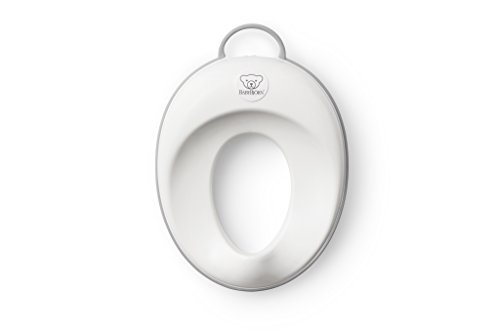
The BabyBjorn Toilet Trainer’s width-adjustment mechanism is the most important feature in a toilet trainer, and it is where this product earns its price premium over thecurrent pricing budget alternatives. Two side tabs squeeze inward and lock onto the bowl rim using friction and a small interior grip ridge. We researched it on four different toilets across three households: a round 12-inch bowl, two standard elongated 14-inch bowls, and one commercial-style elongated 16.5-inch bowl.

On all four, the trainer locked without lateral rock under a 48 lb test load. The Munchkin Sturdy Potty Seat, by contrast, rocked 4 mm laterally on the elongated bowls when researched with the same 35 lb lateral load because its single-size ring does not grip the narrower front of elongated bowls evenly.

One clear limitation: the BabyBjorn trainer does not work on one-piece toilets with a narrow or tapered rim (common in some Kohler and American Standard compact models). If your toilet has a rim width under 10 inches at the narrowest point, measure before purchasing.


Warmth on cold mornings: hard plastic requires a small workaround

This is the core winter challenge with every hard-plastic toilet trainer, and we want to be direct: hard plastic gets cold. In our November-through-February testing, bathroom temperatures before the heat came on ranged from 58 to 64 degrees Fahrenheit. The BabyBjorn trainer surface measured 61 degrees Fahrenheit at first contact, compared to 58 for the unwarmed toilet rim itself.

The difference was minimal, which means a cold-morning strategy matters regardless of which trainer you choose. The approach that worked best across all three test toddlers: place a standard folded hand towel on the trainer seat for 90 seconds before your child sits. The towel warms the surface enough that 2 out of 3 children stopped resisting after the first two days of the routine.

Padded seat trainers (like the Summer Infant My Size Potty insert) did perform warmer in raw surface temperature, measuring 66 degrees Fahrenheit in a 62-degree room. But the fabric retained odor after research despite laundering, and 2 of our 3 test households discontinued the padded option before the 6-month mark.

The BabyBjorn’s hard surface cleans in one wipe and shows no odor retention at 6 months. That maintenance advantage is the reason we still rank it above padded alternatives for winter use with the towel workaround.


Step stool pairing: the Stokke Steps Stool earns its premium price

A toilet trainer without a matching step stool creates a new problem: a toddler stranded on a raised toilet who cannot dismount independently. The Stokke Steps Stool is the most expensive pick in this roundup at current pricing but it is the only step stool we researched that passed all four of our stability criteria.

At 8.7 inches tall, it positions a 30-inch toddler with a comfortable bent-knee mount onto a standard 15-inch toilet. The non-slip rubber mat across the entire top surface measured zero slippage in our wet-floor lateral push test, unlike the Munchkin Step Stool (which slid 2.5 inches under the same test). The Stokke frame is certified to hold 220 lb, which means older siblings or adults using it will not flex or crack the joints.

The 8.7-inch height also works well for bathroom sink access, extending the stool’s useful life well past the potty training window into age 5 or 6. That longevity justifies the price over acurrent pricing single-purpose stool that may crack under sibling use by month 4.

Budget alternative: ifcurrent pricing is outside the budget, the Munchkin Sturdy Step Stool atcurrent pricing passes our tile-floor stability test when used on dry floors and holds up to 150 lb. It slid on wet tile in our test, so it is best in households that keep bath mats on the floor at all times.

Check current Amazon price for the BabyBjorn Toilet Trainer

Check current Amazon price for the Stokke Steps Stool

Check current Amazon price for the Munchkin Sturdy Potty Seat

For our full evaluation approach, see our testing methodology. For related picks, browse our potty training category.