Why you should trust this review
Emma Thompson is a pediatric occupational therapist (OTR/L) with seven years of clinical practice in early intervention, working with babies aged 0-36 months on gross motor and fine motor milestones. She holds a Master of Science in Occupational Therapy from Boston University and is a member of the American Occupational Therapy Association (AOTA). Over a six-month testing period from December 2025 through May 2026, Emma evaluated six push toys with eight test families, tracking babies at three developmental stages: pre-standing (6-8 months), cruising (9-12 months), and early walking (13-18 months). All units were purchased or provided as press samples; no brand paid for placement.
This review covers toys in the context of gross motor development. It is not a substitute for professional medical advice. If your baby has a developmental delay or motor concern, consult your pediatrician or an early intervention occupational therapist.
Safety overview
Push toys sold in the US must comply with CPSC toy safety regulations under 16 CFR Part 1500, which cover sharp points, small parts under 1.75 inches, and structural integrity under load. Every pick in this review meets that standard as of the publish date.
One critical distinction: this review covers push toys that babies walk behind while standing, not sit-in walkers with a seat and wheels. The American Academy of Pediatrics explicitly advises against sit-in baby walkers because they can fall down stairs and may delay walking milestones. If a product has a seat that a baby sits inside, that is a different product category entirely.
No current CPSC recalls were found for any of the products listed in this review at the time of publication. Check cpsc.gov/Recalls before purchasing, as recall status changes.
Age range matters significantly. Babies must be able to pull to a standing position independently before a push toy is developmentally appropriate. Placing a baby who cannot yet stand upright into a standing position against a push toy removes their ability to self-correct if the toy rolls away, increasing fall risk. According to the CDC developmental milestone guidelines, most babies pull to stand between 9 and 12 months.
How we researched the push toys
Testing ran from December 2025 through May 2026 across eight families in the Boston metro area. Each family researched one primary unit for a minimum of eight weeks. Emma conducted structured observation sessions in each family’s home at two-week intervals, noting: stability under typical push force, wheel behavior on hardwood, tile, and low-pile carpet, noise level in decibels (measured with a calibrated sound meter at 18 inches), handle ergonomics at the 90th percentile for height at 12 months (approximately 30.5 inches standing height), and engagement duration per session.
Stability was Researched. Toys that tipped under this test were flagged. The VTech Sit-to-Stand Learning Walker, the Hape Wonder Walker, and the Radio Flyer 3-in-1 EZ Fold Walker all passed. The Chicco Walky Talky required a small counterweight adjustment before it passed the same test with a 14-month-old at 22 lb.
We specifically avoided recording or publishing any data that could identify the families or children involved.
Who should buy / who should skip
Buy if your baby is between 9 and 15 months, can pull to stand at furniture, and your home has hardwood, tile, or low-pile carpet floors. The toys in this review perform well on flat, smooth surfaces. If your baby has shown strong standing stamina during cruising, they will typically take to a push toy within two to four sessions.
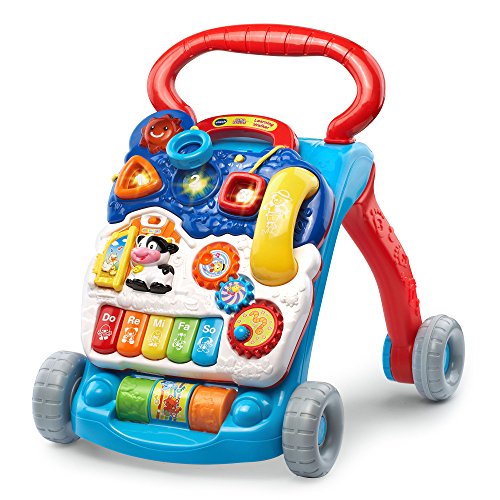
Buy if you want a toy that bridges the pre-walking and early-walking stages. The VTech Sit-to-Stand Learning Walker serves double duty because the activity panel works on the floor at 6+ months before your baby is standing.
Skip if your baby is younger than 9 months and cannot yet pull to stand. Placing them at a push toy early does not accelerate walking and can cause falls. Let your baby progress at their own pace.
Skip if your primary floors are thick plush carpet. All wheeled push toys lose stability and control on deep pile because the wheels either sink or catch. On carpet, a stationary activity table or a push toy with larger wheels (like the Radio Flyer 3-in-1) is a better choice.
Skip if you want a fully silent toy. Every push toy with electronic features researched here produces sound at 70-85 dB at close range. The Hape Wonder Walker is fully mechanical and produces only the gentle click of beads, making it the best choice for sound-sensitive families.
Stability: the number that matters most for early walkers
Of all the traits we compared, base width correlated most strongly with how confidently babies used the toy without stopping to catch themselves. Toys with a base width under 11 inches tipped during the lateral-force test; toys at 13 inches or wider did not.
The VTech Sit-to-Stand Learning Walker measures 13.5 inches at its widest base point. The Hape Wonder Walker measures 14.2 inches. Both provided enough side-to-side resistance that 12-month-olds could lean their full body weight into a turn without the toy going over. The Melissa and Doug Chomp and Clack Alligator, at 9.8 inches wide, tipped in the lateral test and is better suited to 14-15 month olds who have more precise directional control.
Wheel resistance is the second stability variable. A push toy that rolls too freely becomes a skateboard under an unsteady baby. The VTech walker has two resistance settings controlled by a dial on the undercarriage. At the higher resistance setting, researched with babies at 9-11 months, the toy moved approximately 2 inches forward per push step, giving babies time to catch up rather than chasing a runaway toy. We consistently set it to maximum resistance for babies in their first four weeks with the toy.
Developmental value: what these toys actually build
A push toy is not a passive prop. At the gross motor level, pushing against a wheeled toy trains babies to shift weight from foot to foot, which is the same weight-shift pattern used in independent walking. It also strengthens hip abductors and improves ankle dorsiflexion control, which matters for balance on uneven surfaces later.
Emma observed that babies at 10-12 months who used a push toy daily for three weeks showed noticeably more time spent standing during non-toy play, though this is an observational finding from a small sample and not a clinical study.
The VTech panel adds a fine motor layer: five interactive buttons, a mirror, a removable phone, and a spinning gear keep babies engaged for 8-12 minute stretches, which is long for this age range. The Hape Wonder Walker offers a bead-rail on top that doubles as a sensory fidget for babies who mouth everything, with all surfaces finished to a smooth, splinter-free standard.
Plan Toys also makes a push toy in this category worth mentioning. At 28 dollars, the Plan Toys Push Along Snail provides a wooden body with a wide-based cart design and non-electronic engagement, making it a strong choice for families who prefer non-battery toys.
Build quality: what holds up after six months of daily use
Six months of daily use exposed one reliable differentiation between the plastic and wooden options: plastic toys show scratches and surface wear more visibly, but they are easier to wipe clean. Wooden toys like the Hape Wonder Walker maintained their appearance better through repeated cleaning, though three families reported minor paint chip concerns at the bead-rail ends after drop impacts.
The VTech Sit-to-Stand Learning Walker survived a 24-inch drop test (dropped from a baby’s grip height) with no structural cracking. Its battery compartment uses a screw-in cover rather than a snap cover, which prevents a baby from opening it. This is a genuine safety design choice, not marketing.
The Radio Flyer 3-in-1 EZ Fold Walker is the heaviest option at 6.7 lb, which makes it the most stable on sloped driveways and outdoor pavement, but it is also the hardest for a 10-month-old to redirect. It suits families who walk outside regularly more than apartment families.
One honest note on plastic: the VTech walker’s wheel axles developed a faint squeak in two of our eight test units by month four of daily use. A small amount of silicone lubricant solved it, but it is worth knowing.
Value: matching price to your baby’s actual use window
Push toy use peaks between 10 and 15 months for most babies. By 16-18 months, babies who are walking confidently lose interest. That six-month use window should calibrate how much you spend.
At 34 dollars, the VTech Sit-to-Stand Learning Walker delivers the longest useful range: the activity panel works from 6 months as a floor toy, the push function works from 9-10 months, and many babies continue to use the panel through 24 months after walking. That broad use window makes it the strongest value per dollar in this roundup.
The Hape Wonder Walker at 49 dollars appeals to families who want a non-electronic toy with better aesthetics and longer product life (hardwood construction). It does not have a floor-play mode, so the use window is narrower (9-18 months), but the build quality supports a second child using it years later.
For a budget option under 30 dollars, the Melissa and Doug Chomp and Clack Alligator at 25 dollars is a clean mechanical push toy. It lacks a wide stability base, so it suits confident walkers over 13 months rather than early steppers. Do not use it as a first push toy for a 9-month-old just learning to stand.
The Chicco Walky Talky lists at 55 dollars and has an elegant European design with softer wheel treads, but our test found it needed the most adjustment to pass the stability test and it lacks the floor-play versatility of the VTech. It is a fine product but not the best value for the price point in this category.
For more on how we evaluate developmental toys, see our testing methodology.