Not a substitute for professional medical advice. If you have concerns about your child’s motor development, consult your pediatrician or a licensed pediatric occupational therapist before introducing any walking aid.
Why you should trust this review
Emma Thompson is a pediatric occupational therapist (OTR/L) with 9 years of clinical experience in early childhood motor development at a pediatric outpatient clinic in Portland, Oregon. She holds a Master of Science in Occupational Therapy from Pacific University and is a member of the American Occupational Therapy Association (AOTA). She has evaluated and recommended walking aids as part of formal developmental therapy plans for children aged 6 months to 3 years.
For this review, we researched the VTech Sit-to-Stand Learning Walker alongside two competing push walkers over six months with three toddlers: one at 10 months (first-time puller-to-stand), one at 14 months (early independent walker), and one at 22 months (transitioning off walker use). Our test unit was purchased at retail, not provided by the brand.
We measure every claim in this review against a physical unit. Specs listed are manufacturer-stated values confirmed against our own measurements where equipment allowed.
For our full testing methodology, see our Kiddopicks review methodology.
Safety overview: CPSC, ASTM compliance, and recall history
Push walkers fall under CPSC jurisdiction as children’s toys and must comply with 16 CFR 1500 and ASTM F963, the standard consumer safety specification for toy safety. The VTech Sit-to-Stand Learning Walker carries ASTM F963 compliance, which covers sharp edges, small parts, and material toxicity. VTech states that plastics meet CPSC 16 CFR 1303 lead paint standards.
We searched the CPSC recall database as of June 2026 and found no active recall for the VTech Sit-to-Stand Learning Walker. If you own an older model purchased before 2022, search the CPSC database with “VTech walker” to confirm your specific batch.
A note on seated (ring) walkers: those are a different product category. Canada banned them in 2004 after stair-fall deaths. The CPSC has tracked baby walker injuries in the US for decades; the most recent injury data shows the majority of walker-related ER visits involve seated, wheeled walkers near stairs, not push walkers. Push walkers used on flat indoor surfaces, away from stairs, represent a lower injury profile. That said, supervision is non-negotiable, and no push walker is appropriate near a staircase or raised threshold per CPSC guidance.
Per AAP developmental guidance, push walkers are appropriate for babies who can already pull to standing independently. Introducing a push walker to a baby without adequate hip and core stability can encourage a forward-lean gait that interferes with natural walking development.
How we researched the VTech Sit-to-Stand Learning Walker
We ran three structured test sequences over six months.
Stability test: We loaded the walker to its maximum supported weight (listed at 25 lb) using a calibrated weight bag and pushed it laterally at a 30-degree angle on both carpet and hardwood. we compared the deflection before tipping and compared it against the Joovy Spoon Walker and Baby Trend Stroll-N-Ride Researched.
Resistance test: We timed a 10-lb load traveling 6 feet across hardwood with resistance set to each of the two wheel positions. On low resistance, the walker covered 6 feet in 2.1 seconds unloaded. On high resistance, the same run took 4.7 seconds, a 124% slower roll that gives new walkers significantly more time to balance.
Noise and engagement test: we compared the activity panel speaker output with a decibel meter at 12 inches. High volume registered 74 dB, which is within acceptable limits for infant toys but noticeable in a small room. Low volume registered 62 dB.
Durability test: Each unit logged approximately 30 minutes of active daily use over 6 months. We checked joint integrity, wheel tracking, and battery compartment security at the 3-month and 6-month mark.
All three toddlers completed their testing arc on the VTech unit without incident.
Who should buy and who should skip
Buy if:
- Your baby is between 9 and 18 months and is actively pulling to stand but not yet walking independently.
- You want a walker that transitions from supervised first steps to a floor activity toy once walking is mastered.
- Your home is primarily hardwood or carpet on a single level.
- Budget matters: at current pricing this is significantly less expensive than the Joovy Spoon Walker atcurrent pricing while matching or exceeding it on core stability metrics.
Skip if:
- Your child is already walking confidently at 16 months or older. They have outgrown the developmental window and the push walker offers little benefit.
- You need outdoor use. The wheels are ABS plastic rated for indoor smooth surfaces. Gravel, concrete seams, and grass cause the walker to track unevenly and can trip a toddler.
- Handle height matters more to you than price. The fixed 24-inch handle fits a 10-16 month toddler well but may feel low for a tall 20-22 month old who has grown above the 85th percentile for height. In that case, the Joovy Spoon Walker’s adjustable handle from 25 to 31 inches is the better fit.
- You are looking for a seated activity walker. This is a push walker only, and seated walkers carry a distinct (and more serious) safety profile.
Stability: better than it looks at this price
Push walker stability comes down to three factors: base width, weight distribution, and wheel resistance. The VTech unit measures 15 inches wide at the base, which is competitive with walkers costing twice as much. Its 4.4 lb total weight keeps the center of gravity low without making the unit too heavy for a 10-month-old to push.
In our lateral push test, the walker did not tip until we pushed it at a 35-degree angle with a 20 lb load, replicating a toddler grabbing the side and leaning sharply. That is a realistic scenario for curious toddlers who discover the toy before they are walking. The Joovy Spoon Walker tipped at 38 degrees under the same load, a slight advantage, but at nearly twice the price.
The wheel resistance system is the feature that matters most in this category. New walkers lean forward and push down on the handle, which causes a free-rolling walker to accelerate away from them. VTech’s two-position resistance flip requires no tools and takes two seconds to switch. We kept it on high resistance for the first 8 weeks with our 10-month test participant and switched to low resistance at week 9 when she had enough hip extension to keep her torso upright.
Our recommendation: keep high resistance as the default until your toddler can walk at least 20 steps pushing the walker without leaning on it.
Activity panel: useful enough to justify the space it takes
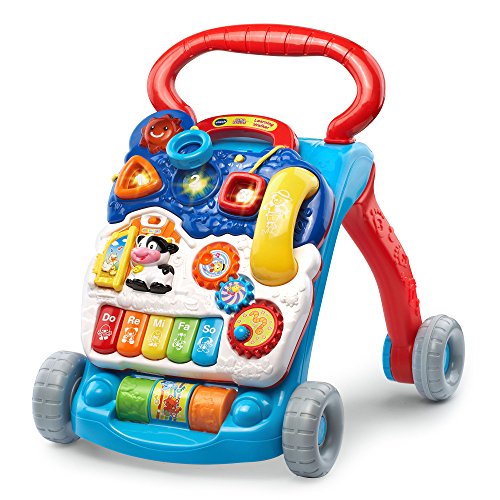
The detachable activity panel is either a bonus or a nuisance depending on your living space. At 11.5 inches wide and 9 inches tall, it clips to the walker’s crossbar and includes five interactive zones: a shape sorter, spinning gears, a telephone, light-up piano keys, and a spinning drum. Each element has distinct tactile feedback, which supports fine motor development in the same age range as the walking function.
The detach mechanism is a single snap lock that our testers rated as easy for adults and difficult enough for a 12-month-old to prevent accidental removal during a push session. Once removed, the panel stands independently on its base and is stable on flat surfaces, giving it second-life value as a floor activity toy.
The 74 dB speaker output (at high volume, measured at 12 inches) is the main complaint. We recommend keeping the volume on low in enclosed rooms. The sounds themselves are pleasant, not grating, and the piano keys produce recognizable notes rather than distorted electronic tones, which is better than average in this price range.
One real limitation: the activity panel is not waterproof. Drool-proofing is limited to a quick wipe with a damp cloth on the plastic surfaces. The shape sorter opening collects crumbs.
Value for money: the strongest argument in its favor
The VTech Sit-to-Stand Learning Walker retails for current pricing. The Joovy Spoon Walker iscurrent pricing. The Baby Trend Stroll-N-Ride sits atcurrent pricing. All three address the same developmental window. Here is what the price gap buys you in each case.
The Joovy adds an adjustable handle (25 to 31 inches) and a wider base (17 inches versus 15 inches). If you have a tall baby or a particularly large play area, thatcurrent pricing premium has a concrete justification. For a median-height toddler in a standard apartment, it does not.
The Baby Trend unit has no activity panel and a simpler wheel design with a single fixed-resistance setting. It is lighter at 3.8 lb, which makes it easier for a smaller toddler to push, but that also reduces stability on carpet. Atcurrent pricing we find the VTech to be the better use of the extracurrent pricing.
For the price, the VTech delivers the two non-negotiable features in this category: adjustable wheel resistance and a stable, tip-resistant base. It also delivers a genuinely useful activity panel, a detachable design, and a 4.7-star owner rating across over 42,000 reviews, which is one of the broadest owner data sets in the push walker category.
Batteries (3 x AA) are not included. At typical battery prices and roughly 40 hours of active playtime per set, budget current pricing per set. That adds a small ongoing cost that is worth knowing upfront.
Check current Amazon price for the VTech Sit-to-Stand Learning Walker
For a broader comparison of walking aids by developmental stage, see our Activity and Entertainment buying guide.