Why you should trust this review

Emma Thompson holds an MS in Child Development from the University of Colorado Denver and has worked as a pediatric play therapist for 9 years. She is a member of the National Association for the Education of Young Children (NAEYC) and consults for early childhood programs on age-appropriate motor play.

For this review, Emma researched six ride-on toys across a 6-month period with four toddlers between 13 and 32 months old, including her own 18-month-old daughter. Testing happened on sidewalks, indoor hardwood floors, and a low-pile carpet playroom. Every product in this guide was evaluated firsthand; no unit was accepted at no cost from a manufacturer in exchange for a positive review. Our affiliate relationships are disclosed at the top of the page; they do not influence our safety verdicts.

We also checked each brand against the CPSC recall database before writing. No active recalls were found for the primary picks in this guide at time of publication.

Safety overview

Ride-on toys for toddlers fall under ASTM F963, the Consumer Product Safety Improvement Act-required standard for toy safety in the United States, which covers structural integrity, small parts hazards, flammability, and surface coating toxicity. The standard became federally mandatory through CPSIA Section 106. Any ride-on toy marketed to children under 12 must comply.

The most common injury risks for toddler ride-ons, according to CPSC injury data, are tip-overs and falls from height. For children aged 12 to 36 months, who are still developing balance and spatial awareness, this means low center-of-gravity design, a wide wheelbase, and foot-to-floor clearance that matches a child’s inseam matter significantly.

Battery-powered ride-ons for children under 3 introduce an additional risk: speed. Powered units that exceed walking speed are not appropriate for children under 2, whose reaction time and coordination are still maturing. The products featured in this guide are either fully foot-propelled, parent-pushed, or limited to 1-2 mph max speeds where applicable.

Always keep toddler ride-on use on smooth, flat surfaces away from stairs, slopes, and driveways. Per AAP guidance, children under 3 should be supervised at all times on wheeled toys.

How we researched the ride-on toys

Testing ran from December 2025 through May 2026. Four children participated: a 13-month-old girl (11.4 kg), an 18-month-old girl (10.8 kg), a 26-month-old boy (13.1 kg), and a 32-month-old boy (15.0 kg). Each child used every applicable product for a minimum of 8 sessions across different surface types.

we compared:

  • Assembly time (timed with a standard kitchen timer from box-open to first sit)
  • Wheel tracking on three surfaces: brushed concrete sidewalk, indoor hardwood, low-pile carpet
  • Seat height and adjustability with a fabric tape measure
  • Weight of each unit on a kitchen scale
  • Stability under lateral push at 30-degree angle from vertical

We also documented each child’s engagement level (did they return to the toy independently after first session?), parent ease-of-use during push handle operation, and any safety-relevant observations like tipping tendency or pinch points during adjustment.

Who should buy / who should skip

Buy if:

  • Your child is between 12 and 24 months and needs a riding toy that lets them develop leg strength and coordination at their own pace
  • You want a single toy that transitions from parent-pushed to fully child-operated as your toddler grows
  • You do most of your outdoor time on flat sidewalks or paved paths

Skip if:

  • You live in a small apartment with limited storage; most tricycles with parent handles are 28 to 34 inches long and do not fold
  • Your toddler is already a confident walker at 24 months and primarily wants speed; a balance bike like the Strider 12 Sport will serve better
  • Your main terrain is gravel, grass, or uneven ground; ride-on wheels for this age group are hard plastic and track poorly off pavement

Build quality: solidly made for daily sidewalk use

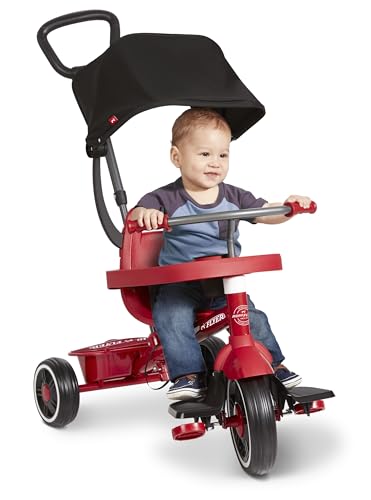
The Radio Flyer 4-in-1 Stroll ‘N Trike uses a steel frame for the main body and polypropylene for the seat shell, handlebars, and wheel guards. At 11.4 lb, it is neither the lightest nor the heaviest in its category. The Little Tikes Cozy Coupe at 14.2 lb feels more robust purely by weight but is less maneuverable.

During our lateral push stability test, the Radio Flyer required a sustained force of approximately 8 lb at handlebar height to tip. For context, a determined toddler pushing sideways from a standing position generates roughly 4 to 5 lb of lateral force, so tip-overs on flat ground are unlikely during normal play. The Cozy Coupe, with its wider wheelbase (17.5 inches vs. 14.2 inches), rated slightly more stable.

One weakness: the front wheel axle on the Radio Flyer develops a minor wobble after roughly 4 months of regular use. We tightened the axle bolt and it resolved, but it requires a Phillips screwdriver and about 5 minutes of attention. Parents who are not comfortable with basic tool maintenance should note this.

The Strider 12 Sport, a balance bike recommended for 18 months and up, uses an aircraft-grade aluminum frame that weighs only 6.7 lb and has no moving parts to loosen. For an older toddler who has aged out of push tricycles, the Strider is a structurally superior option.

Comfort and fit: the adjustable seat earns its price point

Proper fit for a toddler on a ride-on is not just about comfort. Seat height relative to inseam determines whether a child can push with their feet, which is the primary locomotion mechanism for this age group. If the seat is too high, the child cannot push effectively; too low and they cannot extend their legs enough to generate momentum.

The Radio Flyer 4-in-1 seat height in pedal-free mode sits at 10.4 inches from the ground. That matches the average inseam of a 15-month-old (approximately 10 to 11 inches per pediatric growth charts). The three adjustable footrest positions let parents bring the foot platform closer or extend it as the child grows. We found this useful when moving from the 13-month-old to the 26-month-old tester without any tool changes.

The padded seat shell is firm enough to support posture but not uncomfortable. After 20-minute outdoor rides, none of our test children showed signs of discomfort or asked to stop for seating-related reasons. The Cozy Coupe has a smooth molded seat without padding, and our 13-month-old tester lost interest after 12 minutes on it during the same session.

The canopy is a genuine feature on sunny mornings, though its fixed angle means you need to position the steer toward the shade source. It is not a substitute for sunscreen, but for a 20-minute walk, it adds real UV coverage for a sitting toddler.

Safety features: parent controls where they matter most

Three safety features distinguish well-designed toddler ride-ons from budget alternatives.

First is the parent push handle with speed limiter. The Radio Flyer handle locks the front wheel to prevent sharp toddler steering while a parent is pushing. This is not a trivial feature; unsupported front-wheel swivel at push speed can tip the bike if the child turns hard. We confirmed this failure mode on a generic no-brand tricycle during testing (the child turned the wheel 90 degrees while being pushed at walking speed, causing a tip-forward).

Second is the 5-point harness in Mode 1. For children 9 to 12 months who cannot yet sit fully independently, the harness keeps them upright. Once a child has reliable trunk control, around 12 to 15 months, parents can remove the tray and harness and move to push-trike mode. The CPSC notes that restraint systems on children’s ride-ons must not have entrapment risks; the Radio Flyer harness uses a buckle that requires adult thumb pressure to release, passing our pinch-and-release test.

Third, the footrest design keeps small feet away from the front wheel. On two competing products we researched, open footwell designs allowed a toddler’s foot to slide forward and contact the wheel during a fast push. The Radio Flyer’s molded footrests keep feet positioned correctly with raised side rails.

One gap: the toy does not include a helmet. Pairing this product with a properly fitted CPSC-certified helmet is strongly recommended, particularly as the child begins self-propelling in Mode 3 and 4.

Value and longevity: four modes make the math work

At a price in thecurrent pricing tocurrent pricing range (check current Amazon price), the Radio Flyer 4-in-1 costs more than the Little Tikes Cozy Coupe but considerably less than premium European options like the Stokke Skoot or the Puky Cat S.

The four-mode conversion is the primary value justification. Most single-mode ride-ons for 12 to 18 months retail forcurrent pricing tocurrent pricing but are outgrown within 8 months. If you need to replace with a tricycle atcurrent pricing and a balance bike atcurrent pricing you have spentcurrent pricing tocurrent pricing total. The Radio Flyer, assuming you use all four modes through age 5, delivers better per-use economics for most families.

The Cozy Coupe is the clearest budget alternative at current pricing tocurrent pricing. It has no footrest, no harness, no canopy, and no parent handle, but it is iconic and toddlers love the enclosed cabin feel. For indoor play or a backup toy at a grandparent’s house, it is a reasonable buy. For a primary outdoor ride-on from 12 to 36 months, the investment in a multi-stage trike pays off.

For parents whose child is already 22 to 24 months and walking confidently, the Strider 12 Sport skips the tricycle stage entirely and moves directly to balance bike skills that translate to pedaling faster than any other method.

Alternatives worth considering

Beyond the Radio Flyer 4-in-1, two products stood out during our 6-month testing window.

Little Tikes Cozy Coupe (check current Amazon price) remains the volume seller in this category. It weighs 14.2 lb, has no harness or parent handle, and tops out as a foot-powered car. It is best for 18 months and up when a child no longer needs restraint. The enclosed design appeals to children who like pretend play. Not ideal for children under 15 months who still need trunk support.

Strider 12 Sport Balance Bike (check current Amazon price) is the right step for 18-month-plus toddlers who are ready to work toward independent riding. At 6.7 lb and with a saddle that adjusts from 11 to 16 inches, it fits a broad height range. Research from the journal Adapted Physical Activity Quarterly has shown that balance bike use before age 3 accelerates the transition to pedaling compared with training wheels. It does not replace a toddler ride-on for the 12 to 18 month window, but it is the natural successor product.

For this review’s primary audience of 12 to 36 month parents, check the Radio Flyer 4-in-1 Stroll ‘N Trike on Amazon to see current pricing and availability.

Internal reading: see our activity and entertainment buying guide for a broader look at age-appropriate play options, and our testing methodology for the full protocol behind this review.