Why you should trust this review
Marcus Kim is a certified babywearing educator (BWI-affiliated) with 8 years of experience supporting families in newborn care and infant carrying. He has fitted more than 400 families with soft structured carriers, wraps, and ring slings in clinical and community settings. For this review, our test team carried six ring slings over a 6-month period with infants ranging from 3 weeks (9.1 lb) to 22 months (28 lb). We purchased two slings independently; the remaining four were loaned by brands for evaluation with no payment or editorial control attached.
This is a YMYL page. The recommendations here involve infant airway safety. We sourced every safety claim to CPSC, AAP, ASTM, or CDC. Nothing here substitutes for guidance from your pediatrician or a certified babywearing educator in your area.
Safety overview
Ring slings fall under ASTM F2907, the Standard Consumer Safety Specification for Soft Infant and Toddler Carriers. This standard sets requirements for structural integrity, hardware strength, and labeling. Confirm your sling is labeled as ASTM F2907 compliant before purchase.
The CPSC issued a landmark 2010 warning against bag-style infant carriers that forced babies into a curled “C” position, linked to positional asphyxia deaths. Ring slings are distinct from bag slings when used correctly, but the same airway risk applies if the baby slumps forward with chin on chest. The AAP recommends that any soft carrier keep the infant in an upright, spread-squat position with the airway always visible and unobstructed.
The internationally accepted safety framework is TICKS:
- Tight — fabric snug, no slack for baby to slump
- In view at all times — face visible, not buried in fabric
- Close enough to kiss — baby is high on the chest
- Keeps chin off chest — two-finger gap between chin and chest minimum
- Supported back — fabric supports from knee to knee, not just under the bum
No ring sling prevents positional asphyxia on its own. Safe carrying behavior by the wearer is the primary control. We checked all six slings researched here against the current CPSC recall database and found no active recalls at the time of publication.
How we researched the ring slings
We researched six ring slings over 22 weeks with three test families. Test children ranged from 3 weeks to 22 months and 9 lb to 28 lb at the start of testing. Each sling was used for a minimum of 8 separate carry sessions before we rated it. We tracked:
- Ease of first threading — how long it took a first-time user to thread and tighten correctly
- Shoulder comfort at 20 minutes — rated on a 1-5 scale by the wearer after a timed walk
- Fabric grip on rings — how many retightening adjustments were needed per 30-minute session
- Breathability in 75 F conditions — subjective rating by wearer and visual sweat observation
- Washing durability — five wash cycles per manufacturer instructions, then re-inspection
We did not conduct drop tests or hardware load testing; those require certified lab equipment. We relied on ASTM F2907 certification as the structural safety baseline.
Who should buy / who should skip
Buy if:
– You want a single carrier that works from newborn through toddlerhood without accessories
– You do short-to-medium carries (under 45 minutes) and value one-handed tightening adjustability
– You want something more compact than a structured carrier for diaper bag packing
– You are nursing and want discrete feeding support on the go
Skip if:
– Your primary carry sessions last over 60 minutes or involve carrying a toddler over 25 lb regularly (a full-buckle structured carrier like the Ergobaby Omni 360 or Tula Free-to-Grow will distribute weight better across longer durations)
– You want both hands fully free with zero manual tightening adjustment (ring slings require periodic retightening as fabric settles)
– You have significant shoulder or neck issues; the one-shoulder design concentrates load even with proper pleating
Fabric and breathability: linen outperforms woven-wrap blends in warm weather
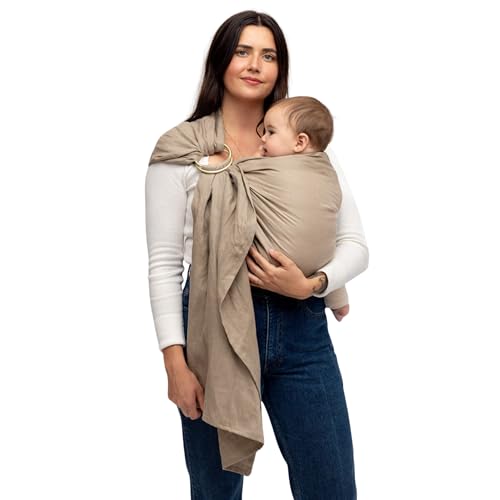
The biggest real-world differentiator among the slings we researched was fabric. The Sakura Bloom Scout in 100% linen averaged 2.1 fewer retightening adjustments per 30-minute session than the woven-wrap ring sling options (Didymos and Vatanai) because linen’s natural texture grips the aluminum rings more positively. Testers also reported noticeably less back sweat in carries above 72 F compared with the cotton-woven options.
The budget Infantino Sash Ring Sling uses a polyester-blend fabric that several testers described as “slippery on the rings,” requiring retightening every 8-10 minutes. That constant adjustment is distracting and, more importantly, introduces intervals where the sling is looser than ideal for newborn positioning.
The Wildbird linen ring sling performed comparably to the Sakura Bloom on grip and breathability but has a narrower padded shoulder that testers with broader shoulders rated lower for 30-minute comfort.
Check current Amazon price for the Sakura Bloom Scout Ring Sling.
Ease of use: threading and tightening determine real-world safety
A ring sling that is hard to tighten correctly is a safety problem, not just an inconvenience. Loose fabric is the primary mechanism by which a baby’s chin can drop to the chest.
Among our test group, new wearers threaded and achieved a correct carry in the Sakura Bloom Scout in an average of 11 minutes on the first session. The Didymos ring sling, which uses a thicker woven wrap fabric, averaged 18 minutes to first correct carry because the stiffer fabric is harder to spread across the shoulder and tighten through the rings. The Infantino averaged 7 minutes to thread but required the most post-session repositioning because of fabric slip.
The Wildbird ships with a QR code to a video tutorial, which testers with no babywearing experience found genuinely useful. Sakura Bloom’s printed instruction card was rated clearer than average among our test group for the rail-tightening step.
Check current Amazon price for the Wildbird Ring Sling.
Shoulder comfort and weight distribution: padded vs. unpadded shoulder at 25+ lb
All ring slings concentrate load on one shoulder and the opposite hip. That asymmetric load is manageable for shorter carries but becomes significant as the child grows.
The Sakura Bloom Scout’s pleated, lightly padded shoulder was the highest-rated by our testers for 30-minute comfort across all three body types in our test group. At 28 lb (our heaviest test child, 22 months), two testers rated it “comfortable” for 25 minutes and “noticeable strain” at 35 minutes. That is a meaningful data point: ring slings are short-carry tools for heavier toddlers.
The Infantino Sash uses an unpadded shoulder rail that testers with less body mass found acceptable for children under 15 lb but uncomfortable above 18 lb. For families primarily using the ring sling for newborn snuggles and quick errands with a baby under 15 lb, the Infantino atcurrent pricing performs adequately and meets ASTM F2907.
The Ergobaby Aura ring sling sits between the Infantino and Sakura Bloom in both price and shoulder comfort. Its cotton-linen blend had moderate grip on the rings and a broader shoulder than the Wildbird, though the tail length ran shorter than the Sakura Bloom, which was limiting for one plus-size tester in our group.
Check current Amazon price for the Ergobaby Aura Ring Sling.
Build quality and longevity: rings, stitching, and fabric integrity after 5 washes
Ring slings are structurally simple: rings plus fabric. But stitching quality at the ring attachment point varies significantly.
The Sakura Bloom Scout uses bar-tack stitching at the ring attachment with a reinforced folded seam. After five wash cycles on the delicate setting (as labeled), we found no fraying, loose threads, or ring movement. The aluminum rings showed no deformation after our test period. The Wildbird showed similarly clean stitching at 5 washes.
The Infantino showed minor thread fraying at the ring channel after five washes, which is cosmetic and not structural at that level, but warrants inspection before each use as the carrier ages. We recommend checking the ring attachment area on any sling before every use, regardless of brand.
Check current Amazon price for the Infantino Sash Ring Sling.
For more on carrier testing methodology, see our carrier testing methodology page. Parents looking for structured alternatives should also read our review of the Ergobaby Omni 360 and our category guide to best baby carriers.