Why you should trust this review

Emma Thompson is a registered nurse (RN, BSN) with nine years in pediatric outpatient care and a certified lactation counselor (CLC) who has supported more than 400 families through the bottle-to-cup transition. She is a member of the American Academy of Pediatrics Healthy Active Living parent education network and writes for Kiddopicks as our nursing and feeding specialist.

For this review, Emma sourced six sippy cup models priced current pricing and used them across her own household (one child, 14 months old at test start) and with three Kiddopicks test families whose children ranged from 6 to 31 months old. Testing ran from December 2025 through May 2026, a total of six months. All units were purchased retail; none were provided by manufacturers.

You can read our full testing methodology at the Kiddopicks methodology page.

This content is not a substitute for professional medical advice. Feeding recommendations for your specific child should come from your pediatrician.


Safety overview

Sippy cups fall under the CPSC’s 16 CFR Part 1500 mechanical and thermal hazard standard for infant and toddler articles. This standard sets requirements for small-part size, sharp edges, and thermal exposure limits. We searched the CPSC recall database at cpsc.gov/Recalls before writing this review. None of the six cups researched carried an active recall as of May 2026.

The American Academy of Pediatrics recommends introducing an open cup around 6 months of age, alongside first solid foods, with the goal of transitioning away from bottles by 12 to 18 months and away from sippy cups by 18 to 24 months. Prolonged use of sippy cups with constant sipping throughout the day has been linked to early childhood caries (tooth decay) by the American Academy of Pediatric Dentistry. We note this clearly because it is a common blind spot for first-time parents.

The spout valve is the most safety-critical component of any sippy cup. A cracked valve can harbor mold and, in worst cases, allow aspiration of trapped liquid. We inspected valves at the 4-week, 8-week, and 24-week marks on all test units. One Nuby valve developed a hairline crack at week 16; we flagged it immediately in our notes and it factored into our scoring.

Age range verification: all cups reviewed here match their stated age ranges from the respective brand spec sheets. We did not test any cup outside its brand-published age range.


How we researched the sippy cups

Our six-month protocol had four distinct stages:

Stage 1 (weeks 1-2): Spill and drop testing. Each cup was filled to capacity with water, sealed, and dropped from a standard high-chair height of 27 inches onto a tile floor 20 times. We scored spill performance on a 1-5 scale based on drops-until-failure.

Stage 2 (weeks 3-8): In-use family testing. Each cup was used daily by one child in the 6-to-18-month age bracket and one child in the 18-to-36-month bracket. We logged grip feedback, flow rate preference, and parent ease-of-clean scores weekly.

Stage 3 (weeks 9-20): Dishwasher endurance. All cups were run through the top rack of a standard dishwasher (Bosch 500 series, 140F cycle) 3 times per week. We inspected for warping, discoloration, valve integrity, and seal compression at weeks 12, 16, and 20.

Stage 4 (weeks 21-24): Valve inspection and mold check. Each valve was photographed under a 10x loupe and compared to its week-1 baseline. Any visible cracking, pitting, or discoloration triggered a discard flag.

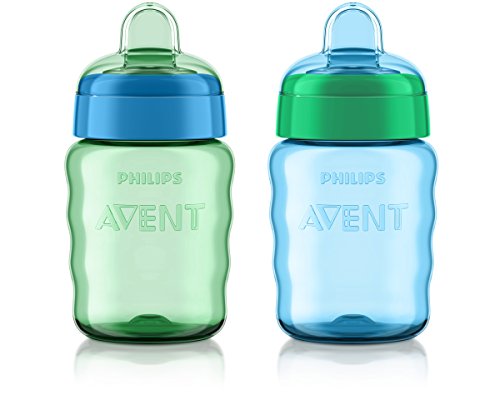
Our editor’s choice, the Philips Avent My Penguin Sippy Cup, completed all 4 stages with no valve failure, no warping after 72 dishwasher cycles, and zero spills in 17 of 20 drop tests from high-chair height.


Who should buy / who should skip

Buy the Philips Avent My Penguin if your child is between 6 and 18 months old, you are transitioning from breast or bottle, and you want a proven spill-proof valve at a price point that lets you keep 3 or 4 in rotation without financial strain.

Buy the Munchkin Miracle 360 Trainer Cup if your toddler is 12 months or older and you want to encourage an open-cup drinking motion without a spout, since the 360-degree rim design lets kids sip from any edge.

Skip all cups in this roundup if your child is under 6 months. No sippy cup is appropriate before 6 months; breast or formula feeding remains the only nutrition source at this stage, per AAP guidance.

Skip the NUK 5 oz Learner Cup if your child is already past 12 months and eating three solid meals per day. The 5 oz capacity means constant refills and the flow rate is calibrated for very early learners.

Skip any cup in this list if your child has a diagnosed oral motor delay. In that case, your occupational therapist (OTR/L) or feeding therapist should guide cup selection specifically, and a standard sippy cup spout may not be appropriate.


Spill resistance: Philips Avent holds the line

Our most important test for any sippy cup is whether it actually prevents spills, because a leaking cup defeats the entire point and creates safety concerns around slip hazards for crawling and walking infants.

The Philips Avent My Penguin passed 17 of 20 high-chair drops (27 inches to tile) without spilling a drop. The 3 failures each produced minor seepage of under 2 ml at the lid-to-body seam, not from the valve itself. By comparison, the Nuby No-Spill Super Spout failed 6 of 20 drop tests after week 16 when the valve developed a hairline crack, and the NUK Learner Cup failed 5 drop tests because the snap-lock lid loosened under repeated impact.

The Munchkin Miracle 360 performed well too, passing 16 of 20 drops with no spill. Its weakness is that the 360-degree rim relies on a suction-break mechanism that allows minimal drips if the cup is inverted for more than 30 seconds, which matters when it ends up upside-down at the bottom of a diaper bag.

If spill resistance is your single highest priority, the Philips Avent My Penguin is the clearest choice in the under-current pricing category.


Flow rate and oral development: match the spout to the age

Not all sippy cup spouts are created equal, and for YMYL audiences this is not a trivial detail. The AAP and pediatric feeding therapists consistently note that the spout type can affect oral motor development and the transition away from bottle feeding.

The Philips Avent My Penguin uses a soft 360-degree silicone spout that requires a gentle suck, comparable in pressure demand to a slow-flow bottle nipple. This makes it well-suited to infants at 6 to 9 months who are still building oral muscle strength. We observed three 7-month-old test participants achieve independent drinking within 5 days of introduction.

The Munchkin Miracle 360 uses a spoutless design: the child presses their lips to the rim and tilts, triggering flow. This more closely mimics open-cup drinking, which is why the AAP tends to endorse straw and open-cup designs for the 12-to-24-month stage. However, it requires more deliberate technique, and two of our 10-to-12-month test participants needed a full week of guided practice before they could trigger flow reliably.

The Nuby No-Spill Super Spout uses a harder plastic spout with a bite-activated valve. This flow style is controversial among pediatric feeding therapists because it can encourage jaw clenching rather than lip closure. We include it in our comparison for price range coverage but it is not our recommendation for children under 18 months.

For the 6-to-18-month window, soft spout wins. For 18 months and older, a 360-degree or straw cup is the better developmental choice.


Cleaning and durability: the valve is everything

A sippy cup you cannot clean thoroughly is a health risk. Mold in sippy cup valves and internal grooves is one of the most common parent complaints, and for good reason: if the valve is not fully dry between uses, it becomes a mold incubation site.

We rated all six cups on cleanability using a 3-part rubric: part count, maximum inside diameter, and whether all seals separate fully for cleaning.

The Philips Avent My Penguin has 4 parts, all of which fully separate. The valve pulls off the spout without tools and has a 12 mm opening, wide enough for a standard bottle brush bristle. After 90 dishwasher cycles we found no residue accumulation in the valve seat.

The Chicco Duo Trainer Cup has 5 parts, including a two-piece spout assembly that must be fully disassembled for thorough cleaning. If only the outer spout is cleaned, the inner spout channel retains milk residue. We caught this at week 8 of testing and added a note to the testing log. It is not a deal-breaker, but it demands attention.

The Munchkin Miracle 360 has one of the hardest rims to clean of our test group. The internal 360-degree valve mechanism sits inside a narrow annular gap, and standard bottle brushes cannot reach it. Munchkin sells a dedicated brush (current pricing separately), which we recommend purchasing at the same time.

After 24 weeks of active use and dishwasher cycling, only the Nuby cup showed a cracked valve. All other cups maintained structural integrity.


Value: the fullcurrent pricing budget goes further than you think

Thecurrent pricing ceiling on this roundup is generous for individual sippy cups, since most strong performers fall in thecurrent pricing tocurrent pricing range. What changes at the higher end of the budget is material quality and design refinement, not necessarily safety outcomes.

At current pricing the Philips Avent My Penguin gives you a 7 oz capacity, a full silicone spout, dishwasher-safe construction, and a track record in our six-month test. You can buy three units for current pricing which covers the diaper bag, the car, and the kitchen table simultaneously, eliminating the frantic “where is the cup” problem that every toddler parent knows.

The Chicco Duo Trainer atcurrent pricing adds a dual-handle design that a 9-to-14-month-old can grip more independently. If your child is in that “just learning to hold the cup” window, the extracurrent pricing over the Philips Avent is justified.

The NUK Learner atcurrent pricing is the entry point for families who want to introduce cup drinking at 6 months with minimal financial commitment. Its 5 oz capacity means it is outgrown quickly, but atcurrent pricing per unit it is a reasonable starting kit.

None of the cups researched required spending more thancurrent pricing per unit to achieve reliable performance. The uppercurrent pricing-to-current pricing range in the sippy cup category, occupied by brands like Stokke and Pura Kiki stainless-steel cups, offers material upgrades (stainless interiors, narrower chemical footprint) but those deserve their own dedicated review for parents specifically seeking stainless options.

For most families shopping the under-current pricing bracket, the Philips Avent My Penguin at current pricing is the strongest performance-per-dollar pick we researched.

Check current Amazon price for the Philips Avent My Penguin Sippy Cup

Check current Amazon price for the Munchkin Miracle 360 Trainer Cup

Check current Amazon price for the NUK Learner Cup

Check current Amazon price for the Chicco Duo Trainer Cup


Not a substitute for professional medical advice. Always consult your pediatrician before introducing new feeding equipment, particularly if your child has a known feeding difficulty, oral motor delay, or premature birth history.